Orlando Executive Airport, Orlando
Updated · 725 residents
Defined by its deep aviation roots and proximity to the Orlando Executive Airport, this neighborhood offers a quiet, functional suburban environment. While it features a unique historical character, residents should be prepared for frequent aircraft noise and limited pedestrian infrastructure.
Key Highlights
About Orlando Executive Airport
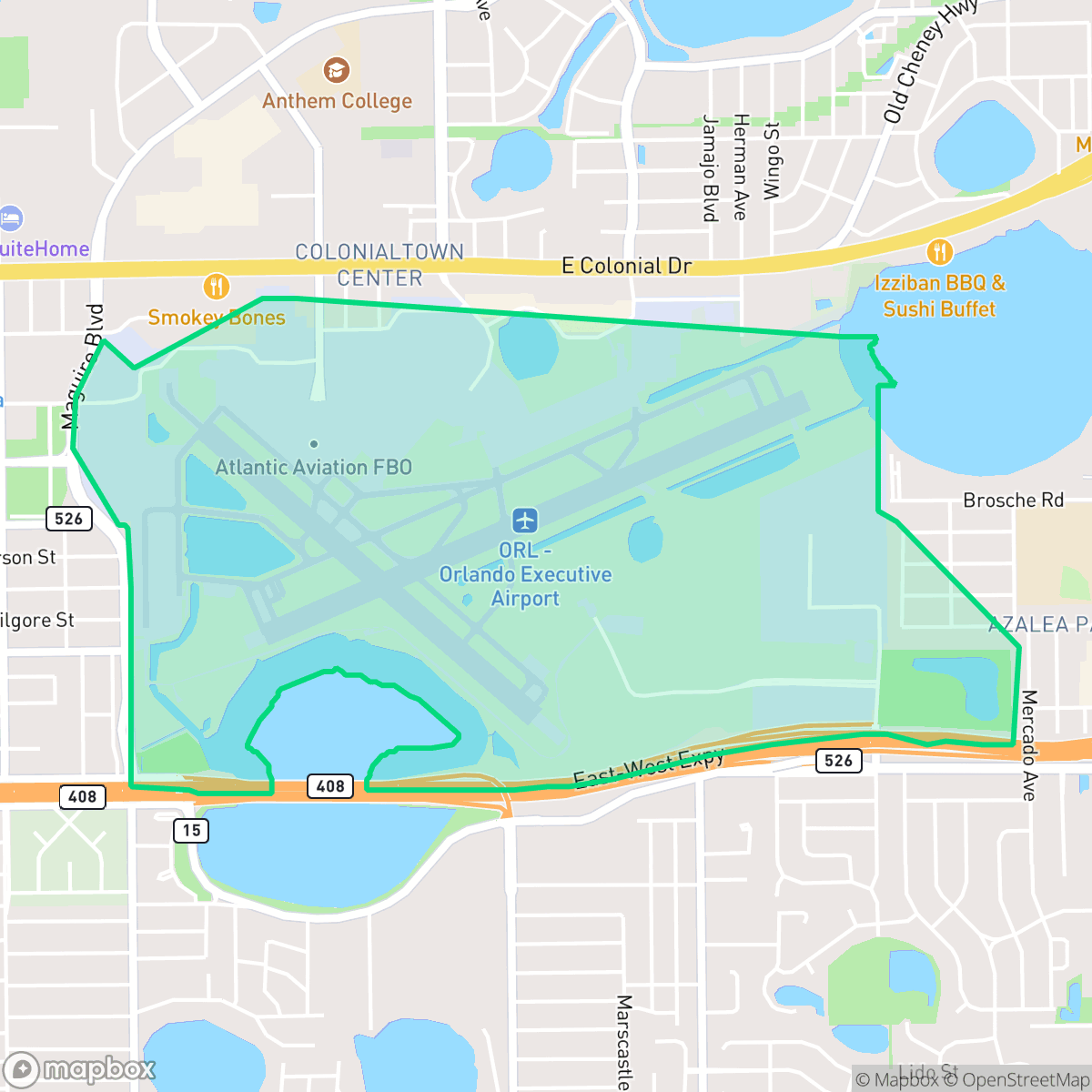
The Orlando Executive Airport neighborhood is defined by its namesake facility, which opened in 1928 as Central Florida's first commercial airport. Originally known as Orlando Municipal Airport, the site played a critical role during World War II as the Orlando Army Air Base, serving as a hub for military pilot training and anti-submarine patrols. Following the war, the airfield transitioned back to civilian use and was renamed Herndon Airport in 1961 to honor city engineer A.B. 'Pat' Herndon. By the 1970s, commercial operations shifted to the larger Orlando International Airport, allowing the site to evolve into a premier general aviation and corporate hub. Today, the area retains a distinct aviation character, highlighted by landmarks like Colonel Joe Kittinger Park, which displays a vintage F-4D Phantom II jet, and streets like Showalter Aviation Street, commemorating the family-led aviation legacy that shaped the district.
The area maintains a balanced suburban atmosphere characterized by a mix of residential streets and light commercial facilities. It serves as a prominent hub for general aviation, with local landmarks like Colonel Joe Kittinger Park providing a clear connection to the region's flight history. The demographic profile is notably diverse, encompassing a mix of families and young adults who benefit from high levels of health insurance coverage and a stable, politically balanced community. According to iHuus data, the neighborhood provides a density that is well-aligned with the broader Orlando average, offering a standard suburban layout.
Prospective residents should weigh the trade-offs associated with living near an active airfield. Acoustic comfort is a significant factor due to frequent aircraft activity, and the area experiences moderate levels of industrial proximity near highway corridors. While residential streets are generally peaceful, the lack of consistent pedestrian crossings and limited public park space make it less ideal for those prioritizing high walkability or extensive outdoor recreation. It remains a practical choice for those who value a central location and a stable, established community environment.
Neighborhood Scores Across 15 Qualities
Residential spacing is somewhat varied, featuring a mix of detached homes with moderate buffers and more closely positioned structures. This level of privacy is slightly higher than the average for Orlando.
Residential streets offer a peaceful environment for walking, though the lack of consistent crossings near major highways makes pedestrian travel less convenient than the Orlando average. Some sidewalks are also partially obscured by mature tree canopy, according to iHuus data.
Residential views consist mainly of conventional tract housing and apartment complexes with modest yard spaces. According to iHuus data, the visual landscape is largely consistent with the city average.
Walking opportunities for pets are constrained by narrow residential verges and a lack of public parks, making this area less dog friendly than the Orlando average. While some lakeside streets offer wider grassy areas, much of the greenery consists of private, fenced yards.
A blend of single-family homes and commercial infrastructure provides a suburban density that is very similar to the Orlando average. Residents will find an even distribution of developed streets and green spaces according to iHuus data.
Activity levels are slightly higher than the Orlando average, though most pockets remain suburban and low-key. While some areas serve as lively local hubs with diverse dining options, much of the neighborhood consists of subdued residential streets and functional commercial strips.
Frequent aircraft activity and proximity to transit corridors result in significant acoustic disturbance. This level of noise is notably higher than the city average, according to iHuus data.
Air quality in this area fluctuates between acceptable and unhealthy levels, appearing slightly lower than the Orlando average. Sensitive groups may experience occasional concern on certain days according to iHuus data.
A blend of light commercial units, warehouses, and airport-related facilities exists alongside residential areas. This mix results in a level of industrial activity that is slightly higher than the city average, specifically near the airport and highway corridors.
Health insurance access among residents is notably higher than the Orlando average, according to iHuus data.
Political leanings in this area are relatively split, mirroring the broader ideological distribution found across Orlando.
Residents will find a varied demographic presence, as the area contains a slightly more diverse spread of young adults, families, and older individuals than the Orlando average.
Flood safety levels in this area are consistent with the city average, though a lack of detailed FEMA studies means specific risks remain undetermined. According to iHuus data, residents should remain cautious due to the absence of recent localized flood mapping.
Address-Level Insights for Orlando Executive Airport


iHuus Neighborhood Intelligence Insights
Get address-level neighborhood insights for Orlando Executive Airport
- Street-level scores — see how individual blocks compare, not just neighborhood averages
- Micro-zone boundaries — identify quiet pockets, flood boundaries, and walkable clusters before you visit
- 15 dimensions in full — walkability, noise, air quality, school quality, insurance coverage, population age profile, urban/rural index, and more
- Boundary risk alerts — know if your address sits near a block boundary where scores drop, the kind of detail no listing will ever mention
- School insights — individual school ratings and insights, not just district-level data
- Compare before you commit — side-by-side data across neighborhoods, down to block precision
No credit card required
Compare with Any Neighborhood
| Dimension | Orlando Executive Airport | 33rd St. Industrial |
|---|---|---|
| 🚶 Walkabilityavg 5.62 | ||
| 🔊 Acoustic Comfortavg 3.33 | ||
| 🤫 Privacy Indexavg 4.6 | ||
| 🎨 Visual Appealavg 5.36 | ||
| 🐕 Dog Friendlinessavg 5.01 | ||
| 🗺️ Urban-Rural Indexavg 5.48 | ||
| ✨ Neighborhood Vibeavg 2.98 | ||
| 🏥 Health Insurance Coverageavg 5.11 | ||
| 🌿 Air Qualityavg 5.87 | ||
| 🏭 Industrial Proximityavg 5.75 | ||
| 🌊 Flood Safetyavg 4.98 | ||
| 🗳️ Ideological Leanavg 5.62 | ||
| 👥 Population Age Profileavg 3.78 | ||
| 🔥 Fire Safety | ||
| 🏫 School Quality |
Orlando Executive Airport Rankings
School Districts Serving Orlando Executive Airport
School Insights for Orlando Executive Airport
Below average outcomes; significant attendance and academic challenges.
School Insights
See what's really behind every school rating near Orlando Executive Airport
- Individual school ratings — each school's own score with outcome context, not just a district average
- Enrollment & class size data — student-to-teacher ratio and how it compares to the state average
- Full demographics breakdown — ethnicity and gender composition for every school in the enrollment zone
- Every school in the district — all schools within the enrollment boundary ranked by rating, not just the closest one
- Grade levels & benchmarks — elementary through high school, with below/above state-average flags
No credit card required