Mercy Drive, Orlando
Updated · 3,725 residents
Mercy Drive is a quiet, suburban community characterized by a mix of single-family homes and apartment complexes set among natural wetlands and open woodlands. While the area offers a balanced demographic profile, residents should anticipate higher noise levels from nearby transit corridors and consider potential flood risks during heavy rain.
Key Highlights
About Mercy Drive
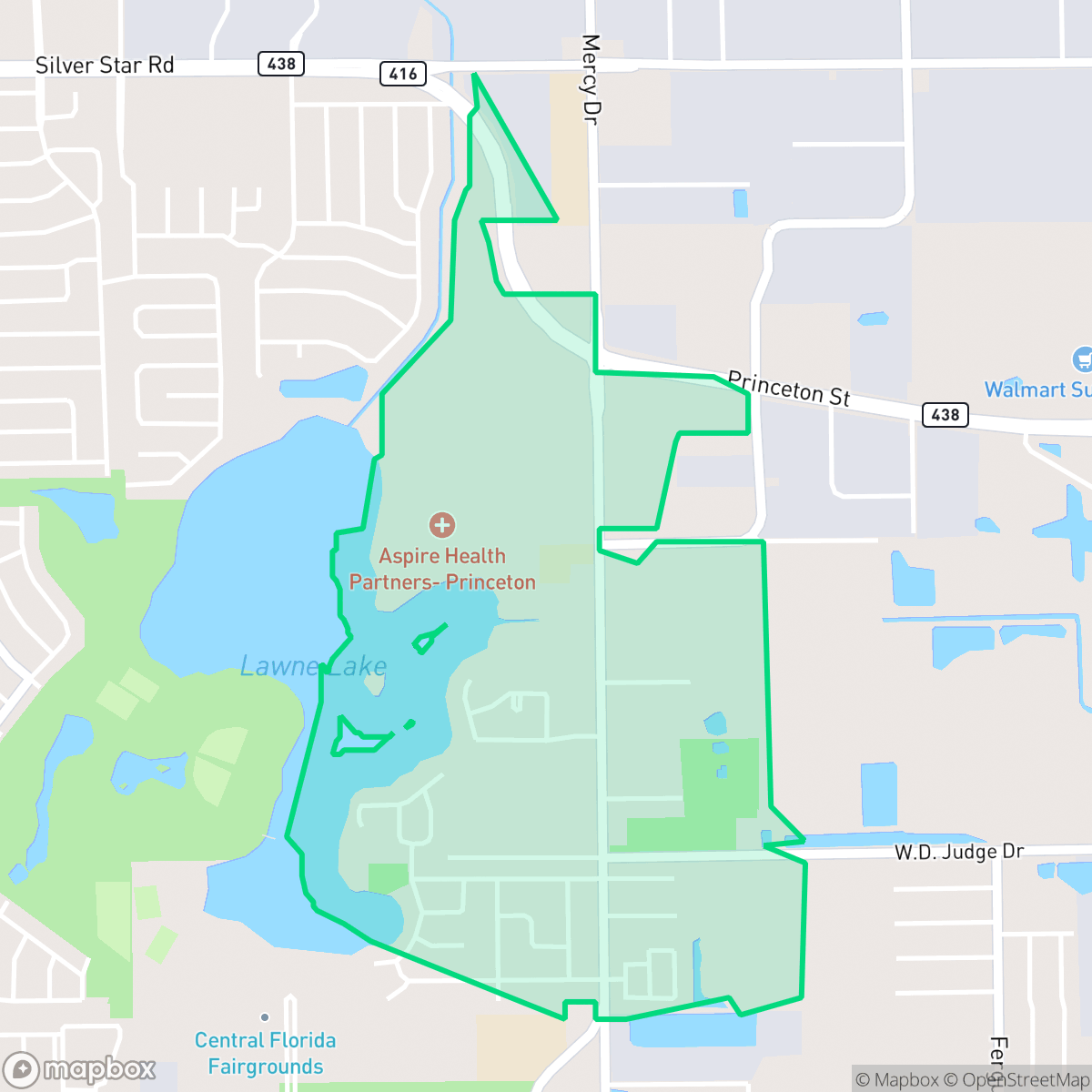
The Mercy Drive neighborhood in Orlando, originally known as Fairvilla Road, saw its first residential subdivisions platted in the mid-1950s. By the 1960s, the area experienced significant development, including the construction of the Mercy Medical Center—now the Aspire Health Partners property—which was operated by the Sisters of Mercy. The neighborhood is centered around Mercy Drive, a primary north-south corridor that serves as a focal point for the community's residential, institutional, and commercial activity. Over the decades, the area has evolved into a diverse, established community characterized by a mix of single-family homes and apartment complexes, including the Village on Mercy. Today, it is recognized for its ongoing revitalization efforts, such as the 2017 City of Orlando Vision Plan, and its focus on community-based resources like the Northwest Community Center and the Bezos Academy.
The area maintains a semi-rural feel, defined by scattered residential development and significant green space rather than dense urban construction. It serves as a calm, established community where the landscape is shaped by natural wetlands and diverse housing types. Residents benefit from a liberal-leaning political environment and a population that spans a wide range of ages, creating a balanced social atmosphere according to iHuus data. This setting provides a distinct alternative to the more congested parts of Orlando, offering a slower pace of life for its inhabitants.
Prospective residents should consider that the neighborhood experiences notable noise from surrounding traffic and transit infrastructure. While the area provides moderate privacy for its inhabitants, it lacks extensive public parks and has limited pedestrian connectivity in some industrial-adjacent zones. It is well-suited for those who prioritize a quiet, suburban lifestyle and value proximity to community-based resources like the Northwest Community Center, provided they are prepared for the neighborhood's specific environmental and acoustic conditions.
Neighborhood Scores Across 15 Qualities
Residential spacing varies between dense apartment rows and detached homes with moderate setbacks. According to iHuus data, this level of separation provides more privacy than the typical Orlando neighborhood.
Residential cul-de-sacs and main arterials offer safe walking paths, though industrial zones to the south lack continuous sidewalks. This area is slightly less walkable than the Orlando average due to these disconnected pedestrian routes.
Residential views consist of tidy tract housing and dense apartment complexes with a higher visual variety than the Orlando average. Many properties feature boxy rooflines and small yards, though some private pools are visible in certain areas according to iHuus data.
Residential streets offer some green verges and private fenced yards, but the area lacks large public parks. While more pet-friendly than much of Orlando, significant industrial zones in the southern half limit outdoor walking options.
Open land and woodland areas are more prevalent here than in most of Orlando. Residents will find a landscape defined by scattered homes and natural wetlands rather than dense urban development.
Residential streets offer a calm atmosphere with very little commercial activity or street life. According to iHuus data, the area lacks significant points of interest and has lower levels of vibrancy than the Orlando average.
Persistent noise from nearby heavy traffic and transit infrastructure is common here. According to iHuus data, acoustic comfort in this area is lower than the Orlando average.
Air quality levels fluctuate between acceptable and unhealthy, presenting occasional concerns for sensitive groups. According to iHuus data, these conditions are roughly in line with the typical levels found across Orlando.
Primarily residential in character, this area maintains a lower level of industrial activity than the Orlando average. While some light commercial services and warehouse-related traffic exist near major transit corridors, the neighborhood lacks heavy industrial zones or significant manufacturing facilities.
Health insurance coverage levels in this area are slightly higher than the Orlando average. According to iHuus data, a portion of the resident population remains uninsured.
Political leanings in this area are notably more liberal than the Orlando average, characterized by a significant liberal majority and a small conservative presence.
A broad range of age demographics defines the area, featuring a more even distribution of young adults, families, and seniors compared to the Orlando average. According to iHuus data, this creates a balanced residential profile rather than one dominated by a single age bracket.
Flood risk in this area is notably higher than the Orlando average, as some parts of the neighborhood fall within a floodplain. Residents should account for potential residual flood risks during heavy rain events.
Address-Level Insights for Mercy Drive


iHuus Neighborhood Intelligence Insights
Get address-level neighborhood insights for Mercy Drive
- Street-level scores — see how individual blocks compare, not just neighborhood averages
- Micro-zone boundaries — identify quiet pockets, flood boundaries, and walkable clusters before you visit
- 15 dimensions in full — walkability, noise, air quality, school quality, insurance coverage, population age profile, urban/rural index, and more
- Boundary risk alerts — know if your address sits near a block boundary where scores drop, the kind of detail no listing will ever mention
- School insights — individual school ratings and insights, not just district-level data
- Compare before you commit — side-by-side data across neighborhoods, down to block precision
No credit card required
Compare with Any Neighborhood
| Dimension | Mercy Drive | 33rd St. Industrial |
|---|---|---|
| 🚶 Walkabilityavg 5.62 | ||
| 🔊 Acoustic Comfortavg 3.33 | ||
| 🤫 Privacy Indexavg 4.6 | ||
| 🎨 Visual Appealavg 5.36 | ||
| 🐕 Dog Friendlinessavg 5.01 | ||
| 🗺️ Urban-Rural Indexavg 5.48 | ||
| ✨ Neighborhood Vibeavg 2.98 | ||
| 🏥 Health Insurance Coverageavg 5.11 | ||
| 🌿 Air Qualityavg 5.87 | ||
| 🏭 Industrial Proximityavg 5.75 | ||
| 🌊 Flood Safetyavg 4.98 | ||
| 🗳️ Ideological Leanavg 5.62 | ||
| 👥 Population Age Profileavg 3.78 | ||
| 🔥 Fire Safety | ||
| 🏫 School Quality |
Mercy Drive Rankings
School Districts Serving Mercy Drive
School Insights for Mercy Drive
Below average outcomes; significant attendance and academic challenges.
School Insights
See what's really behind every school rating near Mercy Drive
- Individual school ratings — each school's own score with outcome context, not just a district average
- Enrollment & class size data — student-to-teacher ratio and how it compares to the state average
- Full demographics breakdown — ethnicity and gender composition for every school in the enrollment zone
- Every school in the district — all schools within the enrollment boundary ranked by rating, not just the closest one
- Grade levels & benchmarks — elementary through high school, with below/above state-average flags
No credit card required