Lorna Doone, Orlando
Updated · 1,134 residents
Lorna Doone is a revitalizing community in Orlando known for its historic park and active local scene. Residents enjoy a walkable environment with a semi-rural feel, though the area experiences notable noise from nearby transit corridors.
Key Highlights
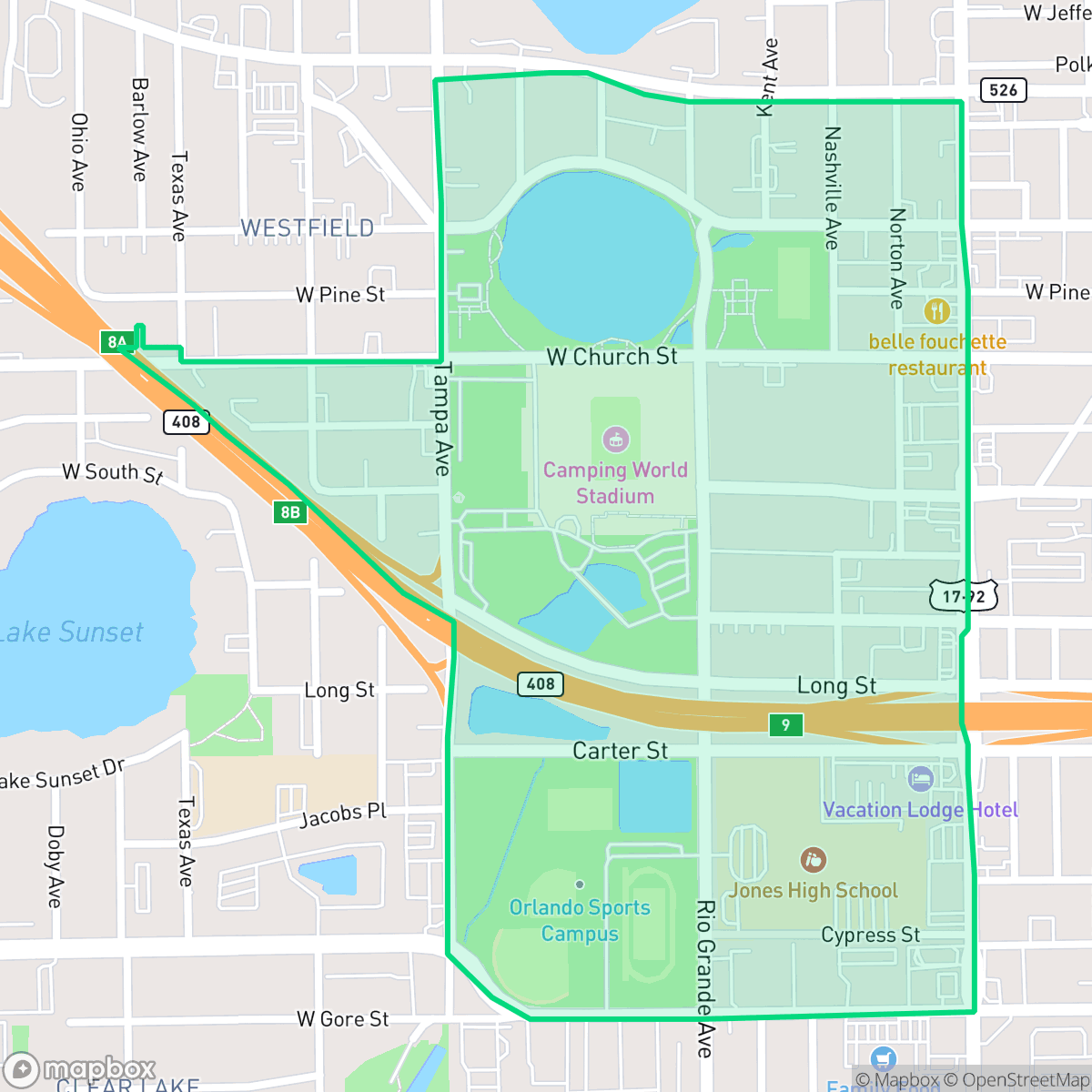
About Lorna Doone
The Lorna Doone neighborhood, located within Orlando's West Lakes area, emerged in the 1940s and 1950s as a thriving Black community characterized by a population of educated, accomplished families. The area later faced significant decline due to discriminatory urban policies and the disruptive construction of Interstate 4. A central landmark, Lake Lorna Doone Park, holds profound historical significance as the site of the first integrated Little League baseball game in the American South, played in 1955. Following decades of neglect, the neighborhood has recently become a focus of comprehensive revitalization efforts led by the nonprofit Lift Orlando, which aims to replace distressed housing with mixed-income developments while preserving the community's heritage. The park itself was fully reconstructed in 2021, reaffirming its role as a vital social anchor for the West Side.
The neighborhood stands out as a vibrant, evolving hub within the West Lakes area. It offers a unique blend of semi-rural tranquility and accessible urban amenities, with a layout that encourages pedestrian activity. The local atmosphere is defined by a diverse generational mix and a strong sense of community, supported by ongoing efforts to improve housing and public spaces. According to iHuus data, the area maintains a higher level of greenery and open space compared to the city average, contributing to its distinct character.
Prospective residents should note that the area experiences significant noise from nearby major transit routes and flight paths. While the neighborhood provides more open land than many parts of the city, flood risk remains a point of caution due to limited recent environmental studies. It is well-suited for those who value community-led growth and proximity to local dining and independent shops, provided they are comfortable with the acoustic environment of a central urban location.
Neighborhood Scores Across 15 Qualities
Residential spacing varies between tightly packed lots and more moderately distanced houses, offering more separation from neighbors than the Orlando average. Some areas feature higher density apartment buildings alongside single-family homes, according to iHuus data.
Sidewalks and safe crossings are available along many streets, making this area more pedestrian friendly than the Orlando average. However, the nearby highway interchange acts as a significant barrier for those attempting to cross larger thoroughfares.
Modest single-family homes and standard rectangular rooftops define the area, providing a visual landscape slightly more varied than the Orlando average. According to iHuus data, the scenery consists primarily of tidy yards and functional apartment complexes.
Access to large lakes and various open grass lots provides more opportunities for pet exercise than the Orlando average. Some nearby parks lack perimeter fencing, so owners should remain mindful of leash requirements.
Frequent open land and scattered homes amidst woodland provide a more tranquil landscape than the typical Orlando urban density. According to iHuus data, this area maintains a higher level of greenery and open space compared to the city average.
Active street life and a diverse selection of local dining options make this area significantly more vibrant than the Orlando average. Residents can access various independent shops, parks, and transit hubs throughout several concentrated pockets of the neighborhood.
Frequent disturbances from nearby major transit routes and flight paths characterize this area. According to iHuus data, the level of acoustic disruption is consistent with the city average.
Air quality in this area fluctuates between acceptable and unhealthy levels, which may pose occasional concerns for sensitive groups. According to iHuus data, conditions are roughly in line with the Orlando average.
Mostly residential in character, this area features a higher concentration of light commercial activity and utility-related transit than the Orlando average. While heavy industry is absent, residents may encounter occasional low-level noise or operational activity near local service hubs.
Health insurance access among residents is slightly above the Orlando average, according to iHuus data. While a significant portion of the population is covered, there remains a notable segment of the community without active coverage.
Voting patterns and census indicators reflect a highly liberal leaning, which is notably more progressive than the Orlando city average.
Residents experience a balanced distribution of age groups, including young adults, families, and seniors. According to iHuus data, this demographic variety is notably more diverse than the Orlando city average.
Flood safety levels are slightly below the Orlando average because FEMA has not yet finished a detailed study for this area. According to iHuus data, residents should remain cautious as the specific risk level remains undetermined.
Address-Level Insights for Lorna Doone


iHuus Neighborhood Intelligence Insights
Get address-level neighborhood insights for Lorna Doone
- Street-level scores — see how individual blocks compare, not just neighborhood averages
- Micro-zone boundaries — identify quiet pockets, flood boundaries, and walkable clusters before you visit
- 15 dimensions in full — walkability, noise, air quality, school quality, insurance coverage, population age profile, urban/rural index, and more
- Boundary risk alerts — know if your address sits near a block boundary where scores drop, the kind of detail no listing will ever mention
- School insights — individual school ratings and insights, not just district-level data
- Compare before you commit — side-by-side data across neighborhoods, down to block precision
No credit card required
Compare with Any Neighborhood
| Dimension | Lorna Doone | 33rd St. Industrial |
|---|---|---|
| 🚶 Walkabilityavg 5.62 | ||
| 🔊 Acoustic Comfortavg 3.33 | ||
| 🤫 Privacy Indexavg 4.6 | ||
| 🎨 Visual Appealavg 5.36 | ||
| 🐕 Dog Friendlinessavg 5.01 | ||
| 🗺️ Urban-Rural Indexavg 5.48 | ||
| ✨ Neighborhood Vibeavg 2.98 | ||
| 🏥 Health Insurance Coverageavg 5.11 | ||
| 🌿 Air Qualityavg 5.87 | ||
| 🏭 Industrial Proximityavg 5.75 | ||
| 🌊 Flood Safetyavg 4.98 | ||
| 🗳️ Ideological Leanavg 5.62 | ||
| 👥 Population Age Profileavg 3.78 | ||
| 🔥 Fire Safety | ||
| 🏫 School Quality |
Lorna Doone Rankings
School Districts Serving Lorna Doone
School Insights for Lorna Doone
Below average outcomes; significant attendance and academic challenges.
School Insights
See what's really behind every school rating near Lorna Doone
- Individual school ratings — each school's own score with outcome context, not just a district average
- Enrollment & class size data — student-to-teacher ratio and how it compares to the state average
- Full demographics breakdown — ethnicity and gender composition for every school in the enrollment zone
- Every school in the district — all schools within the enrollment boundary ranked by rating, not just the closest one
- Grade levels & benchmarks — elementary through high school, with below/above state-average flags
No credit card required