Lake Nona South, Orlando
Updated · 1,516 residents
Lake Nona South is a quiet, suburban residential area defined by its uniform housing and proximity to the region's medical and life sciences hub. While the neighborhood offers a calm environment for young adults, residents should expect limited pedestrian infrastructure and occasional noise from nearby transit corridors.
Key Highlights
About Lake Nona South
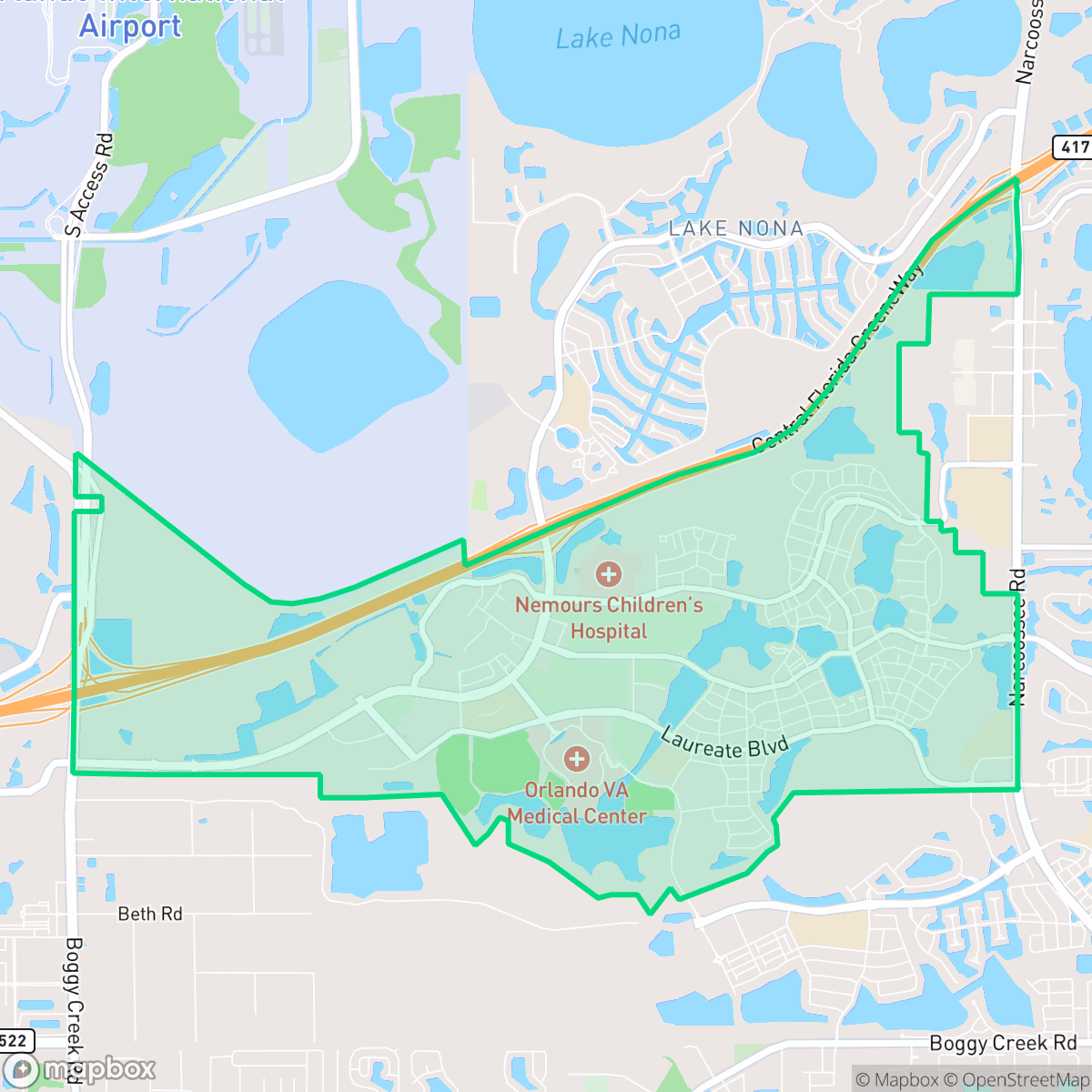
Lake Nona South, a designated neighborhood within the broader Lake Nona master-planned community in southeast Orlando, represents a significant 21st-century transformation of Central Florida landscape. Originally defined by rural wetlands, pine forests, and cattle ranches, the area remained largely undeveloped until the Tavistock Group began its strategic acquisition in the 1990s. The neighborhood's character was fundamentally reshaped starting in 2005 with the establishment of Lake Nona Medical City, a 650-acre health and life sciences cluster that anchors the district. This development transitioned the land from agricultural use into an innovation hub, integrating research institutions, hospitals, and modern residential developments like Laureate Park. Today, Lake Nona South is recognized for its forward-thinking urban planning, emphasizing high-tech infrastructure, sustainable design, and a dense concentration of medical and educational facilities that define its contemporary cultural identity.
The area functions as a low-density residential enclave characterized by standard single-family homes and consistent architectural layouts. It serves as a functional living space for those drawn to the nearby innovation corridor, maintaining a subdued atmosphere that prioritizes residential order over commercial vibrancy or nightlife. The streetscapes are designed for privacy and suburban consistency rather than high-density urban activity.
Potential residents should note that the neighborhood features limited sidewalk access, which impacts walkability for those who prefer to navigate on foot. Due to the proximity of major thoroughfares, some areas experience intermittent traffic noise. The community is generally well-suited for young professionals who value a quiet, predictable environment, though they may find the lack of immediate pet-friendly amenities and the need for personal health insurance coverage to be important considerations. The local school district, Orange County Public Schools, provides stable educational services, though it continues to manage challenges related to enrollment shifts and facility consolidation.
Neighborhood Scores Across 15 Qualities
Close proximity between detached homes means neighbors are often within sight or earshot. According to iHuus data, this lack of separation is more pronounced here than in many other parts of Orlando.
Quiet residential streets allow for low-traffic walking, though the lack of sidewalks makes navigation less convenient than in other parts of Orlando. According to iHuus data, this area falls below the city average for pedestrian connectivity.
Residential streetscapes consist of uniform, single-family homes with consistent rooflines and modest yard spaces. This area presents a more functional, less varied aesthetic than the Orlando average.
Sparse greenery and narrow verges make for limited walking opportunities for pets. According to iHuus data, the amount of accessible open space in this area is below the Orlando average.
Residential streets and green spaces are balanced, though the area feels more suburban than the Orlando average. According to iHuus data, the landscape features less urban density compared to the city center.
Very little commercial activity or nightlife exists here, making the area significantly more subdued than the Orlando average. Residents will find a calm, low-key environment centered around suburban housing and limited local services.
Presence of nearby major thoroughfares contributes to audible levels of noise that are slightly higher than the Orlando average. According to iHuus data, residents may experience intermittent disturbances from passing vehicles and transit activity.
Air quality levels fluctuate between acceptable and unhealthy ranges, which is lower than the Orlando average. According to iHuus data, sensitive groups may experience occasional concern during certain periods.
Predominantly residential streets feature scattered local services and light commercial units, though heavy industrial activity is absent. This mix of amenities and housing is less industrial than the Orlando average, according to iHuus data.
Health insurance access among residents is lower than the Orlando average, according to iHuus data. This indicates a higher proportion of uninsured individuals living in the area compared to much of the city.
Conservative-leaning voters form the majority of the community, representing a more traditional political landscape than the Orlando average according to iHuus data.
Young adults comprise the majority of the local population, making the demographic significantly younger than the Orlando average. According to iHuus data, there is a limited presence of families or older residents in this area.
Flood safety levels in this area are lower than the Orlando average because FEMA has not yet finalized detailed flood studies for this specific location. According to iHuus data, residents should remain cautious as the official risk level remains undetermined.
Address-Level Insights for Lake Nona South


iHuus Neighborhood Intelligence Insights
Get address-level neighborhood insights for Lake Nona South
- Street-level scores — see how individual blocks compare, not just neighborhood averages
- Micro-zone boundaries — identify quiet pockets, flood boundaries, and walkable clusters before you visit
- 15 dimensions in full — walkability, noise, air quality, school quality, insurance coverage, population age profile, urban/rural index, and more
- Boundary risk alerts — know if your address sits near a block boundary where scores drop, the kind of detail no listing will ever mention
- School insights — individual school ratings and insights, not just district-level data
- Compare before you commit — side-by-side data across neighborhoods, down to block precision
No credit card required
Compare with Any Neighborhood
| Dimension | Lake Nona South | 33rd St. Industrial |
|---|---|---|
| 🚶 Walkabilityavg 5.62 | ||
| 🔊 Acoustic Comfortavg 3.33 | ||
| 🤫 Privacy Indexavg 4.6 | ||
| 🎨 Visual Appealavg 5.36 | ||
| 🐕 Dog Friendlinessavg 5.01 | ||
| 🗺️ Urban-Rural Indexavg 5.48 | ||
| ✨ Neighborhood Vibeavg 2.98 | ||
| 🏥 Health Insurance Coverageavg 5.11 | ||
| 🌿 Air Qualityavg 5.87 | ||
| 🏭 Industrial Proximityavg 5.75 | ||
| 🌊 Flood Safetyavg 4.98 | ||
| 🗳️ Ideological Leanavg 5.62 | ||
| 👥 Population Age Profileavg 3.78 | ||
| 🔥 Fire Safety | ||
| 🏫 School Quality |
Lake Nona South Rankings
School Districts Serving Lake Nona South
School Insights for Lake Nona South
Below average outcomes; significant attendance and academic challenges.
School Insights
See what's really behind every school rating near Lake Nona South
- Individual school ratings — each school's own score with outcome context, not just a district average
- Enrollment & class size data — student-to-teacher ratio and how it compares to the state average
- Full demographics breakdown — ethnicity and gender composition for every school in the enrollment zone
- Every school in the district — all schools within the enrollment boundary ranked by rating, not just the closest one
- Grade levels & benchmarks — elementary through high school, with below/above state-average flags
No credit card required