Lake Formosa, Orlando
Updated · 622 residents
Lake Formosa is a vibrant, highly walkable neighborhood known for its upscale lakeside scenery and proximity to cultural landmarks. While residents enjoy a semi-rural atmosphere with abundant greenery, the area experiences notable noise levels due to its location near major transit corridors.
Key Highlights
About Lake Formosa
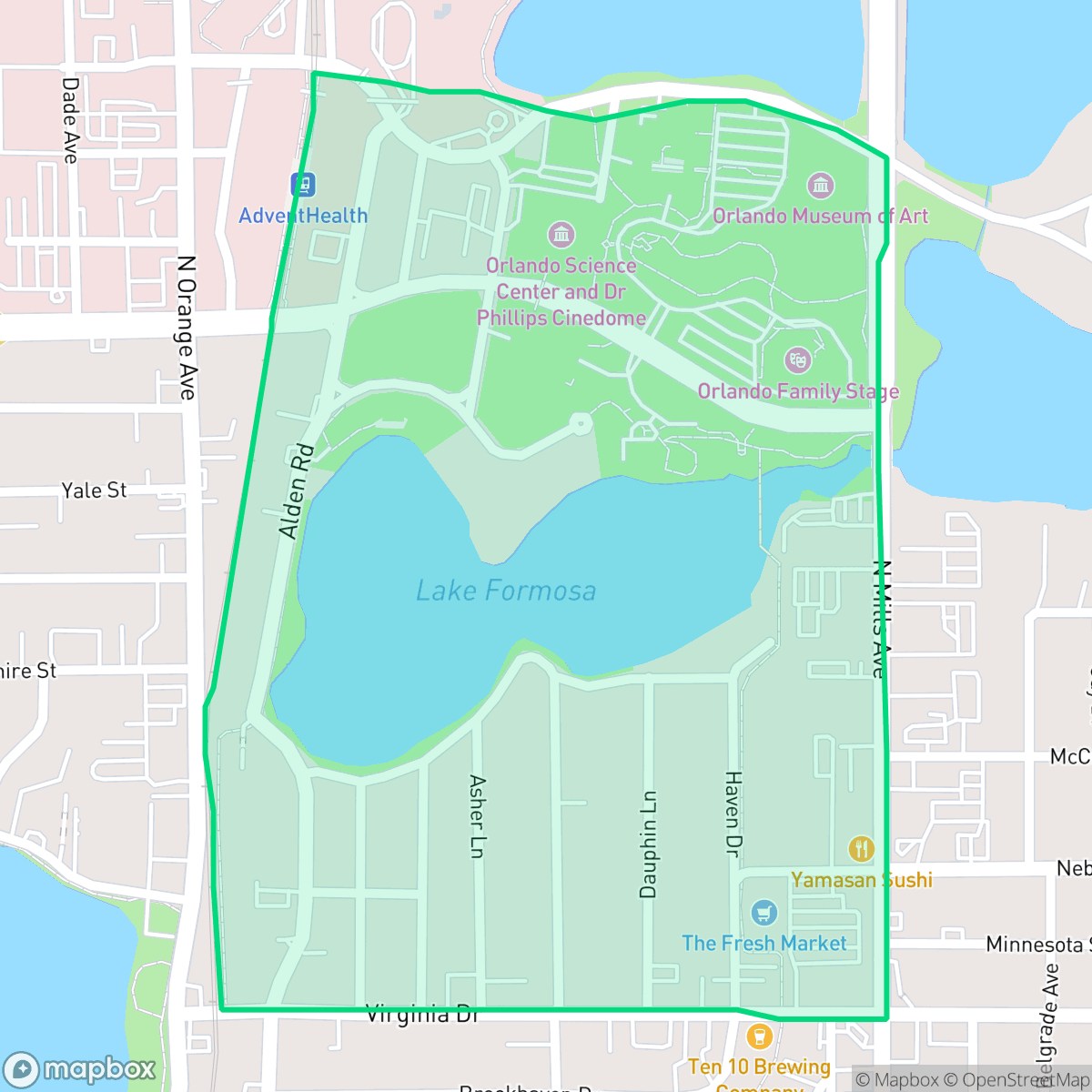
Settled in 1880 by Philadelphia attorney James M. Wilcox, the area around Lake Formosa was originally known as the village of Willcox, which served as a stop on the South Florida Railroad. In 1887, the village was renamed Formosa and featured a local post office until 1908. The neighborhood underwent significant residential development beginning in 1911 with the Idlewild Park subdivision, followed by further expansion during the 1920s Florida land boom. Annexed by Orlando in 1925, the area is characterized by its 1920s-era bungalow and frame vernacular homes, alongside later 1950s ranch-style architecture. Today, the neighborhood maintains a distinct cultural identity through its proximity to the Mennello Museum of American Art, housed in a former private residence, and its historic warehouse district along Alden Road, which has evolved into a hub for local artists and small businesses.
The neighborhood functions as a social hub characterized by a liberal community and a distinct lack of heavy industrial activity. Its visual appeal is defined by manicured properties and mature tree cover, providing a sense of space that balances urban convenience with a quieter, more natural aesthetic. Residents benefit from high rates of health insurance coverage and a diverse demographic mix that spans young adults to seniors, creating a balanced social environment according to iHuus data.
The primary trade-off for this central location is the acoustic environment, as the area is situated near busy roadways and flight paths that create consistent background noise. While the streets are generally pedestrian-friendly, the presence of a highway and railway line can occasionally interrupt continuous movement. The neighborhood maintains moderate flood safety levels and offers a welcoming environment for pet owners who appreciate the local park access and shaded, walkable streets.
Neighborhood Scores Across 15 Qualities
Residential spacing varies between dense apartment blocks and detached houses with moderate yard buffers. According to iHuus data, this level of separation is higher than the Orlando city average.
Sidewalks and safe crossings are widely available on residential streets, making this area significantly more walkable than the Orlando average. However, a major highway and railway corridor bisect the neighborhood, which can limit continuous pedestrian movement across certain sections.
Manicured lakeside properties and large homes with private pools provide a highly aesthetic environment that is significantly more visually appealing than the Orlando average. According to iHuus data, the area features frequent upscale amenities and spacious residential lots.
Connected green spaces and wide paths offer significantly better walking conditions for pets than the Orlando average. Mature tree cover and grassy verges provide shade, though a major highway traverses the area.
Open land and woodland areas provide a more spacious atmosphere than the typical Orlando urban landscape; according to iHuus data, this mix of scattered homes and waterfront development offers more greenery than much of the city.
Local dining, breweries, and nightlife create a much more active atmosphere than the Orlando average. Residents have access to a dense concentration of social hubs near landmarks like Lake Ivanhoe and Harry P. Leu Gardens.
Frequent disturbances from nearby transit corridors and flight paths create a noisier environment than the Orlando average. According to iHuus data, residents can expect significant acoustic interference from adjacent major roadways.
Air quality remains consistently high with rare instances of elevated readings, performing better than the Orlando average according to iHuus data.
Heavy manufacturing is largely absent, leaving the area as a predominantly residential landscape with only occasional light commercial activity. This lack of industrial zoning makes the neighborhood much cleaner and quieter regarding factory-related impact than the Orlando average.
Health insurance enrollment among residents is significantly higher than the Orlando average, according to iHuus data.
Political leanings in this area are notably more liberal than the Orlando average, according to iHuus data.
Residents will find a more balanced distribution of age groups compared to the broader Orlando area, featuring a mix of young adults, families, and seniors according to iHuus data.
Residual flood risks exist within the area as part of a 500-year floodplain; however, safety levels remain higher than the Orlando city average according to iHuus data.
Address-Level Insights for Lake Formosa


iHuus Neighborhood Intelligence Insights
Get address-level neighborhood insights for Lake Formosa
- Street-level scores — see how individual blocks compare, not just neighborhood averages
- Micro-zone boundaries — identify quiet pockets, flood boundaries, and walkable clusters before you visit
- 15 dimensions in full — walkability, noise, air quality, school quality, insurance coverage, population age profile, urban/rural index, and more
- Boundary risk alerts — know if your address sits near a block boundary where scores drop, the kind of detail no listing will ever mention
- School insights — individual school ratings and insights, not just district-level data
- Compare before you commit — side-by-side data across neighborhoods, down to block precision
No credit card required
Compare with Any Neighborhood
| Dimension | Lake Formosa | 33rd St. Industrial |
|---|---|---|
| 🚶 Walkabilityavg 5.62 | ||
| 🔊 Acoustic Comfortavg 3.33 | ||
| 🤫 Privacy Indexavg 4.6 | ||
| 🎨 Visual Appealavg 5.36 | ||
| 🐕 Dog Friendlinessavg 5.01 | ||
| 🗺️ Urban-Rural Indexavg 5.48 | ||
| ✨ Neighborhood Vibeavg 2.98 | ||
| 🏥 Health Insurance Coverageavg 5.11 | ||
| 🌿 Air Qualityavg 5.87 | ||
| 🏭 Industrial Proximityavg 5.75 | ||
| 🌊 Flood Safetyavg 4.98 | ||
| 🗳️ Ideological Leanavg 5.62 | ||
| 👥 Population Age Profileavg 3.78 | ||
| 🔥 Fire Safety | ||
| 🏫 School Quality |
Lake Formosa Rankings
School Districts Serving Lake Formosa
School Insights for Lake Formosa
Below average outcomes; significant attendance and academic challenges.
School Insights
See what's really behind every school rating near Lake Formosa
- Individual school ratings — each school's own score with outcome context, not just a district average
- Enrollment & class size data — student-to-teacher ratio and how it compares to the state average
- Full demographics breakdown — ethnicity and gender composition for every school in the enrollment zone
- Every school in the district — all schools within the enrollment boundary ranked by rating, not just the closest one
- Grade levels & benchmarks — elementary through high school, with below/above state-average flags
No credit card required