Lake Copeland, Orlando
Updated · 546 residents
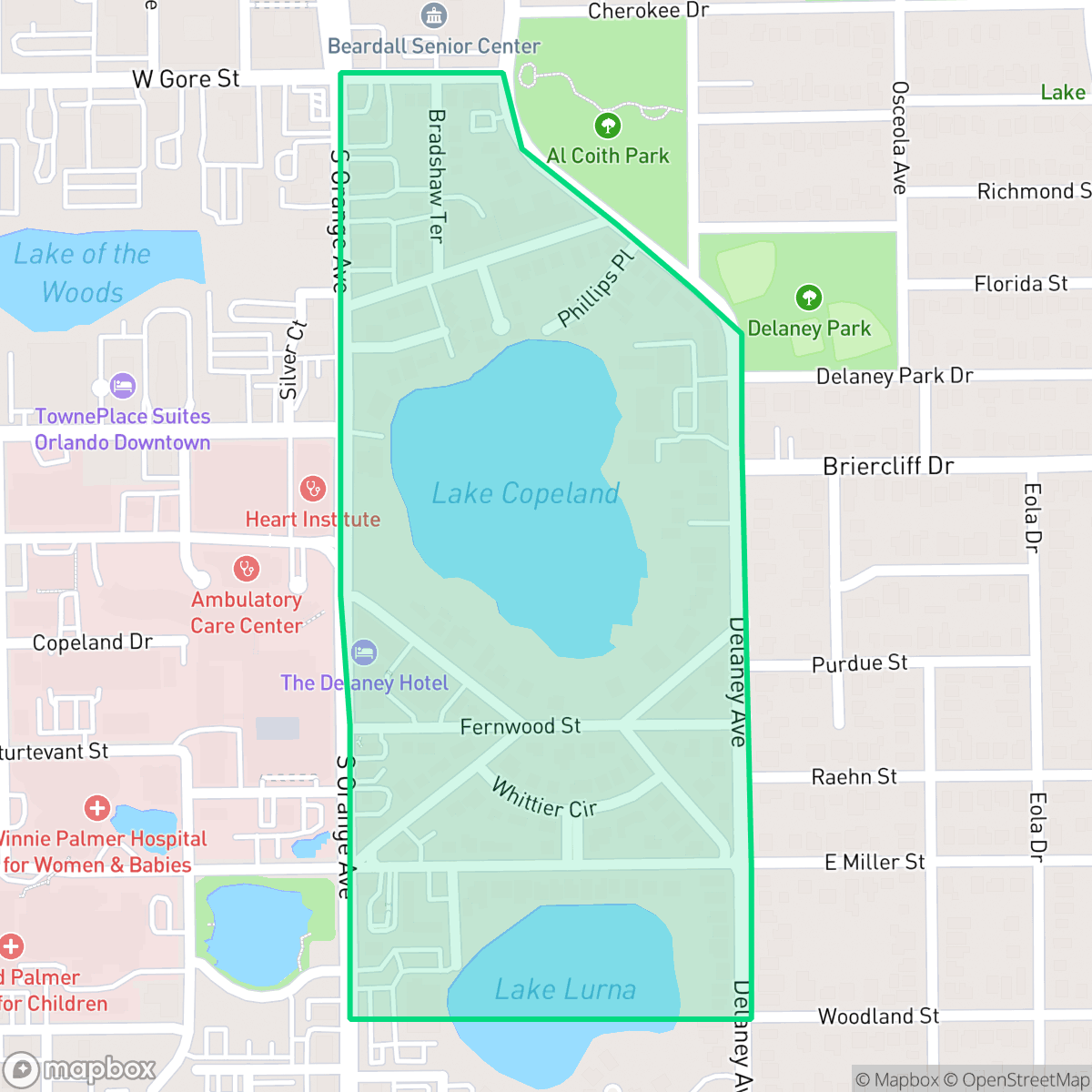
Lake Copeland is a historic, highly walkable enclave south of downtown Orlando known for its diverse early 20th-century architecture and lush, tree-lined streets. Residents enjoy a social, active lifestyle with proximity to local parks and a semi-rural feel that balances urban convenience with quiet, upscale residential character.
Key Highlights
About Lake Copeland
Designated a local historic district in 1984, Lake Copeland is one of Orlando’s earliest suburbs, transitioning from 19th-century farmland to a residential community by the Great Depression. The district’s oldest structure, the 1880s McRae-Raehn House, reflects its rural origins before the area was platted for development. The neighborhood is defined by approximately 110 residences showcasing diverse architectural styles from the early 20th century, including Colonial, Mediterranean, and Tudor Revival, alongside Bungalows and Minimal Traditional forms. Renowned architect James Gamble Rogers II contributed to the area’s distinct character, notably designing the 1927 Claybaugh House. Other landmarks, such as the 1925 Neoclassical Revival Sligh House, highlight the neighborhood's historic prestige. Today, Lake Copeland maintains an intimate, quiet atmosphere south of downtown Orlando, preserved by its unique layout and historic designation.
The area stands out for its aesthetic appeal, featuring mature greenery and custom-built homes that create a distinct, upscale atmosphere. Its grid-like street pattern and extensive sidewalks make it one of the most pedestrian-friendly communities in the region. Residents benefit from a social environment centered around nearby hubs like Delaney Park, where cafes and wellness services are easily accessible. According to iHuus data, the neighborhood maintains a notably low presence of industrial activity, favoring a peaceful residential setting that remains well-connected to the broader Orlando metropolitan area.
Living here offers a unique mix of urban accessibility and semi-rural tranquility, though prospective residents should note the moderate levels of traffic noise from nearby thoroughfares. While the community enjoys high levels of health insurance coverage and a strong sense of civic engagement, official flood studies remain pending, leaving some uncertainty regarding long-term environmental risks. The neighborhood is well-suited for families, young professionals, and retirees who value historic charm, walkability, and a stable, liberal-leaning community within the Orange County Public School district.
Neighborhood Scores Across 15 Qualities
Residential spacing is varied, with many single-family homes providing more separation than the typical Orlando neighborhood. According to iHuus data, while some denser apartment areas exist, most lots offer a decent buffer between neighbors.
A grid-like street pattern with sidewalks and safe crossings makes much of the area accessible on foot, significantly surpassing the Orlando average. Low-traffic residential streets provide a navigable environment, although some larger thoroughfares are dominated by parking lots.
Large homes featuring private pools and custom landscaping provide a more aesthetically pleasing environment than the Orlando average. According to iHuus data, the presence of mature greenery and high-end amenities contributes to a premium visual character throughout the area.
Tree-lined streets and nearby lakes provide ample space for walks. According to iHuus data, the availability of green spaces and low traffic exposure makes this area significantly more dog friendly than much of Orlando.
Open land and wooded areas are more frequent here than in most of Orlando. Residents will find a landscape featuring scattered homes amidst fields, though some sections contain denser suburban developments.
Bustling local hubs and walkable pockets around Delaney Park provide a significantly higher level of activity than the Orlando average. Residents have access to a dense concentration of cafes, restaurants, and wellness services within a highly walkable suburban landscape.
Steady traffic sounds originate from a nearby busy street, though acoustic levels remain slightly better than the Orlando average according to iHuus data.
Air quality in this area fluctuates between acceptable and unhealthy levels on certain days. According to iHuus data, conditions are generally comparable to the Orlando average, though sensitive groups should remain aware of occasional periods of concern.
Industrial activity is notably lower than the Orlando average, consisting primarily of residential pockets and light commercial uses such as a local brewery. Residents may notice occasional loading activity or utility infrastructure, but heavy industry is absent from the area.
Health insurance accessibility among residents is significantly higher than the Orlando average, according to iHuus data. This indicates a well-covered population with greater access to medical services.
Voting patterns and census indicators show a much more liberal leaning than the Orlando average, according to iHuus data.
Residents live alongside a diverse mix of young adults, families, and seniors. This demographic distribution is more balanced than the typical age profile found across Orlando.
Flood safety levels in this area are roughly in line with the Orlando average, though a lack of detailed FEMA studies means specific risks remain undetermined. Residents should exercise caution as official flood studies for this neighborhood have not yet been completed.
Address-Level Insights for Lake Copeland


iHuus Neighborhood Intelligence Insights
Get address-level neighborhood insights for Lake Copeland
- Street-level scores — see how individual blocks compare, not just neighborhood averages
- Micro-zone boundaries — identify quiet pockets, flood boundaries, and walkable clusters before you visit
- 15 dimensions in full — walkability, noise, air quality, school quality, insurance coverage, population age profile, urban/rural index, and more
- Boundary risk alerts — know if your address sits near a block boundary where scores drop, the kind of detail no listing will ever mention
- School insights — individual school ratings and insights, not just district-level data
- Compare before you commit — side-by-side data across neighborhoods, down to block precision
No credit card required
Compare with Any Neighborhood
| Dimension | Lake Copeland | 33rd St. Industrial |
|---|---|---|
| 🚶 Walkabilityavg 5.62 | ||
| 🔊 Acoustic Comfortavg 3.33 | ||
| 🤫 Privacy Indexavg 4.6 | ||
| 🎨 Visual Appealavg 5.36 | ||
| 🐕 Dog Friendlinessavg 5.01 | ||
| 🗺️ Urban-Rural Indexavg 5.48 | ||
| ✨ Neighborhood Vibeavg 2.98 | ||
| 🏥 Health Insurance Coverageavg 5.11 | ||
| 🌿 Air Qualityavg 5.87 | ||
| 🏭 Industrial Proximityavg 5.75 | ||
| 🌊 Flood Safetyavg 4.98 | ||
| 🗳️ Ideological Leanavg 5.62 | ||
| 👥 Population Age Profileavg 3.78 | ||
| 🔥 Fire Safety | ||
| 🏫 School Quality |
Lake Copeland Rankings
School Districts Serving Lake Copeland
School Insights for Lake Copeland
Below average outcomes; significant attendance and academic challenges.
School Insights
See what's really behind every school rating near Lake Copeland
- Individual school ratings — each school's own score with outcome context, not just a district average
- Enrollment & class size data — student-to-teacher ratio and how it compares to the state average
- Full demographics breakdown — ethnicity and gender composition for every school in the enrollment zone
- Every school in the district — all schools within the enrollment boundary ranked by rating, not just the closest one
- Grade levels & benchmarks — elementary through high school, with below/above state-average flags
No credit card required