Lake Cherokee, Orlando
Updated · 1,594 residents
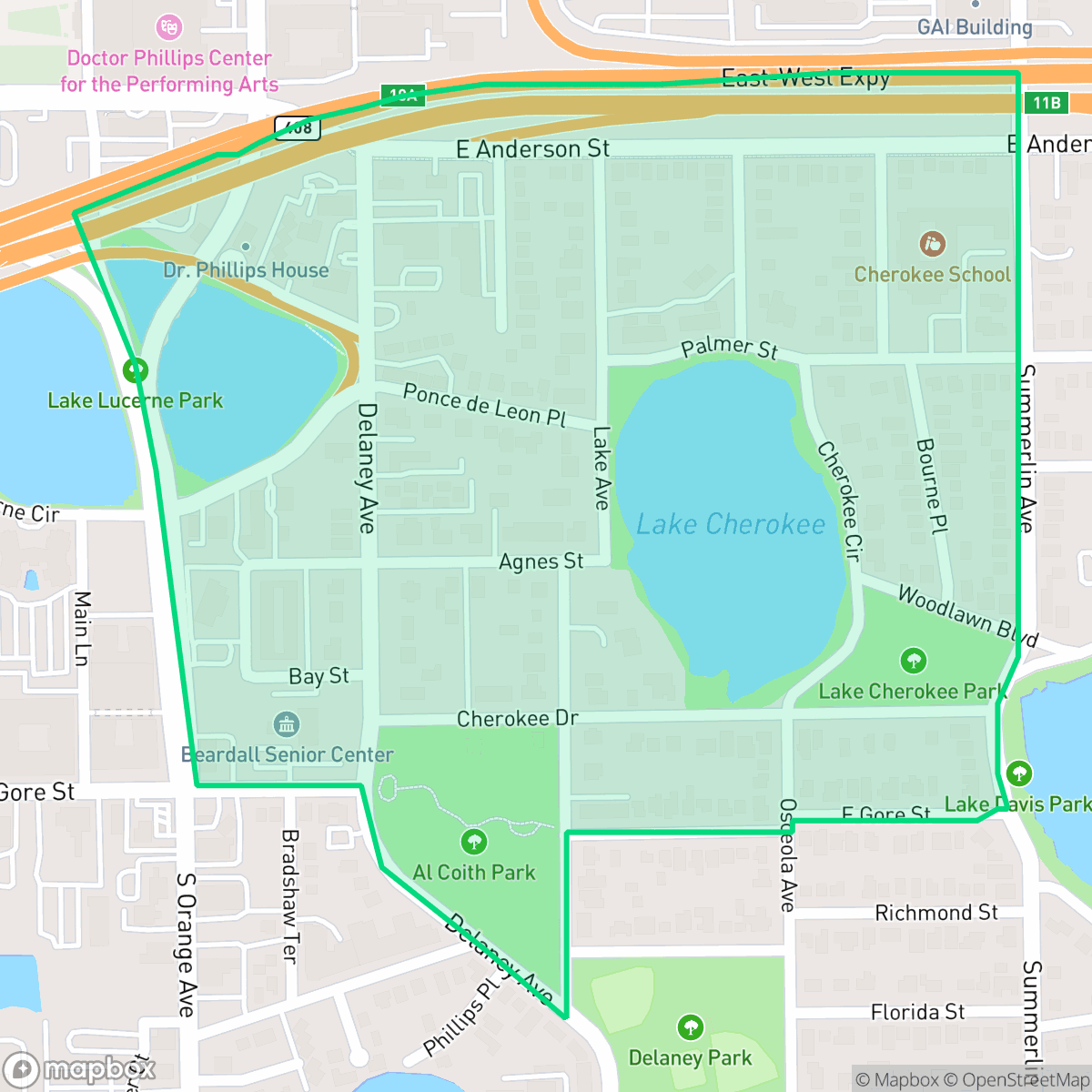
Lake Cherokee is an upscale, highly walkable neighborhood known for its historic charm and manicured, tree-lined streets. While the area offers a vibrant, active lifestyle with excellent access to local amenities, residents should anticipate higher noise levels from nearby transit corridors and flight paths.
Key Highlights
About Lake Cherokee
Established in the late 1870s, the Lake Cherokee Historic District is one of Orlando’s oldest residential neighborhoods. Originally known as Lake Eva and later Lake Minnie, the area gained prominence in the 1880s when newlyweds built homes along the shoreline, creating a cluster of residences famously dubbed “Honeymoon Row.” The district features a diverse architectural legacy, ranging from Victorian-era landmarks like the 1887 Poyntz-O’Neal House to 1920s Florida Land Boom bungalows and the 1947 Art Deco Wellborn Apartments. Significant institutional buildings include the 1926 Mediterranean Revival-style Cherokee School. Designated a local historic district in 1981 and listed on the National Register of Historic Places, the neighborhood remains defined by its preserved historic homes, brick-lined streets, and the serene, namesake lake that served as the original anchor for Orlando’s early elite.
This neighborhood serves as a vibrant, central hub in Orlando, defined by its blend of historic architecture and modern, active living. Residents enjoy a high degree of walkability, with dense sidewalk networks connecting them to a variety of local dining and wellness services. The landscape is characterized by upscale, well-maintained estates and significant vegetation, creating a polished, suburban environment that remains deeply connected to the city center. According to iHuus data, the area fosters a diverse, multi-generational community that leans strongly progressive in its social and political outlook.
While the area offers aesthetic appeal and convenience, prospective residents should consider specific livability trade-offs. The neighborhood experiences notable noise from nearby highway interchanges and frequent flight paths, which may impact acoustic comfort. Additionally, while the area provides excellent walking routes for pets and pedestrians, it faces moderate flood risks and lower rates of health insurance coverage compared to the broader Orlando region. It is best suited for those who prioritize a walkable, historic, and community-oriented lifestyle over absolute quiet or suburban isolation.
Neighborhood Scores Across 15 Qualities
Residential spacing provides a moderate level of separation, offering more buffer between neighbors than the Orlando average. Most homes feature visible distance from one another, often supplemented by tree screening in backyard areas.
Pedestrian infrastructure is significantly better than the Orlando average, featuring dense sidewalk networks and safe crossings even near major highway corridors. While a heavy tree canopy can occasionally obscure paths on residential streets, most areas offer reliable connectivity for walkers.
Large estates featuring private pools and well-maintained landscaping characterize this area. According to iHuus data, the visual environment is notably more polished than the Orlando average.
Lakeside paths and abundant green verges provide excellent walking areas for pets. According to iHuus data, the amount of accessible greenery and safe walking routes here is significantly higher than the Orlando average.
Residential streets and green spaces exist in roughly equal measure, providing a landscape that is slightly less dense than the Orlando average. This layout offers an established suburban environment characterized by significant vegetation and single-family homes.
Local activity levels are significantly higher than the Orlando average, offering a diverse mix of bustling mixed-use hubs and quiet, park-filled residential spaces. Residents have access to an energetic variety of dining, wellness services, and outdoor recreational areas according to iHuus data.
Frequent disturbances from nearby transit corridors and flight paths characterize the area. According to iHuus data, acoustic comfort in Lake Cherokee is lower than the Orlando average.
Air quality fluctuates between acceptable and unhealthy levels, presenting occasional concerns for sensitive groups. This condition remains largely consistent with the average found throughout Orlando.
Primarily residential and recreational in nature, this area lacks heavy industrial facilities and sits well below the city average for industrial proximity. While noise from nearby highway interchanges and parking structures is present, there are no significant industrial hazards or large-scale manufacturing operations within the neighborhood.
Health insurance access among residents is lower than the Orlando average, according to iHuus data.
Voting patterns and census indicators in Lake Cherokee reflect a much more progressive leaning than the Orlando average, according to iHuus data.
Residents encounter a diverse age range spanning young adults to older populations, representing a more varied demographic spread than the Orlando average. According to iHuus data, this balance creates a multi-generational community atmosphere.
Flood risk in this area is slightly above the Orlando average, though a lack of detailed FEMA studies means the precise level of exposure remains undetermined. Residents should maintain awareness of local drainage and water levels during heavy rain events.
Address-Level Insights for Lake Cherokee


iHuus Neighborhood Intelligence Insights
Get address-level neighborhood insights for Lake Cherokee
- Street-level scores — see how individual blocks compare, not just neighborhood averages
- Micro-zone boundaries — identify quiet pockets, flood boundaries, and walkable clusters before you visit
- 15 dimensions in full — walkability, noise, air quality, school quality, insurance coverage, population age profile, urban/rural index, and more
- Boundary risk alerts — know if your address sits near a block boundary where scores drop, the kind of detail no listing will ever mention
- School insights — individual school ratings and insights, not just district-level data
- Compare before you commit — side-by-side data across neighborhoods, down to block precision
No credit card required
Compare with Any Neighborhood
| Dimension | Lake Cherokee | 33rd St. Industrial |
|---|---|---|
| 🚶 Walkabilityavg 5.62 | ||
| 🔊 Acoustic Comfortavg 3.33 | ||
| 🤫 Privacy Indexavg 4.6 | ||
| 🎨 Visual Appealavg 5.36 | ||
| 🐕 Dog Friendlinessavg 5.01 | ||
| 🗺️ Urban-Rural Indexavg 5.48 | ||
| ✨ Neighborhood Vibeavg 2.98 | ||
| 🏥 Health Insurance Coverageavg 5.11 | ||
| 🌿 Air Qualityavg 5.87 | ||
| 🏭 Industrial Proximityavg 5.75 | ||
| 🌊 Flood Safetyavg 4.98 | ||
| 🗳️ Ideological Leanavg 5.62 | ||
| 👥 Population Age Profileavg 3.78 | ||
| 🔥 Fire Safety | ||
| 🏫 School Quality |
Lake Cherokee Rankings
School Districts Serving Lake Cherokee
School Insights for Lake Cherokee
Below average outcomes; significant attendance and academic challenges.
School Insights
See what's really behind every school rating near Lake Cherokee
- Individual school ratings — each school's own score with outcome context, not just a district average
- Enrollment & class size data — student-to-teacher ratio and how it compares to the state average
- Full demographics breakdown — ethnicity and gender composition for every school in the enrollment zone
- Every school in the district — all schools within the enrollment boundary ranked by rating, not just the closest one
- Grade levels & benchmarks — elementary through high school, with below/above state-average flags
No credit card required