Holden-Parramore, Orlando
Updated · 3,947 residents
Holden-Parramore is a historically significant district defined by its vibrant urban energy and rich cultural landmarks. While the area offers a walkable grid layout, residents should be prepared for significant noise from nearby transit corridors and a landscape characterized by functional industrial and residential development.
Key Highlights
About Holden-Parramore
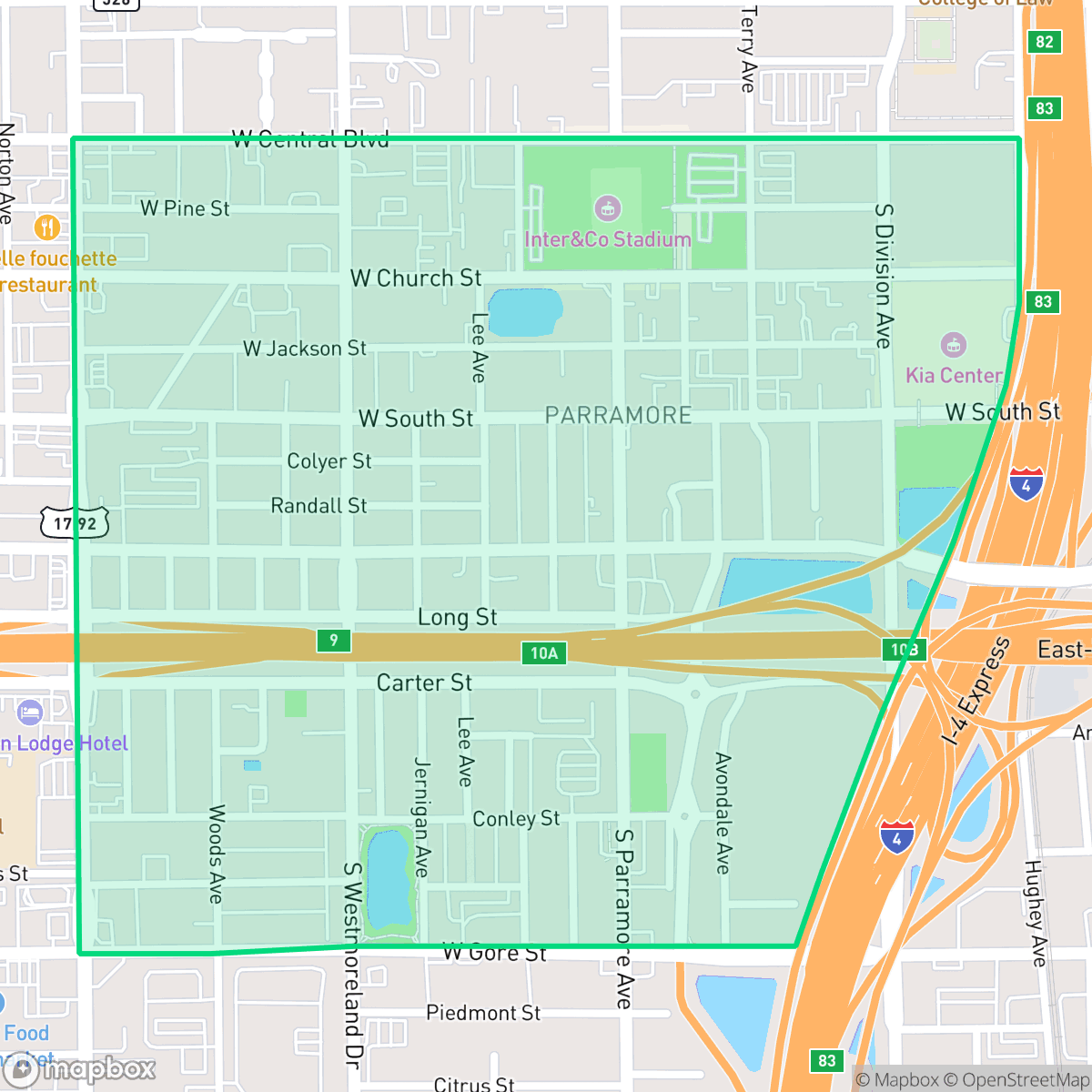
The Holden-Parramore Historic District, listed on the National Register of Historic Places, emerged in the early 20th century as the primary hub for Orlando's African American community due to Jim Crow-era segregation policies that relegated Black residents to the area west of Division Avenue. The neighborhood is historically significant for its collection of frame vernacular residences and shotgun houses, which were once prevalent in the area. Key cultural landmarks include the Wells’Built Hotel, which provided lodging for Black travelers and performers during segregation, and the site of the former Holden Street Elementary School. Despite being physically divided by the construction of Interstate 4 and the East-West Expressway in the 1960s, the neighborhood remains a vital center of Orlando's Black history, home to historic churches like the Ebenezer United Methodist Church and the legacy of Jones High School.
The neighborhood features a mix of residential streets and commercial blocks that create a bustling atmosphere. With its central location and close proximity to major transit hubs, the area maintains a high level of activity that appeals to those seeking an urban lifestyle. The landscape is primarily functional, featuring a blend of modest housing and light industrial facilities that reflect the ongoing development of the region.
Prospective residents should consider that the neighborhood experiences higher than average noise levels due to its location near major highway interchanges and rail lines. While the grid layout supports moderate walkability, the presence of large infrastructure barriers and a high flood risk are important factors to consider. The area is best suited for individuals who prioritize proximity to city transit and a strong sense of community history over quiet, suburban-style living.
Neighborhood Scores Across 15 Qualities
Residential spacing varies throughout the area, featuring a mix of closely packed structures and larger lots with some buffer between neighbors. According to iHuus data, privacy levels are slightly higher than the Orlando average.
A consistent grid layout and sidewalk network exist, though large highway interchanges create significant barriers for pedestrians. While walkability is higher than the Orlando average, high speed arterials can make certain routes feel less accessible.
Standard urban development and industrial features define the area, which offers less visual variety than the Orlando average. Residents will observe a landscape of modest housing, multi-unit blocks, and large parking lots.
Limited green space and large highway interchanges constrain walking routes, though some residents benefit from nearby stadium parks and grassy lots. This area offers slightly more access to open spaces than the Orlando average according to iHuus data.
A blend of residential streets and commercial blocks creates a landscape similar to the Orlando average. This area features a diverse mix of low-rise housing, light industrial warehouses, and dense infrastructure.
Significant activity levels and a high concentration of social hubs make this area much more lively than the Orlando average. Local dining, transit hubs, and nearby civic institutions create a bustling atmosphere throughout the neighborhood.
Frequent traffic and transit sounds from nearby freeways and rail lines characterize the area. This level of acoustic disturbance is notably higher than the Orlando city average, according to iHuus data.
Air quality levels fluctuate between acceptable and unhealthy periods, which may present occasional concerns for sensitive groups. According to iHuus data, these conditions are roughly in line with the typical air quality found across Orlando.
Light industrial facilities, warehouses, and auto-related businesses are present alongside residential areas, making the industrial density slightly higher than the Orlando average. Residents may encounter active transit traffic and occasional utility odors near gas stations and commercial service hubs.
Health insurance access for residents is slightly above the Orlando average, though a significant portion of the population remains uninsured according to iHuus data.
Voting patterns and census indicators show a much more liberal political leaning than the Orlando average, according to iHuus data.
A balanced mix of young adults, families, and older residents defines the area. This demographic variety is notably more diverse than the typical age distribution found across Orlando.
Significant flood risk exists within this area due to its location inside a designated floodplain; according to iHuus data, this vulnerability is notably higher than the Orlando average.
Address-Level Insights for Holden-Parramore


iHuus Neighborhood Intelligence Insights
Get address-level neighborhood insights for Holden-Parramore
- Street-level scores — see how individual blocks compare, not just neighborhood averages
- Micro-zone boundaries — identify quiet pockets, flood boundaries, and walkable clusters before you visit
- 15 dimensions in full — walkability, noise, air quality, school quality, insurance coverage, population age profile, urban/rural index, and more
- Boundary risk alerts — know if your address sits near a block boundary where scores drop, the kind of detail no listing will ever mention
- School insights — individual school ratings and insights, not just district-level data
- Compare before you commit — side-by-side data across neighborhoods, down to block precision
No credit card required
Compare with Any Neighborhood
| Dimension | Holden-Parramore | 33rd St. Industrial |
|---|---|---|
| 🚶 Walkabilityavg 5.62 | ||
| 🔊 Acoustic Comfortavg 3.33 | ||
| 🤫 Privacy Indexavg 4.6 | ||
| 🎨 Visual Appealavg 5.36 | ||
| 🐕 Dog Friendlinessavg 5.01 | ||
| 🗺️ Urban-Rural Indexavg 5.48 | ||
| ✨ Neighborhood Vibeavg 2.98 | ||
| 🏥 Health Insurance Coverageavg 5.11 | ||
| 🌿 Air Qualityavg 5.87 | ||
| 🏭 Industrial Proximityavg 5.75 | ||
| 🌊 Flood Safetyavg 4.98 | ||
| 🗳️ Ideological Leanavg 5.62 | ||
| 👥 Population Age Profileavg 3.78 | ||
| 🔥 Fire Safety | ||
| 🏫 School Quality |
Holden-Parramore Rankings
School Districts Serving Holden-Parramore
School Insights for Holden-Parramore
Below average outcomes; significant attendance and academic challenges.
School Insights
See what's really behind every school rating near Holden-Parramore
- Individual school ratings — each school's own score with outcome context, not just a district average
- Enrollment & class size data — student-to-teacher ratio and how it compares to the state average
- Full demographics breakdown — ethnicity and gender composition for every school in the enrollment zone
- Every school in the district — all schools within the enrollment boundary ranked by rating, not just the closest one
- Grade levels & benchmarks — elementary through high school, with below/above state-average flags
No credit card required