Florida Center, Orlando
Updated · 4,967 residents
Florida Center serves as the vibrant heart of Orlando's tourism industry, defined by its high-energy atmosphere and proximity to major theme parks. While the area offers diverse residential options and clean air, residents should expect significant noise from heavy traffic and limited public green space for pets.
Key Highlights
About Florida Center
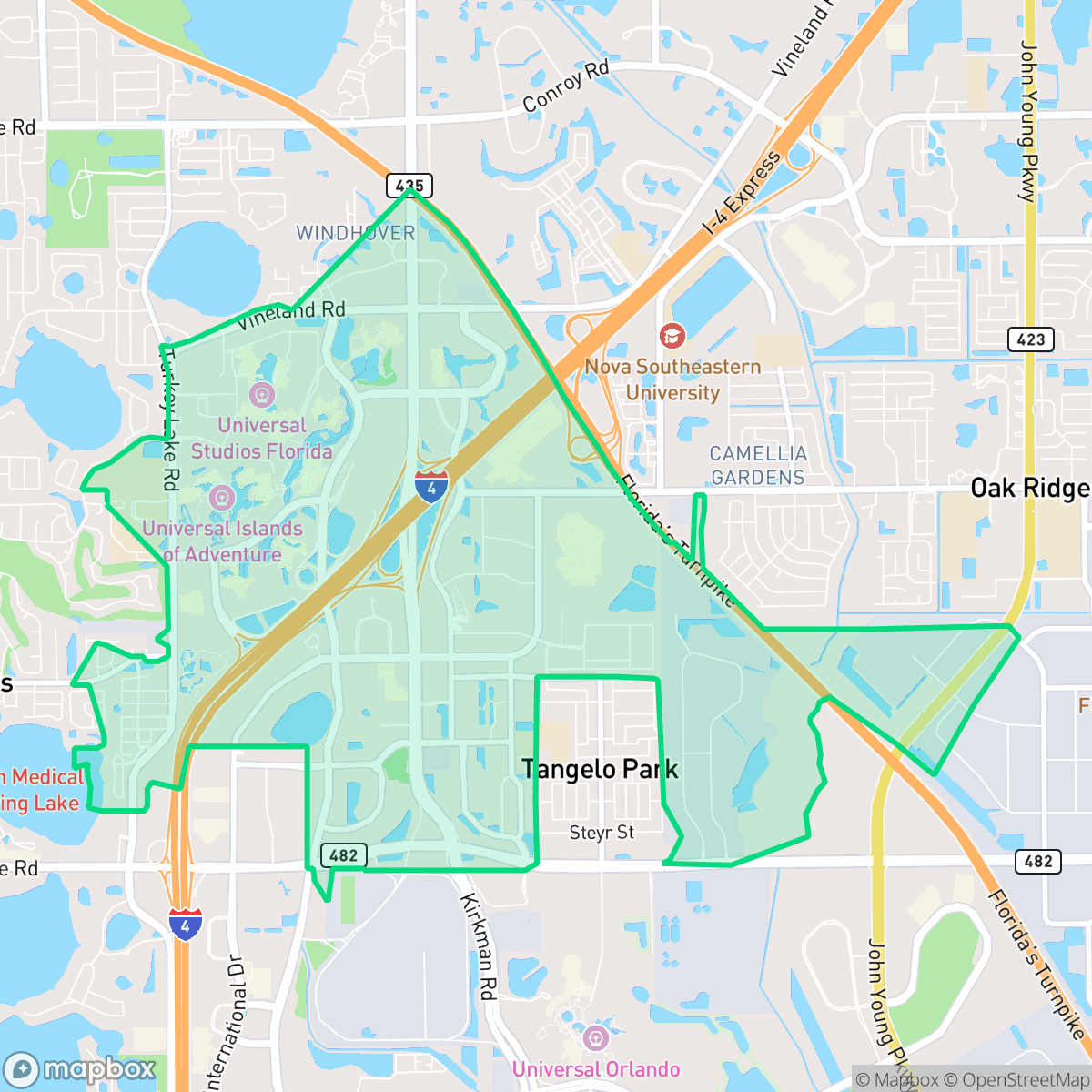
Florida Center is a prominent tourism-oriented district in Orlando, primarily developed in the 1970s following the opening of Walt Disney World in 1971. The area was established as a specific zoning district designed to accommodate the rapid expansion of Orlando's hospitality and entertainment infrastructure along the International Drive corridor. Characterized by its high-density commercial development, the neighborhood serves as the epicenter of the city's tourism industry, featuring a dense concentration of hotels, convention facilities, and major theme park properties, including portions of the Universal Orlando Resort. Its layout reflects a mid-to-late 20th-century urban planning approach focused on visitor accessibility, with International Drive serving as its signature thoroughfare. The area’s historical significance lies in its role as the primary catalyst for transforming Orlando into a global tourism destination.
The neighborhood functions as a bustling urban hub where residential life intersects with the city's primary hospitality corridor. Residents enjoy a visually diverse environment that blends standard housing with more manicured, affluent pockets. The area maintains a balanced demographic profile, attracting a mix of young adults, families, and older individuals who appreciate the constant energy and access to regional entertainment.
Living here involves specific trade-offs, particularly regarding acoustic comfort and pedestrian mobility. While quiet residential streets allow for manageable walking, the arterial roads create fragmented paths that can be difficult to navigate on foot. Potential residents should also note the moderate flood risk and the limited availability of public parks for pets. Although the local school district remains stable with strong institutional support, it is currently navigating complex enrollment shifts and potential facility consolidations.
Neighborhood Scores Across 15 Qualities
Residential structures range from shared-wall apartments to closely spaced houses with minimal buffers. This level of density and proximity to neighbors sits slightly above the Orlando average according to iHuus data.
Walking is manageable on quiet residential streets, but major highways and arterial roads create fragmented paths for pedestrians. According to iHuus data, the overall ease of walking is slightly below the Orlando average due to these large-scale infrastructure barriers.
Residential views feature a mix of standard tract housing and more affluent pockets with manicured landscaping. According to iHuus data, the visual variety in this area is slightly higher than the Orlando average.
Narrow sidewalk verges and a lack of accessible public parks make pet excursions difficult. According to iHuus data, the available greenery consists mostly of private yards or fenced areas rather than the expansive public walking spaces found elsewhere in Orlando.
Residential streets and green spaces are distributed in relatively equal measure, creating a suburban density slightly higher than the Orlando average. According to iHuus data, the landscape features a mix of multi-family housing, commercial corridors, and significant industrial or forest buffers.
Frequent activity from diverse dining, entertainment venues, and transit hubs creates a much more vibrant atmosphere than the city average. While some pockets remain quiet and residential, many areas function as high-energy hubs with significant pedestrian movement and nightlife.
Frequent disturbances from nearby railroad tracks and heavy freeway traffic are common here. This level of acoustic disruption is higher than the average found across Orlando.
Air quality remains mostly clean with rare instances of elevated readings. This level of air purity is notably better than the Orlando city average, according to iHuus data.
Primarily residential and light commercial, this area experiences slightly more industrial-related activity than the Orlando average due to nearby utility substations and logistics hubs. While heavy industry is largely absent, residents near major highways or storage facilities may encounter increased truck traffic and operational noise.
Health insurance accessibility is lower than the Orlando average. According to iHuus data, a significant portion of the resident population lacks coverage.
Political views in this area are split fairly evenly between conservative and liberal leanings. This landscape reflects a more balanced ideological mix than the broader Orlando area, according to iHuus data.
Residents live alongside a balanced mix of young adults, families, and older individuals. According to iHuus data, this demographic variety is slightly higher than the Orlando average.
Flood risk in this area is slightly higher than the Orlando average, though a lack of detailed FEMA studies means precise levels remain undetermined. Residents should remain aware of potential drainage concerns during heavy rain events.
Address-Level Insights for Florida Center


iHuus Neighborhood Intelligence Insights
Get address-level neighborhood insights for Florida Center
- Street-level scores — see how individual blocks compare, not just neighborhood averages
- Micro-zone boundaries — identify quiet pockets, flood boundaries, and walkable clusters before you visit
- 15 dimensions in full — walkability, noise, air quality, school quality, insurance coverage, population age profile, urban/rural index, and more
- Boundary risk alerts — know if your address sits near a block boundary where scores drop, the kind of detail no listing will ever mention
- School insights — individual school ratings and insights, not just district-level data
- Compare before you commit — side-by-side data across neighborhoods, down to block precision
No credit card required
Compare with Any Neighborhood
| Dimension | Florida Center | 33rd St. Industrial |
|---|---|---|
| 🚶 Walkabilityavg 5.62 | ||
| 🔊 Acoustic Comfortavg 3.33 | ||
| 🤫 Privacy Indexavg 4.6 | ||
| 🎨 Visual Appealavg 5.36 | ||
| 🐕 Dog Friendlinessavg 5.01 | ||
| 🗺️ Urban-Rural Indexavg 5.48 | ||
| ✨ Neighborhood Vibeavg 2.98 | ||
| 🏥 Health Insurance Coverageavg 5.11 | ||
| 🌿 Air Qualityavg 5.87 | ||
| 🏭 Industrial Proximityavg 5.75 | ||
| 🌊 Flood Safetyavg 4.98 | ||
| 🗳️ Ideological Leanavg 5.62 | ||
| 👥 Population Age Profileavg 3.78 | ||
| 🔥 Fire Safety | ||
| 🏫 School Quality |
Florida Center Rankings
School Districts Serving Florida Center
School Insights for Florida Center
Below average outcomes; significant attendance and academic challenges.
School Insights
See what's really behind every school rating near Florida Center
- Individual school ratings — each school's own score with outcome context, not just a district average
- Enrollment & class size data — student-to-teacher ratio and how it compares to the state average
- Full demographics breakdown — ethnicity and gender composition for every school in the enrollment zone
- Every school in the district — all schools within the enrollment boundary ranked by rating, not just the closest one
- Grade levels & benchmarks — elementary through high school, with below/above state-average flags
No credit card required