Eagles Nest, Orlando
Updated · 3,120 residents
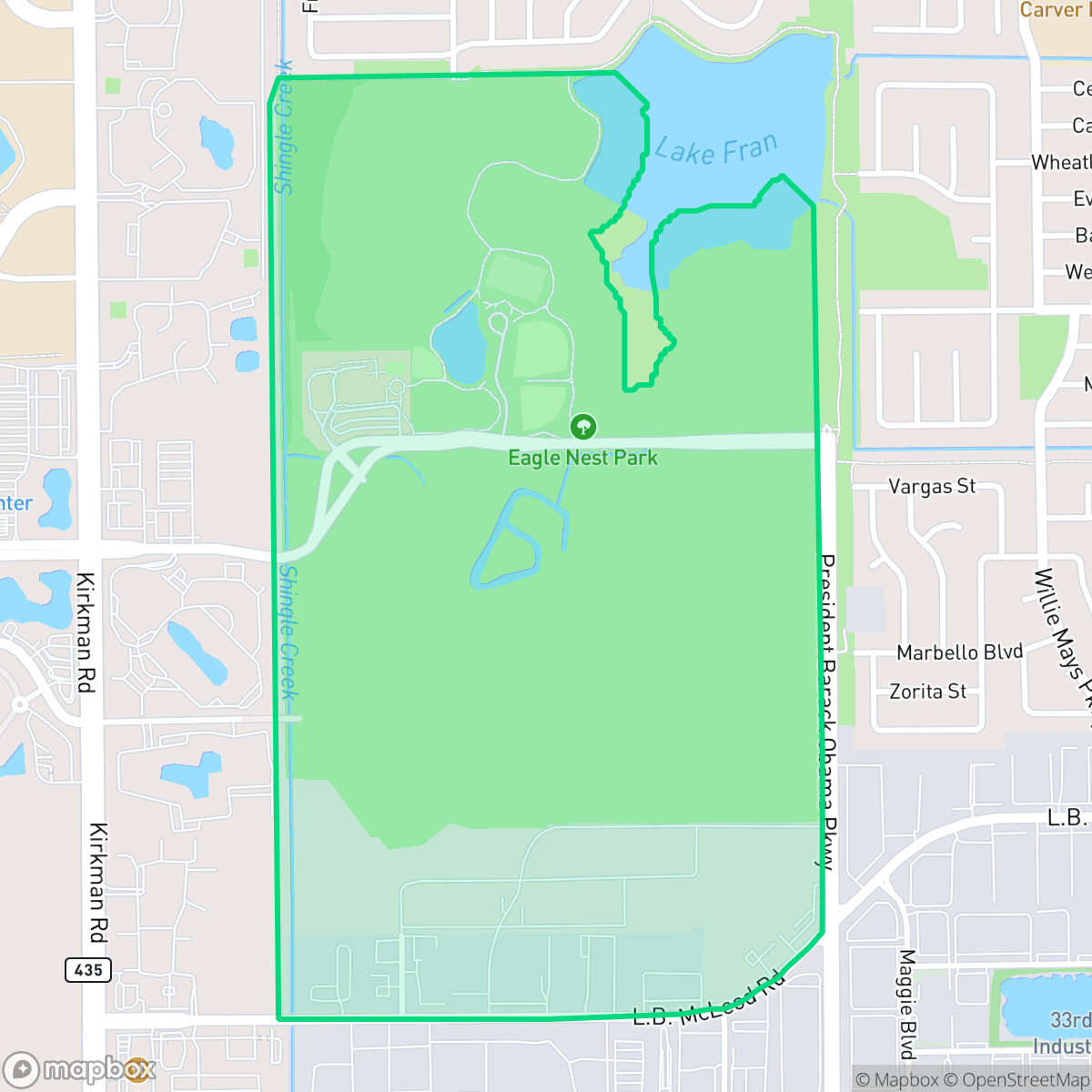
Eagles Nest is a quiet, semi-rural community in Orlando characterized by its abundant greenery, wooded trails, and high walkability. It offers a peaceful residential environment with a strong progressive identity and consistently clean air.
Key Highlights
About Eagles Nest
Eagles Nest functions as a tranquil, semi-rural enclave within the broader Orlando landscape. The area is defined by its extensive network of wooded trails and lakeside paths, which support a highly walkable environment that is particularly well-suited for pet owners. With a landscape featuring significant natural buffers and large residential lots, the neighborhood provides a degree of privacy that is uncommon in more densely populated parts of the city. According to iHuus data, the area maintains a distinct, strongly liberal political profile and a diverse demographic mix of young adults, families, and older residents.
Residents benefit from high air quality and a quiet atmosphere, though the neighborhood lacks major commercial hubs and nightlife. While the area offers a serene living experience, prospective residents should note that health insurance access is lower than the city average. Additionally, the community is served by the Orange County School District, which is currently navigating school consolidation efforts and enrollment shifts alongside its established academic programs.
Neighborhood Scores Across 15 Qualities
Residential privacy is notably higher than the Orlando average due to large lot sizes and significant natural buffers. While some apartment clusters exist, much of the area features substantial separation between buildings and ample green space.
Extensive sidewalk networks and dedicated lakeside paths make pedestrian travel much easier here than in the rest of Orlando. Residents can rely on continuous walkways and safe crossings throughout most residential streets according to iHuus data.
Typical middle-class housing and apartment complexes define the local landscape, offering a visual profile that is roughly consistent with the Orlando average. Residential lots are modest in size and feature standard suburban architecture.
Extensive wooded trails, lakeside paths, and continuous green buffers provide significantly more space for pet exercise than the Orlando average. According to iHuus data, the abundance of connected nature preserves and canal-side routes makes this area highly suitable for dog owners.
Frequent open land and scattered homes amid woodlands provide a much more rural feel than the Orlando average. According to iHuus data, the area features significant preserved greenery and wetlands interspersed with low-density residential pockets.
Daily activity is subdued due to a lack of commercial hubs, though the area remains slightly more active than the Orlando average. Residents will find a calm environment centered around parks and greenery rather than bustling retail or nightlife.
Steady traffic sounds from nearby busy streets are present, though the level of acoustic disturbance remains slightly lower than the Orlando average according to iHuus data.
Air quality remains consistently high with rare instances of elevated readings, notably better than the Orlando average according to iHuus data.
Industrial presence varies across the area, ranging from quiet residential pockets to locations near warehouses and storage facilities. According to iHuus data, this level of commercial and light industrial integration is roughly comparable to the Orlando average.
Health insurance coverage among residents is notably lower than the Orlando average. According to iHuus data, a significant portion of the population lacks employer or private coverage.
Voting patterns and census indicators reveal a highly liberal political leaning, which is significantly more progressive than the average for Orlando. According to iHuus data, this area maintains a distinct ideological profile compared to the rest of the city.
Residents live alongside a balanced distribution of young adults, families, and older individuals. According to iHuus data, this demographic spread is slightly more varied than the average found throughout Orlando.
Flood risk in this area is comparable to the Orlando average, though specific details remain undetermined because FEMA has not completed a full study for this location. Residents should exercise caution as the precise level of vulnerability is currently unverified according to iHuus data.
Address-Level Insights for Eagles Nest


iHuus Neighborhood Intelligence Insights
Get address-level neighborhood insights for Eagles Nest
- Street-level scores — see how individual blocks compare, not just neighborhood averages
- Micro-zone boundaries — identify quiet pockets, flood boundaries, and walkable clusters before you visit
- 15 dimensions in full — walkability, noise, air quality, school quality, insurance coverage, population age profile, urban/rural index, and more
- Boundary risk alerts — know if your address sits near a block boundary where scores drop, the kind of detail no listing will ever mention
- School insights — individual school ratings and insights, not just district-level data
- Compare before you commit — side-by-side data across neighborhoods, down to block precision
No credit card required
Compare with Any Neighborhood
| Dimension | Eagles Nest | 33rd St. Industrial |
|---|---|---|
| 🚶 Walkabilityavg 5.62 | ||
| 🔊 Acoustic Comfortavg 3.33 | ||
| 🤫 Privacy Indexavg 4.6 | ||
| 🎨 Visual Appealavg 5.36 | ||
| 🐕 Dog Friendlinessavg 5.01 | ||
| 🗺️ Urban-Rural Indexavg 5.48 | ||
| ✨ Neighborhood Vibeavg 2.98 | ||
| 🏥 Health Insurance Coverageavg 5.11 | ||
| 🌿 Air Qualityavg 5.87 | ||
| 🏭 Industrial Proximityavg 5.75 | ||
| 🌊 Flood Safetyavg 4.98 | ||
| 🗳️ Ideological Leanavg 5.62 | ||
| 👥 Population Age Profileavg 3.78 | ||
| 🔥 Fire Safety | ||
| 🏫 School Quality |
Eagles Nest Rankings
School Districts Serving Eagles Nest
School Insights for Eagles Nest
Below average outcomes; significant attendance and academic challenges.
School Insights
See what's really behind every school rating near Eagles Nest
- Individual school ratings — each school's own score with outcome context, not just a district average
- Enrollment & class size data — student-to-teacher ratio and how it compares to the state average
- Full demographics breakdown — ethnicity and gender composition for every school in the enrollment zone
- Every school in the district — all schools within the enrollment boundary ranked by rating, not just the closest one
- Grade levels & benchmarks — elementary through high school, with below/above state-average flags
No credit card required