Dover Shores West, Orlando
Updated · 1,766 residents
Dover Shores West is a distinct mid-century community characterized by its tree-lined streets and a polished suburban aesthetic. Residents enjoy a highly walkable environment with easy access to local independent dining and retail hubs, creating a balanced, semi-rural atmosphere within the city.
Key Highlights
About Dover Shores West
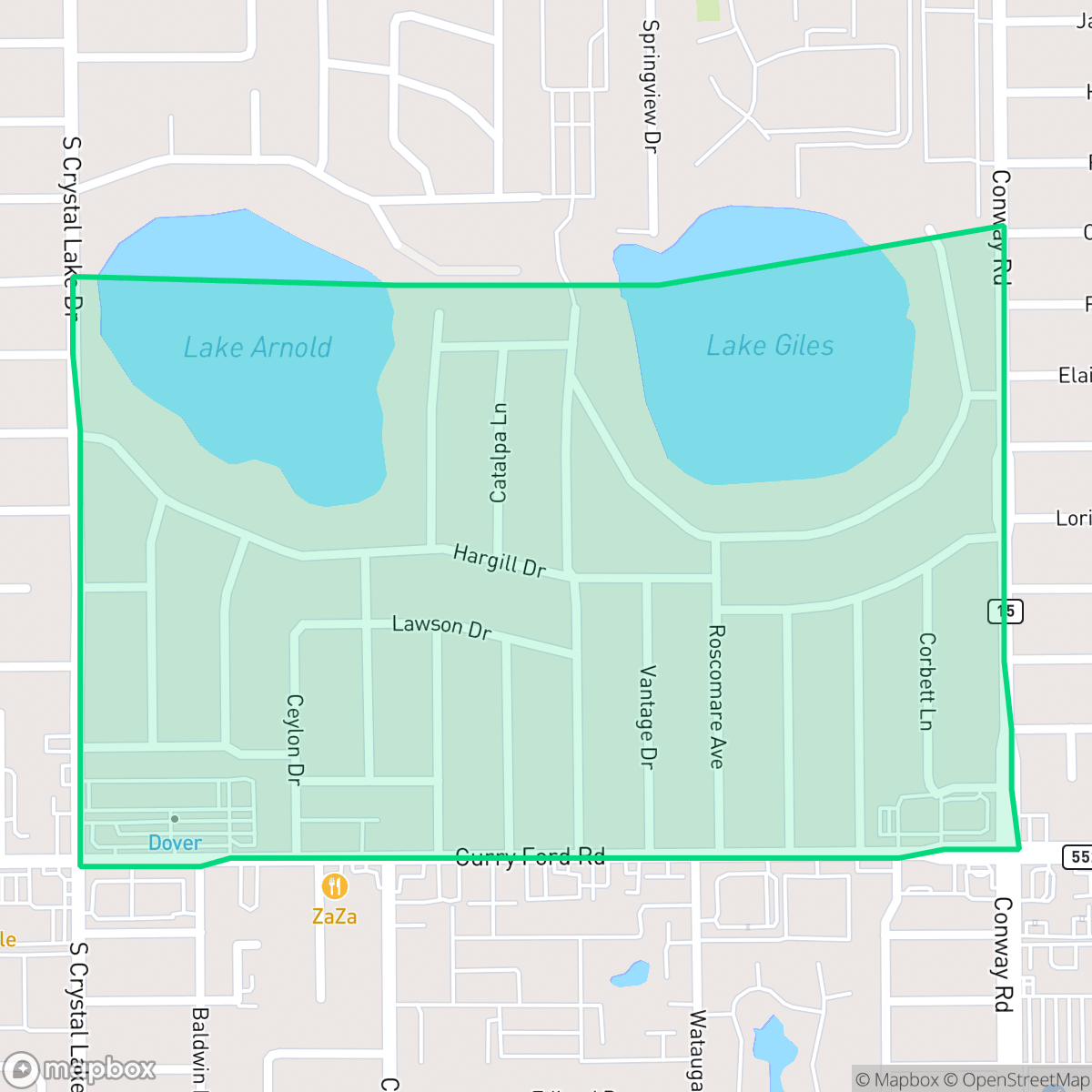
Dover Shores West was developed in the mid-1950s by the Jamerson family, transforming land previously used for cattle ranching into a residential community. The neighborhood is characterized by its mid-century architectural stock, featuring numerous bungalows and mid-century modern homes constructed between 1950 and 1960. A central historical anchor is the Dover Shores Shopping Center, established in 1958, which remains a significant local landmark and hub for long-standing small businesses. Known for its suburban character and proximity to the Curry Ford West district, the neighborhood reflects the post-World War II expansion of Orlando, retaining a distinct mid-century identity defined by its original residential layout and enduring community-focused commercial spaces.
The area offers a blend of manicured lakefront estates and mid-century residential pockets, providing a more spacious and private feel than many other parts of Orlando. With a diverse demographic mix of families, young professionals, and retirees, the community maintains a steady, moderate pace of life. Its highly walkable layout is supported by mature tree canopies that shade pedestrian paths, while the proximity to independent restaurants and wellness services provides a convenient, localized lifestyle. The neighborhood is notably more liberal in its political leanings compared to the wider city average.
While the neighborhood benefits from high levels of health insurance coverage and a low industrial presence, prospective residents should note the consistent hum from nearby traffic. The area remains largely residential with a semi-rural character, though it sits within a 500-year floodplain. Families are served by the Orange County School District, which is currently navigating enrollment shifts and facility consolidations while maintaining strong institutional trust through voter-approved funding for local schools.
Neighborhood Scores Across 15 Qualities
Housing density varies throughout the area, with lakefront properties offering more isolation than the tighter suburban blocks found inland. According to iHuus data, this level of spacing provides more separation between neighbors than is typical for much of Orlando.
Pedestrian access is well-supported by sidewalks and safe crossings at major intersections, making this area significantly more walkable than the Orlando average. Many residential streets feature a mature tree canopy that provides shade for walkers, though it occasionally obscures some paths.
Manicured lakefront properties and large homes with private pools create a visual environment that is notably more polished than the Orlando average. According to iHuus data, the area features well-maintained estates and spacious landscapes.
Wide grassy verges along Lake Conway and residential streets provide accessible walking areas for pets. This level of accessibility for dogs is slightly higher than the Orlando average, according to iHuus data.
Open land and wooded areas are frequently interspersed with residential clusters, providing a more semi-rural character than the typical Orlando urban landscape. According to iHuus data, this density sits above the city average for developed urbanity.
Local dining and wellness services provide a steady rhythm of activity that is more lively than the Orlando average. While some lakeside pockets remain subdued, many parts of the area function as walkable suburban hubs with a variety of independent restaurants and retail shops.
Local traffic from a nearby busy street creates a consistent hum, though this level of activity is slightly higher than the average found across Orlando.
Air quality levels are generally acceptable, though sensitive groups may encounter occasional periods of concern. According to iHuus data, the air quality in this area is slightly better than the Orlando average.
Primarily residential in character, this area features only light commercial activity and lacks significant heavy industry. While some nearby storage facilities and arterial roads introduce occasional freight traffic, the industrial density is notably lower than the Orlando average.
Health insurance access among residents is notably higher than the Orlando average, according to iHuus data.
Political leanings in this area are notably more liberal than the Orlando average, according to iHuus data.
Residents live alongside a balanced mix of young adults, families, and seniors. According to iHuus data, this demographic variety is more diverse than the average age profile found across Orlando.
Residual flood risk exists within this area, though safety levels are notably higher than the Orlando average. According to iHuus data, the neighborhood sits within a 500-year floodplain.
Address-Level Insights for Dover Shores West


iHuus Neighborhood Intelligence Insights
Get address-level neighborhood insights for Dover Shores West
- Street-level scores — see how individual blocks compare, not just neighborhood averages
- Micro-zone boundaries — identify quiet pockets, flood boundaries, and walkable clusters before you visit
- 15 dimensions in full — walkability, noise, air quality, school quality, insurance coverage, population age profile, urban/rural index, and more
- Boundary risk alerts — know if your address sits near a block boundary where scores drop, the kind of detail no listing will ever mention
- School insights — individual school ratings and insights, not just district-level data
- Compare before you commit — side-by-side data across neighborhoods, down to block precision
No credit card required
Compare with Any Neighborhood
| Dimension | Dover Shores West | 33rd St. Industrial |
|---|---|---|
| 🚶 Walkabilityavg 5.62 | ||
| 🔊 Acoustic Comfortavg 3.33 | ||
| 🤫 Privacy Indexavg 4.6 | ||
| 🎨 Visual Appealavg 5.36 | ||
| 🐕 Dog Friendlinessavg 5.01 | ||
| 🗺️ Urban-Rural Indexavg 5.48 | ||
| ✨ Neighborhood Vibeavg 2.98 | ||
| 🏥 Health Insurance Coverageavg 5.11 | ||
| 🌿 Air Qualityavg 5.87 | ||
| 🏭 Industrial Proximityavg 5.75 | ||
| 🌊 Flood Safetyavg 4.98 | ||
| 🗳️ Ideological Leanavg 5.62 | ||
| 👥 Population Age Profileavg 3.78 | ||
| 🔥 Fire Safety | ||
| 🏫 School Quality |
Dover Shores West Rankings
School Districts Serving Dover Shores West
School Insights for Dover Shores West
Below average outcomes; significant attendance and academic challenges.
School Insights
See what's really behind every school rating near Dover Shores West
- Individual school ratings — each school's own score with outcome context, not just a district average
- Enrollment & class size data — student-to-teacher ratio and how it compares to the state average
- Full demographics breakdown — ethnicity and gender composition for every school in the enrollment zone
- Every school in the district — all schools within the enrollment boundary ranked by rating, not just the closest one
- Grade levels & benchmarks — elementary through high school, with below/above state-average flags
No credit card required