Delaney Park, Orlando
Updated · 1,344 residents
Delaney Park is a historic, highly walkable enclave defined by its lush, oak-lined streets and diverse architectural styles. Residents enjoy a peaceful, pet-friendly atmosphere with significant greenery and proximity to the urban core, though the area experiences occasional traffic noise from nearby thoroughfares.
Key Highlights
About Delaney Park
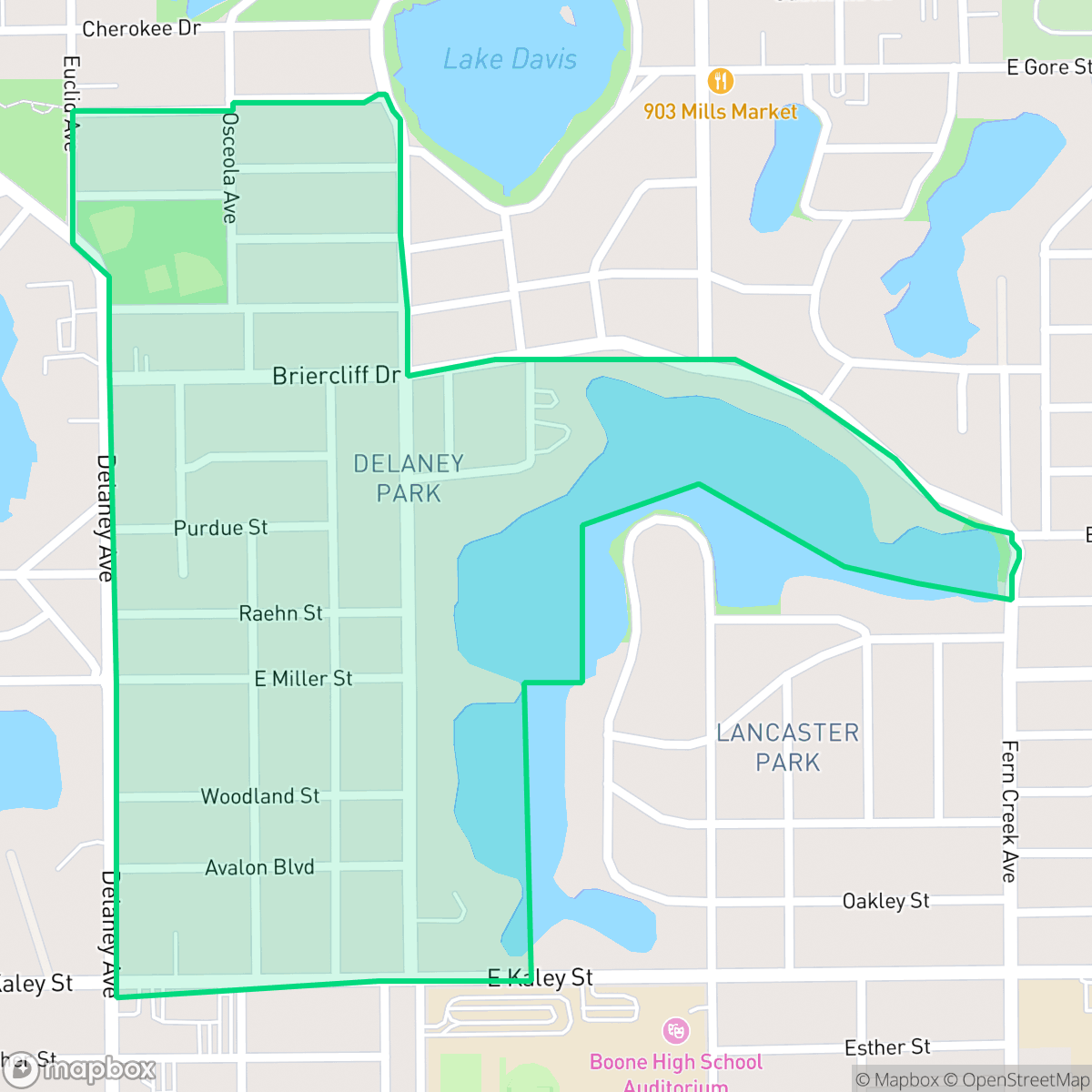
Delaney Park is one of Orlando’s oldest residential neighborhoods, with roots tracing back to the 1870s when pioneer James Delaney acquired 40 acres south of downtown. The neighborhood experienced significant development from the 1920s through the 1940s, resulting in a distinct architectural character defined by Craftsman bungalows, Mediterranean Revival, and Colonial Revival homes. Its signature aesthetic includes mature, oak-lined streets and historic brick roads. Central to the community is the namesake Delaney Park, a 7.25-acre public space originally established as Duckworth Park and renamed in 1959. Known for its preserved historic charm and walkability, the neighborhood serves as a quiet, family-oriented enclave that balances its early 20th-century heritage with proximity to the modern urban core of Orlando.
Delaney Park serves as a tranquil residential hub characterized by its high levels of greenery and a distinct semi-rural feel that persists despite its location near the city center. According to iHuus data, the area attracts a diverse mix of young professionals, families, and long-term residents, all of whom benefit from a landscape marked by custom architecture and extensive tree cover. The neighborhood maintains a strong sense of community, with a notably progressive political leaning and high rates of health insurance coverage among its population. Its layout favors pedestrians, offering a dense grid of streets that makes it one of the most walkable residential areas in the city.
While the neighborhood offers a high quality of life, prospective residents should consider the surrounding environment. The area is purely residential with no nearby industrial sites, but it does experience a steady hum of traffic noise from adjacent busy roads. Families are served by the Orange County School District, which provides stable leadership and institutional trust, though the system is currently managing complex challenges related to enrollment fluctuations and school consolidation. Overall, the area is best suited for those seeking a balance between historic charm, a lush suburban environment, and easy access to the amenities of downtown Orlando.
Neighborhood Scores Across 15 Qualities
Residential lots offer a balanced amount of spacing with tree screening between many neighbors. This level of separation from adjacent properties is higher than the Orlando average according to iHuus data.
Pedestrians benefit from a dense grid of quiet, tree-shaded streets with consistent sidewalks and safe crossings. This area offers significantly higher walkability than the Orlando average, though some larger parking lots are present near main roads.
Manicured landscapes, private pools, and large lakefront estates create a highly aesthetic environment that is significantly more visually appealing than the Orlando average. According to iHuus data, the presence of custom architecture and extensive greenery defines the area's high-end character.
Tree-lined streets and lakeside paths provide much better walking opportunities for pets than the Orlando average. Residents can utilize various grass verges and proximity to small lakes for low-traffic exercise routes.
Frequent open land and high vegetation density provide a more semi-rural feel than the typical Orlando landscape. According to iHuus data, this area features significant lake coverage and established greenery that distinguishes it from the denser city average.
Local amenities and dining options create a noticeably more vibrant atmosphere than the Orlando average. While many areas remain subdued and residential, certain pockets near local parks and landmarks offer high walkability and consistent activity.
Steady traffic hum from nearby busy streets characterizes the area. According to iHuus data, acoustic levels in Delaney Park are notably higher than the Orlando city average.
Air quality in Delaney Park fluctuates between acceptable and unhealthy levels, mirroring the general conditions found across Orlando. Sensitive individuals may experience occasional concern during periods of poor air quality according to iHuus data.
Heavy industry, warehouses, and hazardous sites are absent from this area. This neighborhood maintains a significantly cleaner profile regarding industrial proximity than the Orlando average.
Health insurance enrollment among residents is notably higher than the Orlando average, according to iHuus data.
Political leanings in this area are notably more liberal than the Orlando average. According to iHuus data, the neighborhood maintains a distinct progressive majority with only a small opposing presence.
A diverse range of age groups resides here, offering more demographic variety than the typical Orlando neighborhood. According to iHuus data, this balance includes a stable blend of young professionals, families, and long-term older residents.
Flood risk levels in this area are slightly below the Orlando average due to a lack of detailed FEMA studies. According to iHuus data, there is an undetermined level of potential risk for residents.
Address-Level Insights for Delaney Park


iHuus Neighborhood Intelligence Insights
Get address-level neighborhood insights for Delaney Park
- Street-level scores — see how individual blocks compare, not just neighborhood averages
- Micro-zone boundaries — identify quiet pockets, flood boundaries, and walkable clusters before you visit
- 15 dimensions in full — walkability, noise, air quality, school quality, insurance coverage, population age profile, urban/rural index, and more
- Boundary risk alerts — know if your address sits near a block boundary where scores drop, the kind of detail no listing will ever mention
- School insights — individual school ratings and insights, not just district-level data
- Compare before you commit — side-by-side data across neighborhoods, down to block precision
No credit card required
Compare with Any Neighborhood
| Dimension | Delaney Park | 33rd St. Industrial |
|---|---|---|
| 🚶 Walkabilityavg 5.62 | ||
| 🔊 Acoustic Comfortavg 3.33 | ||
| 🤫 Privacy Indexavg 4.6 | ||
| 🎨 Visual Appealavg 5.36 | ||
| 🐕 Dog Friendlinessavg 5.01 | ||
| 🗺️ Urban-Rural Indexavg 5.48 | ||
| ✨ Neighborhood Vibeavg 2.98 | ||
| 🏥 Health Insurance Coverageavg 5.11 | ||
| 🌿 Air Qualityavg 5.87 | ||
| 🏭 Industrial Proximityavg 5.75 | ||
| 🌊 Flood Safetyavg 4.98 | ||
| 🗳️ Ideological Leanavg 5.62 | ||
| 👥 Population Age Profileavg 3.78 | ||
| 🔥 Fire Safety | ||
| 🏫 School Quality |
Delaney Park Rankings
School Districts Serving Delaney Park
School Insights for Delaney Park
Below average outcomes; significant attendance and academic challenges.
School Insights
See what's really behind every school rating near Delaney Park
- Individual school ratings — each school's own score with outcome context, not just a district average
- Enrollment & class size data — student-to-teacher ratio and how it compares to the state average
- Full demographics breakdown — ethnicity and gender composition for every school in the enrollment zone
- Every school in the district — all schools within the enrollment boundary ranked by rating, not just the closest one
- Grade levels & benchmarks — elementary through high school, with below/above state-average flags
No credit card required