Coytown, Orlando
Updated · 379 residents
Coytown offers a unique blend of semi-rural greenery and urban accessibility, anchored by its proximity to notable recreational trails and parks. Residents enjoy a highly walkable environment with an upscale aesthetic, characterized by spacious properties and well-maintained residential architecture.
Key Highlights
About Coytown
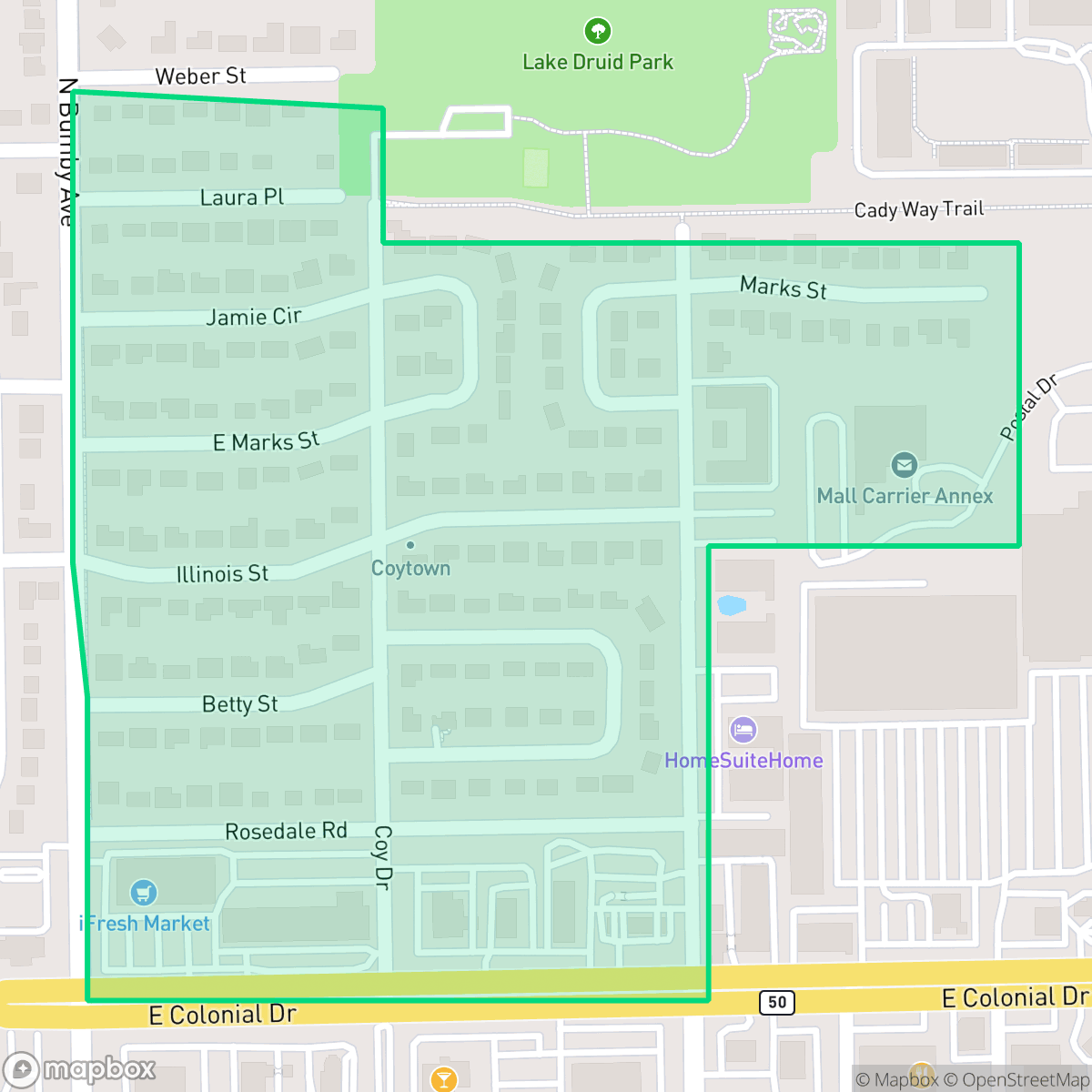
Coytown is a small residential neighborhood in Orlando, Florida, historically situated near the Colonialtown district. The area is defined by its proximity to Lake Druid Park, which features Orlando's first mountain bike park, and the Cady Way Trail. This trail follows the corridor of the former Orlando and Winter Park Railway, locally known as the 'Dinky Line,' which operated from the late 19th century until 1969. While Coytown functions primarily as a quiet residential enclave, its landscape has been shaped by these recreational landmarks and its historical connection to the city's early rail infrastructure. The neighborhood maintains a distinct, modest character, serving as a transitional area between the dense urban core and the suburban developments that expanded across Orlando during the mid-20th century.
The neighborhood serves as a vibrant hub that balances residential tranquility with active community life. It features a diverse demographic mix, ranging from young professionals to families and seniors, all of whom benefit from high levels of health insurance coverage and minimal industrial presence. The visual landscape is defined by substantial homes and private outdoor spaces that provide a more open, spacious feel than many other parts of the city.
While the area is highly walkable, prospective residents should note that steady traffic noise from nearby thoroughfares is a common feature of the local acoustic environment. According to iHuus data, the community maintains a moderate level of flood safety and a strong sense of social cohesion, making it well-suited for those who value connectivity to nature and local amenities alongside a liberal-leaning social atmosphere.
Neighborhood Scores Across 15 Qualities
Residential spacing provides more separation between neighbors than the typical Orlando area, featuring a mix of multi-family clusters and single-family homes with moderate buffering. According to iHuus data, some properties maintain distance through backyard fencing and vegetation.
Sidewalks are well established across residential areas and major shopping centers, offering significantly better connectivity than the Orlando average. While much of the neighborhood features a connected grid, some high-traffic intersections and the southern commercial edge may be more difficult to navigate on foot.
Spacious properties with private pools and large homes characterize much of this area, making the visual landscape notably more attractive than the Orlando average. According to iHuus data, the neighborhood features a mix of substantial residential estates and well-maintained apartment complexes.
Access to lakefront greenspace and wide, grassy verges provide more space for pet exercise than the typical Orlando neighborhood. According to iHuus data, fenced residential yards and nearby public parks make this a favorable area for dog owners.
Open land and scattered homes amid woodland provide a more spacious environment than the typical Orlando urban density. According to iHuus data, this area maintains a higher presence of greenery and undeveloped plots compared to the city average.
High-energy pockets and a diverse selection of dining and wellness services make this area significantly more lively than the Orlando average. While some residential sections remain quiet, many blocks offer high walkability near various cafes and parks according to iHuus data.
Steady traffic sounds from a nearby busy street are common here. This level of acoustic activity is slightly higher than the Orlando average according to iHuus data.
Air quality in this area fluctuates between acceptable and unhealthy levels. According to iHuus data, these conditions are slightly higher than the average for Orlando.
Residential and light commercial uses dominate the area, with significantly fewer industrial hazards than the Orlando average. Residents may encounter occasional traffic or utility odors near gas stations and large retail centers, but heavy industrial activity is absent.
Health insurance accessibility is exceptionally high in this area, significantly outpacing the Orlando city average according to iHuus data.
Voting patterns and census indicators reflect a much more liberal leaning than the Orlando average, according to iHuus data.
Residents live alongside a balanced mix of young professionals, families, and seniors. According to iHuus data, the age distribution in Coytown is more varied than the typical profile found across Orlando.
Residual flood risk exists within this area due to its location in a 500-year floodplain; however, safety levels remain notably higher than the Orlando average according to iHuus data.
Address-Level Insights for Coytown


iHuus Neighborhood Intelligence Insights
Get address-level neighborhood insights for Coytown
- Street-level scores — see how individual blocks compare, not just neighborhood averages
- Micro-zone boundaries — identify quiet pockets, flood boundaries, and walkable clusters before you visit
- 15 dimensions in full — walkability, noise, air quality, school quality, insurance coverage, population age profile, urban/rural index, and more
- Boundary risk alerts — know if your address sits near a block boundary where scores drop, the kind of detail no listing will ever mention
- School insights — individual school ratings and insights, not just district-level data
- Compare before you commit — side-by-side data across neighborhoods, down to block precision
No credit card required
Compare with Any Neighborhood
| Dimension | Coytown | 33rd St. Industrial |
|---|---|---|
| 🚶 Walkabilityavg 5.62 | ||
| 🔊 Acoustic Comfortavg 3.33 | ||
| 🤫 Privacy Indexavg 4.6 | ||
| 🎨 Visual Appealavg 5.36 | ||
| 🐕 Dog Friendlinessavg 5.01 | ||
| 🗺️ Urban-Rural Indexavg 5.48 | ||
| ✨ Neighborhood Vibeavg 2.98 | ||
| 🏥 Health Insurance Coverageavg 5.11 | ||
| 🌿 Air Qualityavg 5.87 | ||
| 🏭 Industrial Proximityavg 5.75 | ||
| 🌊 Flood Safetyavg 4.98 | ||
| 🗳️ Ideological Leanavg 5.62 | ||
| 👥 Population Age Profileavg 3.78 | ||
| 🔥 Fire Safety | ||
| 🏫 School Quality |
Coytown Rankings
School Districts Serving Coytown
School Insights for Coytown
Below average outcomes; significant attendance and academic challenges.
School Insights
See what's really behind every school rating near Coytown
- Individual school ratings — each school's own score with outcome context, not just a district average
- Enrollment & class size data — student-to-teacher ratio and how it compares to the state average
- Full demographics breakdown — ethnicity and gender composition for every school in the enrollment zone
- Every school in the district — all schools within the enrollment boundary ranked by rating, not just the closest one
- Grade levels & benchmarks — elementary through high school, with below/above state-average flags
No credit card required