Conway, Orlando
Updated · 3,758 residents
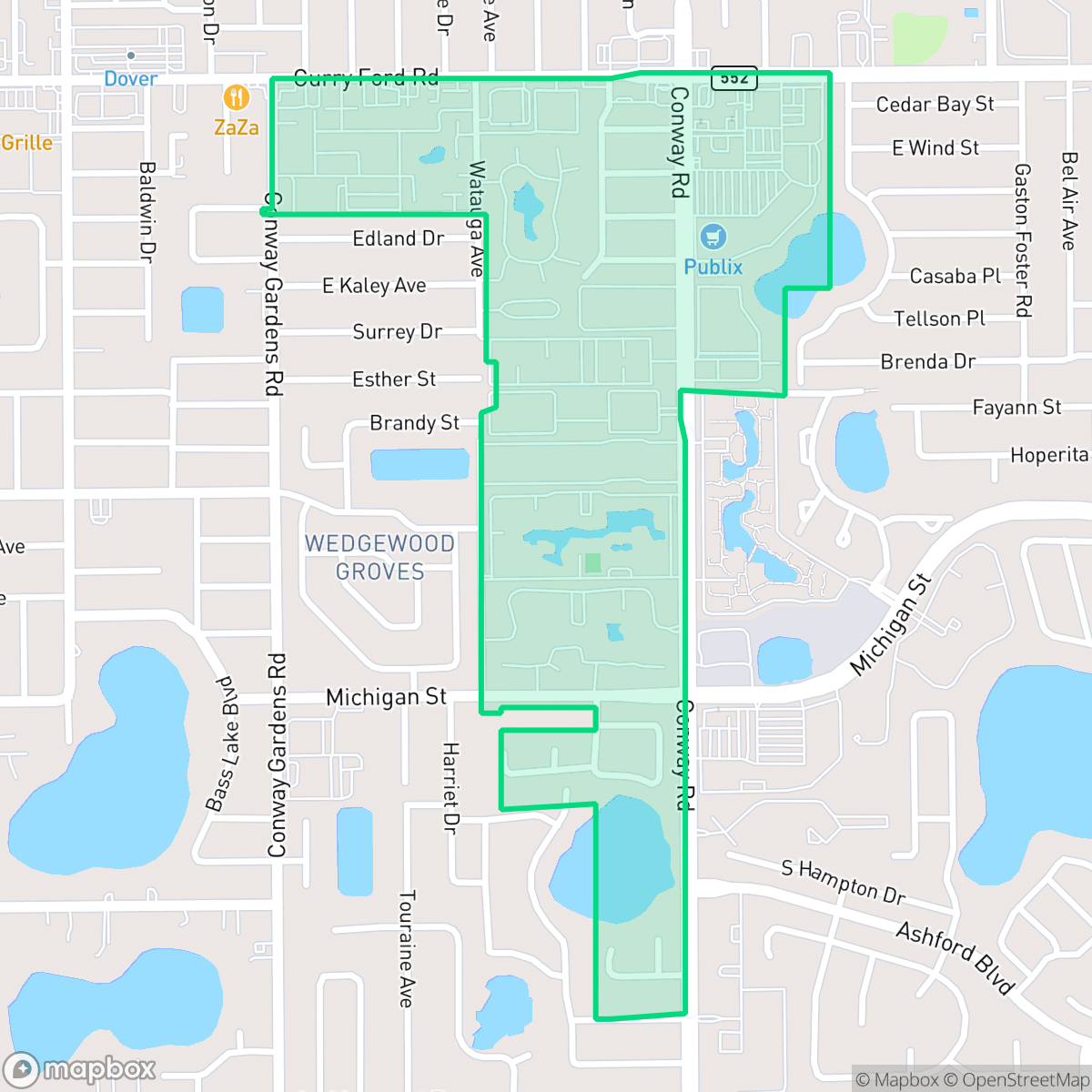
Conway is anchored by the expansive Lake Conway chain of lakes and defined by its polished, upscale suburban character. The neighborhood features high walkability and a vibrant local atmosphere, serving as a distinct residential hub within southeast Orlando.
Key Highlights
About Conway
Conway, an unincorporated community in southeast Orlando, was settled in the 1850s and developed as an organized community by the early 1900s. Its history is defined by the 1880s arrival of an 'English Colony,' a group of settlers who established citrus groves and introduced leisure activities like yachting and polo, with a local polo field once located near the present-day Dover Shores Shopping Center. The area is anchored by the 1,800-acre Lake Conway chain of lakes. Historically significant infrastructure includes the brick Conway Road, one of Orange County's first paved highways, which connected the settlement to downtown Orlando. The neighborhood’s current character was largely shaped by residential expansion from the 1950s through the 1970s, resulting in a distinct mix of mid-century ranch-style homes and lakefront properties.
The area is characterized by a blend of well-maintained mid-century homes and private lakefront properties, creating a polished visual landscape. Residents benefit from a highly walkable environment, with continuous sidewalks and safe intersections that connect local dining, retail, and fitness services. According to iHuus data, the neighborhood serves as an active mixed-use hub where residential life integrates with steady commercial activity, providing a more vibrant social atmosphere than many other parts of Orlando. While the community offers significant appeal, prospective residents should consider that acoustic comfort is affected by steady traffic noise from nearby arterial roads. Air quality levels fluctuate similarly to the broader Orlando region, and the area maintains a semi-rural feel with pockets of undeveloped land. Families are served by the Orange County School District, which provides stable educational leadership despite ongoing enrollment shifts and facility consolidation efforts. The area is well-suited for those who value pedestrian access to local amenities and a diverse demographic environment.
Neighborhood Scores Across 15 Qualities
Residential spacing varies significantly between dense apartment blocks and detached single-family homes. According to iHuus data, this neighborhood offers more separation between neighbors than the typical Orlando area.
Pedestrian infrastructure is well established, featuring continuous sidewalks along residential streets and safe crossings at major intersections. This network is significantly more comprehensive than the typical Orlando average, according to iHuus data.
Manicured residential properties and frequent private backyard pools contribute to a visual landscape that is notably more polished than the Orlando average. According to iHuus data, the area features an affluent suburban feel characterized by large homes and well-maintained amenities.
Continuous sidewalks with wide grass verges and perimeter paths around retention ponds provide ample space for pet exercise. According to iHuus data, these features make the area more dog friendly than much of Orlando.
Frequent open land and scattered homes among woodlands provide a more spacious feel than the Orlando average. Residents will find a mix of suburban density featuring single-family homes and apartment complexes interspersed with undeveloped areas, according to iHuus data.
Highly walkable streets and a diverse array of local dining, fitness, and retail services create a rhythmic social atmosphere that is significantly more vibrant than the Orlando average. According to iHuus data, this area serves as a local hotspot where residential life blends seamlessly with steady commercial activity.
Frequent traffic sounds from nearby busy streets characterize the area. This level of acoustic activity is slightly higher than the average for Orlando.
Air quality in Conway fluctuates between acceptable and unhealthy levels, presenting occasional concerns for sensitive groups. This level of air quality is largely consistent with the average found throughout Orlando.
Minimal heavy industry characterizes this area, making it significantly cleaner than the Orlando average. While most of the neighborhood is residential, residents near arterial roads or storage facilities may experience occasional noise from freight traffic and loading activities.
Health insurance access among residents is notably higher than the Orlando average, according to iHuus data. This indicates a well-covered population with greater access to medical services.
Political leanings in Conway skew more liberal than the Orlando average. According to iHuus data, the area maintains a liberal majority with a modest opposing presence.
A balanced mix of young adults, families, and older residents characterizes the area. According to iHuus data, this demographic variety is more diverse than the typical age distribution found across Orlando.
Residual flood risks exist within the area, though safety levels are notably higher than the Orlando average according to iHuus data.
Address-Level Insights for Conway


iHuus Neighborhood Intelligence Insights
Get address-level neighborhood insights for Conway
- Street-level scores — see how individual blocks compare, not just neighborhood averages
- Micro-zone boundaries — identify quiet pockets, flood boundaries, and walkable clusters before you visit
- 15 dimensions in full — walkability, noise, air quality, school quality, insurance coverage, population age profile, urban/rural index, and more
- Boundary risk alerts — know if your address sits near a block boundary where scores drop, the kind of detail no listing will ever mention
- School insights — individual school ratings and insights, not just district-level data
- Compare before you commit — side-by-side data across neighborhoods, down to block precision
No credit card required
Compare with Any Neighborhood
| Dimension | Conway | 33rd St. Industrial |
|---|---|---|
| 🚶 Walkabilityavg 5.62 | ||
| 🔊 Acoustic Comfortavg 3.33 | ||
| 🤫 Privacy Indexavg 4.6 | ||
| 🎨 Visual Appealavg 5.36 | ||
| 🐕 Dog Friendlinessavg 5.01 | ||
| 🗺️ Urban-Rural Indexavg 5.48 | ||
| ✨ Neighborhood Vibeavg 2.98 | ||
| 🏥 Health Insurance Coverageavg 5.11 | ||
| 🌿 Air Qualityavg 5.87 | ||
| 🏭 Industrial Proximityavg 5.75 | ||
| 🌊 Flood Safetyavg 4.98 | ||
| 🗳️ Ideological Leanavg 5.62 | ||
| 👥 Population Age Profileavg 3.78 | ||
| 🔥 Fire Safety | ||
| 🏫 School Quality |
Conway Rankings
School Districts Serving Conway
School Insights for Conway
Below average outcomes; significant attendance and academic challenges.
School Insights
See what's really behind every school rating near Conway
- Individual school ratings — each school's own score with outcome context, not just a district average
- Enrollment & class size data — student-to-teacher ratio and how it compares to the state average
- Full demographics breakdown — ethnicity and gender composition for every school in the enrollment zone
- Every school in the district — all schools within the enrollment boundary ranked by rating, not just the closest one
- Grade levels & benchmarks — elementary through high school, with below/above state-average flags
No credit card required