City of Orlando-GOAA, Orlando
Updated · 1,240 residents
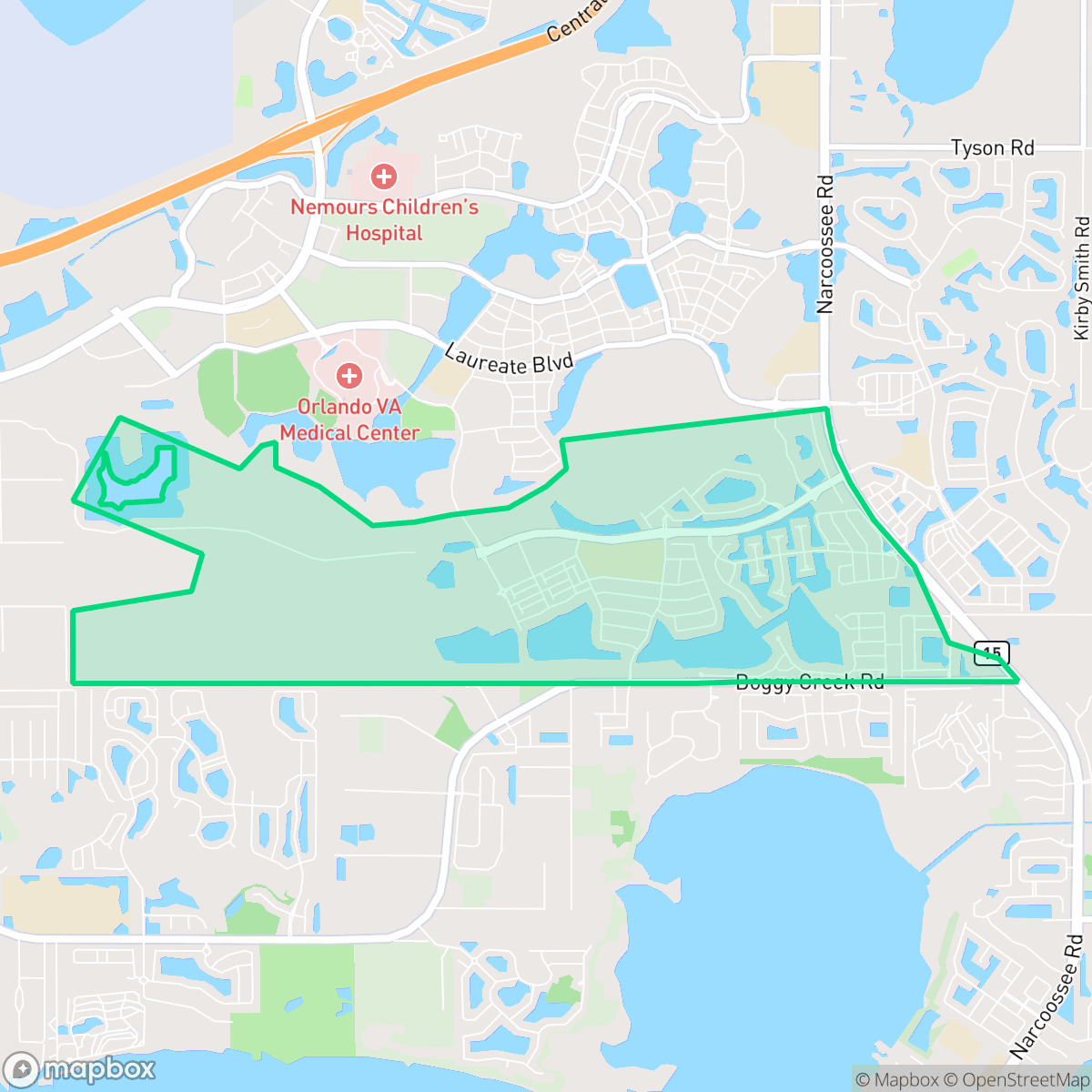
The City of Orlando-GOAA is a tranquil, suburban neighborhood defined by its proximity to international aviation infrastructure and a predominantly young adult demographic. Residents benefit from a quiet residential atmosphere with manageable walkability, though the area offers limited local commercial amenities and pet-friendly spaces.
Key Highlights
About City of Orlando-GOAA
The area now managed by the City of Orlando-GOAA originated as Pinecastle Army Airfield in 1940, later serving as a major Strategic Air Command installation during the Cold War. It was renamed McCoy Air Force Base in 1958 to honor Colonel Michael N.W. McCoy, who died in a 1957 training accident. As a critical military hub, the base housed B-52 Stratofortresses before its closure in 1975. Following a transition to civilian control, the site was redeveloped into the Orlando International Airport. The airport retains the 'MCO' designation as a lasting tribute to the base's military heritage. Today, the property remains a vital aviation-centric industrial and commercial district, evolving from a Cold War military post into a major international gateway for Central Florida.
The area functions as a quiet residential enclave situated within a broader industrial and commercial landscape. It features a suburban layout characterized by uniform housing tracts and managed retention ponds. While the neighborhood maintains a peaceful environment that is noticeably quieter than the city average, it remains functional and basic in its visual appeal. The housing density results in limited privacy between neighbors, as homes are positioned with narrow side yards. This neighborhood is best suited for young adults who prioritize a subdued, low-key living environment over proximity to active retail or dining hubs. Prospective residents should consider that the area has limited pet-friendly infrastructure and that air quality can occasionally fluctuate. While the location provides a stable suburban experience, it is currently navigating the broader educational transitions affecting both Orange and Osceola County school districts. According to iHuus data, health insurance coverage remains moderate, and the community maintains a conservative political inclination.
Neighborhood Scores Across 15 Qualities
Residential structures are positioned in close proximity with narrow side yards, resulting in less privacy than the typical Orlando neighborhood. According to iHuus data, the density of housing placement offers minimal separation between adjacent homes.
Quiet residential streets and modern suburban layouts with continuous sidewalks provide a manageable environment for walking, though overall accessibility is slightly below the Orlando average.
Standard housing with modest yards defines much of the area, which sits below the Orlando city average for visual variety. Some pockets feature more modern homes with complex rooflines and private pools according to iHuus data.
Walking opportunities for dogs are somewhat constrained, as the area lacks the consistent green verges and public park access found in other parts of Orlando. According to iHuus data, while some woodland edges exist, the neighborhood falls below the city average for pet-friendly infrastructure.
Uniform housing tracts and managed retention ponds create a suburban environment that is less dense than the Orlando average. This area provides an even balance between residential streetscapes and managed green spaces.
Minimal commercial activity and very few local destinations create a tranquil atmosphere that is significantly more subdued than the Orlando average. Residents will find a peaceful, low-key environment, though much of the area lacks nearby shops or dining options.
Steady traffic sounds from nearby busy streets are present; however, the acoustic environment remains significantly quieter than the Orlando city average according to iHuus data.
Air quality in this area fluctuates between acceptable and unhealthy levels, presenting occasional concerns for sensitive groups. This level of-air quality is slightly below the Orlando average according to iHuus data.
Light commercial services and small-scale industrial units are interspersed with residential pockets, representing a level of industrial proximity that is roughly consistent with the Orlando average.
Health insurance accessibility in this area is roughly in line with the Orlando city average. According to iHuus data, slightly less than half of the resident population is covered by a health insurance plan.
Political preferences in this area skew more conservative than the Orlando average. According to iHuus data, a conservative majority exists alongside a modest opposing presence.
A significant majority of residents are young adults, representing a younger demographic than the Orlando average. Families and older residents make up a much smaller portion of the population according to iHuus data.
Flood risk in this area is somewhat higher than the Orlando average; however, according to iHuus data, there is currently no detailed federal study available to confirm specific flood levels.
Address-Level Insights for City of Orlando-GOAA


iHuus Neighborhood Intelligence Insights
Get address-level neighborhood insights for City of Orlando-GOAA
- Street-level scores — see how individual blocks compare, not just neighborhood averages
- Micro-zone boundaries — identify quiet pockets, flood boundaries, and walkable clusters before you visit
- 15 dimensions in full — walkability, noise, air quality, school quality, insurance coverage, population age profile, urban/rural index, and more
- Boundary risk alerts — know if your address sits near a block boundary where scores drop, the kind of detail no listing will ever mention
- School insights — individual school ratings and insights, not just district-level data
- Compare before you commit — side-by-side data across neighborhoods, down to block precision
No credit card required
Compare with Any Neighborhood
| Dimension | City of Orlando-GOAA | 33rd St. Industrial |
|---|---|---|
| 🚶 Walkabilityavg 5.62 | ||
| 🔊 Acoustic Comfortavg 3.33 | ||
| 🤫 Privacy Indexavg 4.6 | ||
| 🎨 Visual Appealavg 5.36 | ||
| 🐕 Dog Friendlinessavg 5.01 | ||
| 🗺️ Urban-Rural Indexavg 5.48 | ||
| ✨ Neighborhood Vibeavg 2.98 | ||
| 🏥 Health Insurance Coverageavg 5.11 | ||
| 🌿 Air Qualityavg 5.87 | ||
| 🏭 Industrial Proximityavg 5.75 | ||
| 🌊 Flood Safetyavg 4.98 | ||
| 🗳️ Ideological Leanavg 5.62 | ||
| 👥 Population Age Profileavg 3.78 | ||
| 🔥 Fire Safety | ||
| 🏫 School Quality |
City of Orlando-GOAA Rankings
School Districts Serving City of Orlando-GOAA
School Insights for City of Orlando-GOAA
Below average outcomes; significant attendance and academic challenges.
School Insights
See what's really behind every school rating near City of Orlando-GOAA
- Individual school ratings — each school's own score with outcome context, not just a district average
- Enrollment & class size data — student-to-teacher ratio and how it compares to the state average
- Full demographics breakdown — ethnicity and gender composition for every school in the enrollment zone
- Every school in the district — all schools within the enrollment boundary ranked by rating, not just the closest one
- Grade levels & benchmarks — elementary through high school, with below/above state-average flags
No credit card required