Catalina, Orlando
Updated · 2,494 residents
Catalina is a quiet, lakefront community in Orlando defined by its unique canal system and proximity to Clear Lake. While the area offers a peaceful residential environment, residents should expect higher noise levels due to nearby transportation corridors and limited pedestrian infrastructure.
Key Highlights
About Catalina
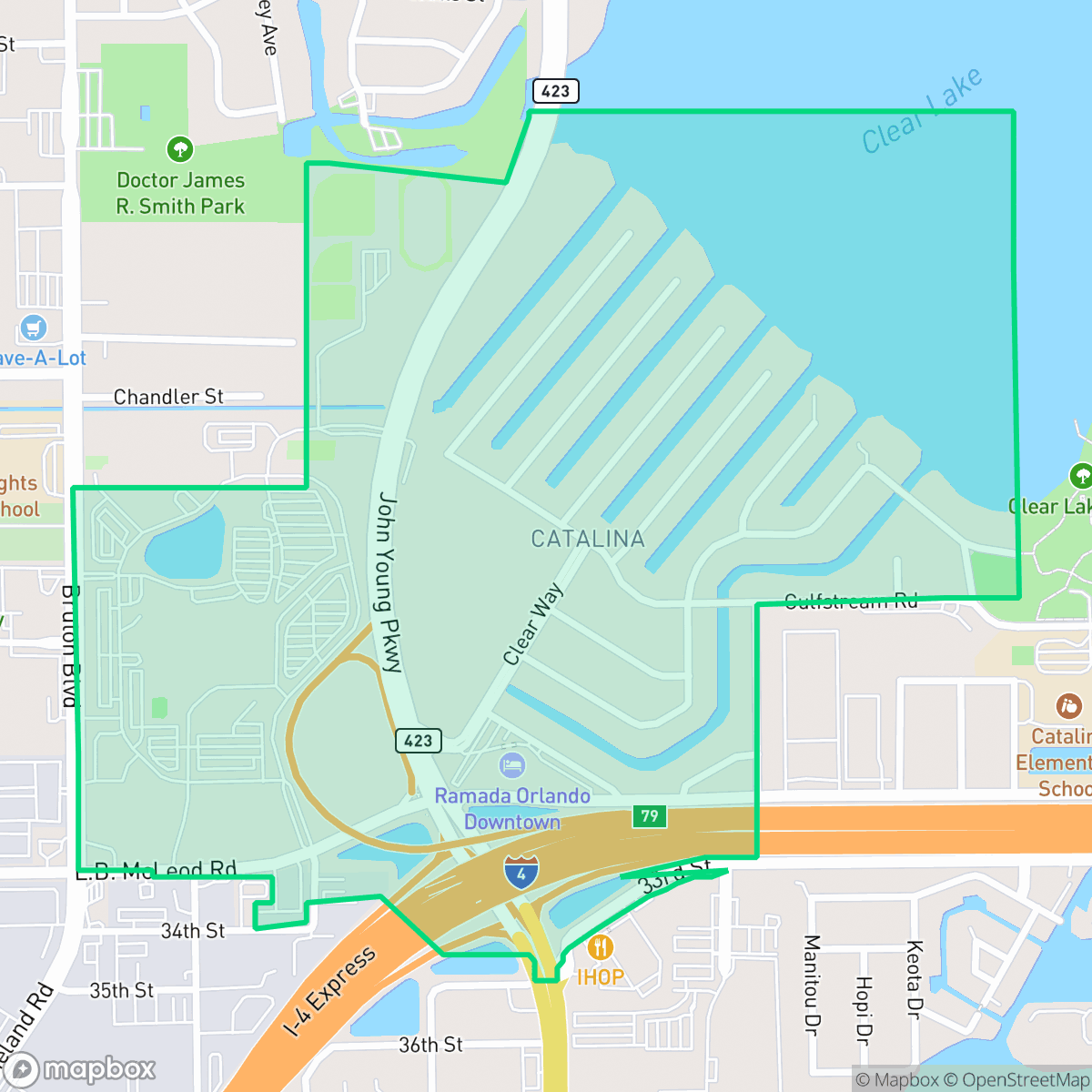
Established in 1957, the Isle of Catalina is a distinct lakefront community situated on the shores of Clear Lake in Orlando. Developed during the 1950s and 1960s, the neighborhood was designed to accommodate the influx of families arriving for the burgeoning space program, Martin Marietta, and the development of Walt Disney World. The community is architecturally notable for its seven canals, which were constructed by the Army Corps of Engineers to emulate the aesthetic of European cities like Venice and Amsterdam. Home to one of the oldest homeowners' associations in the United States, the neighborhood maintains a private lake house and boat launch, emphasizing a lifestyle centered on the natural water features of Clear Lake, which is recognized as one of Orlando's premier fishing destinations.
The area functions as a quiet, residential enclave that maintains a balanced suburban feel. Its visual character is defined by a mix of standard residential tracts and functional commercial zones, with occasional noise from nearby transit paths and highway interchanges. Despite these industrial and transit-related influences, the community retains a distinct identity through its water-centric design, which provides residents with access to local fishing and boating opportunities.
Prospective residents should weigh the appeal of an established, diverse neighborhood against its specific livability trade-offs. While the area offers a moderate level of privacy and a stable demographic mix, it faces challenges regarding pedestrian connectivity and limited green space for pets. The local school district, managed by Orange County Public Schools, provides stable educational leadership, though it is currently navigating operational shifts and facility consolidation. This neighborhood is well-suited for those who prioritize a central location and a quiet, water-adjacent lifestyle over high-density walkability or extensive park access.
Neighborhood Scores Across 15 Qualities
Residential spacing offers a moderate level of separation between neighbors, which is slightly higher than the typical density found across Orlando. While houses generally maintain a consistent buffer, some areas near major roads or industrial zones experience increased visibility.
Low-traffic residential streets and school zones offer safe walking conditions, though high-speed highway interchanges nearby create difficult pedestrian barriers. According to iHuus data, the overall ease of walking is slightly below the Orlando average due to these discontinuous sidewalks.
Visual variety in the area is consistent with the Orlando average, featuring a mix of functional industrial structures and residential tracts. Some sections offer enhanced appeal through waterfront canal access and private pools, according to iHuus data.
Green space for pets is somewhat limited due to an abundance of concrete and asphalt. While some residential areas feature grassy verges and nearby athletic fields, certain sections lack safe access to parks according to iHuus data.
Street layouts and green spaces are distributed almost equally, mirroring the broader Orlando average. The area features a variety of residential, commercial, and waterfront developments according to iHuus data.
Activity levels are slightly below the city average, as much of the area is composed of calm suburban streets with limited commercial density. While some pockets near transit hubs offer dining and hospitality services, many sections remain primarily residential and car-oriented.
Frequent noise from nearby major transportation corridors characterizes this area. According to iHuus data, acoustic comfort in Catalina is lower than the Orlando average due to proximity to heavy traffic and transit paths.
Air quality levels are generally acceptable, though periodic periods of poor air may cause concern for sensitive individuals. This area experiences conditions that are slightly lower than the Orlando city average according to iHuus data.
Primarily residential in nature, this area features slightly more commercial activity than the Orlando average. While heavy industry is absent, residents may notice some transit-related noise and utility odors near local gas stations and southern warehouse zones.
Health insurance access within the neighborhood is slightly above the Orlando average. According to iHuus data, a significant portion of the population remains uninsured.
Political leanings in this area are notably more liberal than the Orlando average. According to iHuus data, the community maintains a liberal majority with a small opposing presence.
Residents live alongside a varied demographic of young adults, families, and seniors. This age distribution is slightly more diverse than the typical profile found in Orlando.
Flood safety levels in this area are slightly below the Orlando average because FEMA has not yet finished a detailed study for this specific location. Residents should remain cautious as the precise risk level remains unverified according to iHuus data.
Address-Level Insights for Catalina


iHuus Neighborhood Intelligence Insights
Get address-level neighborhood insights for Catalina
- Street-level scores — see how individual blocks compare, not just neighborhood averages
- Micro-zone boundaries — identify quiet pockets, flood boundaries, and walkable clusters before you visit
- 15 dimensions in full — walkability, noise, air quality, school quality, insurance coverage, population age profile, urban/rural index, and more
- Boundary risk alerts — know if your address sits near a block boundary where scores drop, the kind of detail no listing will ever mention
- School insights — individual school ratings and insights, not just district-level data
- Compare before you commit — side-by-side data across neighborhoods, down to block precision
No credit card required
Compare with Any Neighborhood
| Dimension | Catalina | 33rd St. Industrial |
|---|---|---|
| 🚶 Walkabilityavg 5.62 | ||
| 🔊 Acoustic Comfortavg 3.33 | ||
| 🤫 Privacy Indexavg 4.6 | ||
| 🎨 Visual Appealavg 5.36 | ||
| 🐕 Dog Friendlinessavg 5.01 | ||
| 🗺️ Urban-Rural Indexavg 5.48 | ||
| ✨ Neighborhood Vibeavg 2.98 | ||
| 🏥 Health Insurance Coverageavg 5.11 | ||
| 🌿 Air Qualityavg 5.87 | ||
| 🏭 Industrial Proximityavg 5.75 | ||
| 🌊 Flood Safetyavg 4.98 | ||
| 🗳️ Ideological Leanavg 5.62 | ||
| 👥 Population Age Profileavg 3.78 | ||
| 🔥 Fire Safety | ||
| 🏫 School Quality |
Catalina Rankings
School Districts Serving Catalina
School Insights for Catalina
Below average outcomes; significant attendance and academic challenges.
School Insights
See what's really behind every school rating near Catalina
- Individual school ratings — each school's own score with outcome context, not just a district average
- Enrollment & class size data — student-to-teacher ratio and how it compares to the state average
- Full demographics breakdown — ethnicity and gender composition for every school in the enrollment zone
- Every school in the district — all schools within the enrollment boundary ranked by rating, not just the closest one
- Grade levels & benchmarks — elementary through high school, with below/above state-average flags
No credit card required