Bel Air, Orlando
Updated · 799 residents
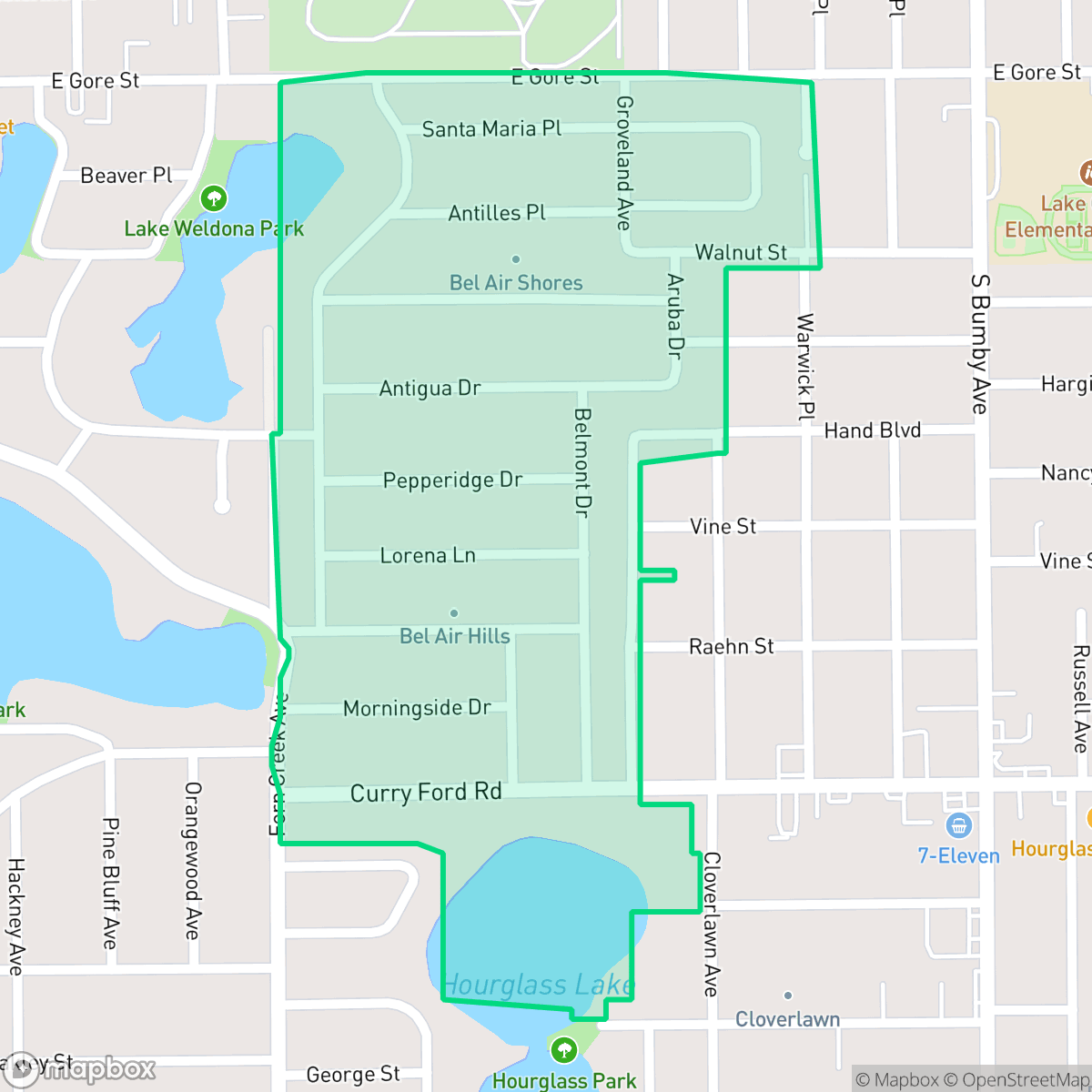
Bel Air is a pedestrian-friendly enclave southeast of downtown Orlando, characterized by its mature tree canopy and established sidewalk networks. The neighborhood maintains a steady, balanced atmosphere with a mix of local cafes and breweries, offering residents a blend of suburban calm and accessible amenities.
Key Highlights
About Bel Air
Developed beginning in 1955, the Bel Air neighborhood in Orlando was carved out of former orange groves. Its early growth was closely tied to its proximity to the Orange Memorial Hospital—now the Orlando Regional Medical Center—which led to a high concentration of physicians residing in the area. This influx of medical professionals earned the community its enduring local nickname, "Pill Hill." Today, the neighborhood is recognized for its collection of Midcentury Ranch-style homes, which characterize its architectural identity. Situated southeast of downtown Orlando, Bel Air remains a notable example of the mid-20th-century residential expansion that shaped the city's suburban landscape.
The area offers a distinct semi-rural aesthetic, defined by significant lake coverage and pockets of woodland that create a visually appealing environment. Residents benefit from a high level of health insurance coverage and a social climate that leans toward liberal perspectives. The community is well-suited for those who value an active lifestyle, as the infrastructure supports consistent walking and exploration through its well-maintained residential streets.
While the neighborhood provides a peaceful setting, it is important to note that steady traffic noise is occasionally present due to nearby thoroughfares. Prospective residents should also be aware that the local school district is currently navigating administrative transitions and potential consolidation efforts. Despite these factors, the area remains a stable choice for families and professionals who prioritize proximity to regional medical facilities and a diverse, balanced demographic profile.
Neighborhood Scores Across 15 Qualities
Housing density is higher than the Orlando average, featuring standard suburban setbacks with private yards and moderate separation between neighboring properties. According to iHuus data, homes are typically positioned within a few dozen meters of one another.
Established sidewalk networks and a mature tree canopy make much of the area easy to navigate on foot. According to iHuus data, these low-traffic residential streets offer significantly better pedestrian accessibility than the Orlando average.
Large homes and manicured lakefront properties provide a highly aesthetic environment that is notably more visually pleasing than the Orlando average. Many residences feature extensive landscaping, private pools, and significant greenery according to iHuus data.
Walking routes for dogs are primarily found along lakeside paths and a central park area, though public green space is somewhat limited. Most greenery in the neighborhood consists of private yards rather than wide public verges, making it slightly better for pet owners than the Orlando average.
Open land and woodland pockets provide a more semi-rural atmosphere than the typical Orlando suburban landscape. This area features a blend of scattered homes and dense residential pockets with significant lake coverage, according to iHuus data.
Local activity levels are notably higher than the Orlando average, offering a balanced mix of residential life and accessible amenities. Residents can find a steady presence of cafes, breweries, and restaurants scattered throughout the suburban landscape.
Steady traffic sounds from a nearby busy street are present, though the area remains significantly quieter than the Orlando average according to iHuus data.
Air quality in this area fluctuates between acceptable and unhealthy levels, presenting occasional concerns for sensitive groups. According to iHuus data, these conditions are roughly in line with the city average.
Residential and institutional uses dominate the area, with very little heavy industry or warehouse activity compared to the Orlando average. Residents may encounter occasional transit traffic or light commercial utility odors near local amenities like the brewery and gas station, according to iHuus data.
Health insurance access among residents is significantly higher than the Orlando average, according to iHuus data.
Political leanings in this area trend significantly more liberal than the Orlando average. This ideological tilt is reflected in the community's social and civic engagement patterns, according to iHuus data.
Residents live alongside a varied demographic of young adults, families, and seniors. This distribution indicates a more balanced age profile than the typical Orlando average, according to iHuus data.
Flood safety levels in this area are roughly comparable to the Orlando average. Because FEMA has not yet finished a detailed flood study for this specific location, residents should exercise caution regarding potential water risks.
Address-Level Insights for Bel Air


iHuus Neighborhood Intelligence Insights
Get address-level neighborhood insights for Bel Air
- Street-level scores — see how individual blocks compare, not just neighborhood averages
- Micro-zone boundaries — identify quiet pockets, flood boundaries, and walkable clusters before you visit
- 15 dimensions in full — walkability, noise, air quality, school quality, insurance coverage, population age profile, urban/rural index, and more
- Boundary risk alerts — know if your address sits near a block boundary where scores drop, the kind of detail no listing will ever mention
- School insights — individual school ratings and insights, not just district-level data
- Compare before you commit — side-by-side data across neighborhoods, down to block precision
No credit card required
Compare with Any Neighborhood
| Dimension | Bel Air | 33rd St. Industrial |
|---|---|---|
| 🚶 Walkabilityavg 5.62 | ||
| 🔊 Acoustic Comfortavg 3.33 | ||
| 🤫 Privacy Indexavg 4.6 | ||
| 🎨 Visual Appealavg 5.36 | ||
| 🐕 Dog Friendlinessavg 5.01 | ||
| 🗺️ Urban-Rural Indexavg 5.48 | ||
| ✨ Neighborhood Vibeavg 2.98 | ||
| 🏥 Health Insurance Coverageavg 5.11 | ||
| 🌿 Air Qualityavg 5.87 | ||
| 🏭 Industrial Proximityavg 5.75 | ||
| 🌊 Flood Safetyavg 4.98 | ||
| 🗳️ Ideological Leanavg 5.62 | ||
| 👥 Population Age Profileavg 3.78 | ||
| 🔥 Fire Safety | ||
| 🏫 School Quality |
Bel Air Rankings
School Districts Serving Bel Air
School Insights for Bel Air
Below average outcomes; significant attendance and academic challenges.
School Insights
See what's really behind every school rating near Bel Air
- Individual school ratings — each school's own score with outcome context, not just a district average
- Enrollment & class size data — student-to-teacher ratio and how it compares to the state average
- Full demographics breakdown — ethnicity and gender composition for every school in the enrollment zone
- Every school in the district — all schools within the enrollment boundary ranked by rating, not just the closest one
- Grade levels & benchmarks — elementary through high school, with below/above state-average flags
No credit card required