Azalea Park, Orlando
Updated · 548 residents
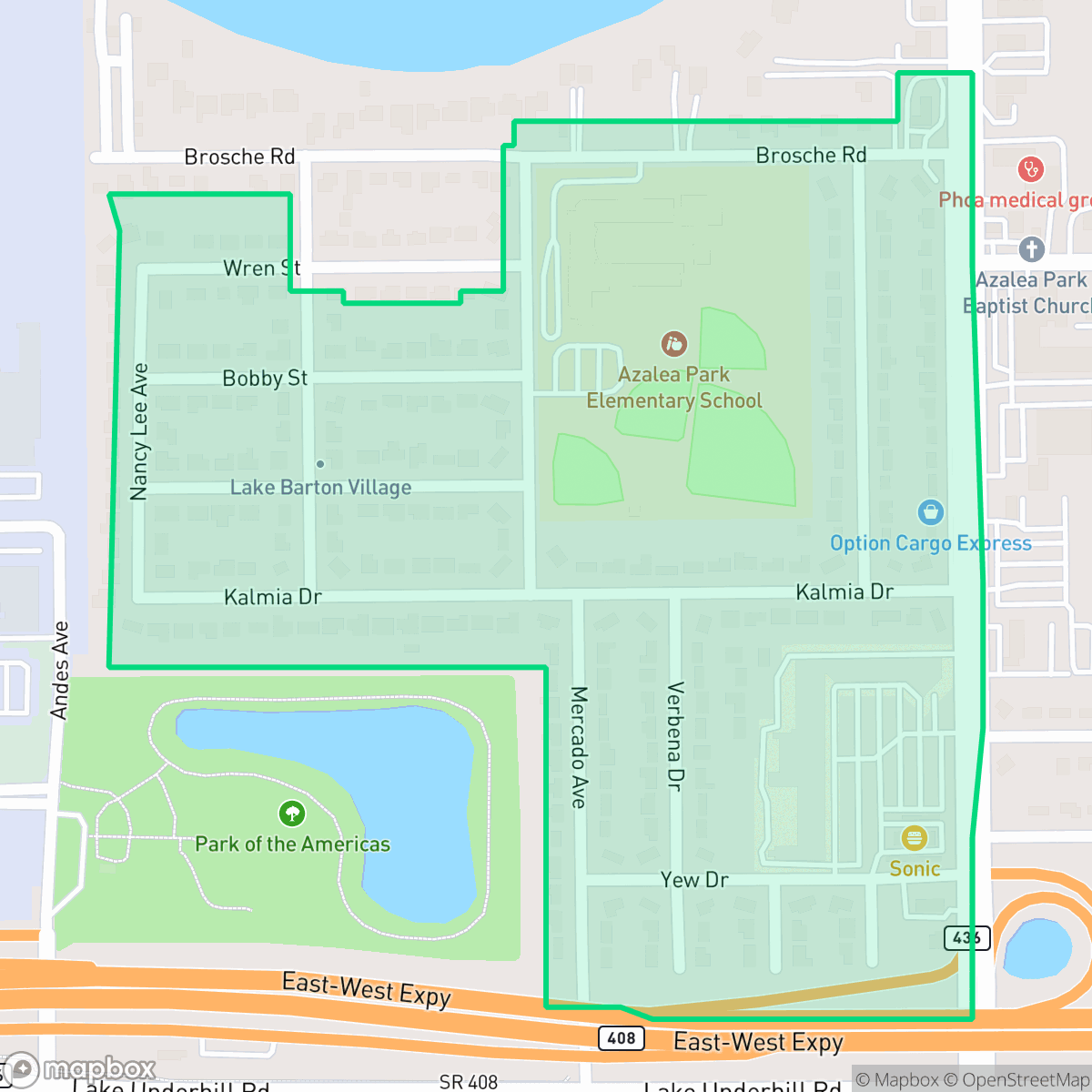
Azalea Park is a mid-century suburban enclave known for its semi-rural atmosphere and accessible pedestrian pathways. While the area offers a diverse community and good walkability, residents should be prepared for significant noise from nearby flight paths.
Key Highlights
About Azalea Park
Azalea Park, a census-designated place in Orange County, was developed in the early 1950s as a major post-World War II suburban project. Conceived by developer Wellborn C. Phillips, Sr., the 1,100-home subdivision was built on the site of a former private airfield and surrounding citrus groves. The neighborhood is characterized by its mid-century suburban layout and modest residential architecture. Historically serving as a bedroom community for Orlando’s growing workforce, it has evolved into a diverse enclave. Today, the area is known for its community-led beautification programs and a growing cultural identity reflected in a diverse local culinary scene. It remains distinct from the downtown Dickson-Azalea Park, serving as a vintage residential community with proximity to the Orlando Executive Airport and regional infrastructure hubs.
The area provides a balanced living environment characterized by a multi-generational population and a blend of suburban housing with pockets of natural scenery. Residents benefit from a higher level of walkability compared to many other parts of Orlando, as main roads feature consistent sidewalks and safe crossings. The community maintains an energetic vibe supported by a variety of local dining and retail options, fostering a distinct identity that distinguishes it from more quiet residential zones.
Prospective residents should consider the trade-offs associated with the location, specifically regarding acoustic comfort. Due to its proximity to the Orlando Executive Airport, the area experiences frequent aircraft noise. Additionally, while the neighborhood offers moderate privacy with small wooded buffers between some properties, it also sits near light industrial sites, which can lead to increased daytime traffic. Standard precautions for flood safety are recommended, and the local school district provides stable, long-term educational infrastructure despite current enrollment adjustments.
Neighborhood Scores Across 15 Qualities
Residential spacing varies throughout the area, with some homes situated close together while others benefit from small wooded buffers. This level of density offers more separation between neighbors than the typical Orlando neighborhood, according to iHuus data.
Main roads feature consistent sidewalks and safe crossings, making this area more walkable than much of Orlando. While residential streets are low-traffic, some interior paths lack dedicated pedestrian infrastructure according to iHuus data.
Typical tract housing and mid-range apartments define the area, featuring tidy but compact yards. This landscape offers more visual variety than much of Orlando.
Walking paths around local school fields and green verges provide ample space for exercise. According to iHuus data, these connected green areas offer a higher level of dog friendliness than the Orlando average.
Frequent open land and scattered homes amid woodlands provide a more semi-rural atmosphere than the typical Orlando urban density. Residents can expect a mix of suburban housing and commercial strips alongside pockets of natural scenery, according to iHuus data.
Local activity levels are notably higher than the Orlando average. Residents benefit from a varied mix of dining, retail, and civic institutions that create a more energetic environment than typical quiet residential areas.
Constant aircraft noise from the nearby airport runway makes this area significantly louder than most other parts of Orlando. According to iHuus data, acoustic comfort is very low due to its immediate proximity to heavy flight paths.
Air quality in Azalea Park fluctuates between acceptable and unhealthy levels, which may cause occasional concern for sensitive groups. This level of air quality is roughly in line with the Orlando average according to iHuus data.
Light industrial and commercial units exist alongside residential areas, making the level of industrial proximity slightly above the Orlando average. Residents may encounter active daytime traffic and service-oriented businesses such as gas stations or printing services near their homes.
Health insurance access among residents is significantly higher than the Orlando average, according to iHuus data.
Political leanings in this area are fairly evenly split between conservative and liberal perspectives. This represents a slightly more balanced ideological landscape than the average found throughout Orlando.
Residents of all ages live here, representing a more balanced distribution of young adults, families, and seniors than is typically seen in the wider Orlando area. According to iHuus data, this variety creates a multi-generational community profile.
Flood risk levels are slightly higher than the Orlando average, though a lack of detailed FEMA studies means the area's precise vulnerability remains undetermined. According to iHuus data, residents should maintain standard precautions for central Florida weather patterns.
Address-Level Insights for Azalea Park


iHuus Neighborhood Intelligence Insights
Get address-level neighborhood insights for Azalea Park
- Street-level scores — see how individual blocks compare, not just neighborhood averages
- Micro-zone boundaries — identify quiet pockets, flood boundaries, and walkable clusters before you visit
- 15 dimensions in full — walkability, noise, air quality, school quality, insurance coverage, population age profile, urban/rural index, and more
- Boundary risk alerts — know if your address sits near a block boundary where scores drop, the kind of detail no listing will ever mention
- School insights — individual school ratings and insights, not just district-level data
- Compare before you commit — side-by-side data across neighborhoods, down to block precision
No credit card required
Compare with Any Neighborhood
| Dimension | Azalea Park | 33rd St. Industrial |
|---|---|---|
| 🚶 Walkabilityavg 5.62 | ||
| 🔊 Acoustic Comfortavg 3.33 | ||
| 🤫 Privacy Indexavg 4.6 | ||
| 🎨 Visual Appealavg 5.36 | ||
| 🐕 Dog Friendlinessavg 5.01 | ||
| 🗺️ Urban-Rural Indexavg 5.48 | ||
| ✨ Neighborhood Vibeavg 2.98 | ||
| 🏥 Health Insurance Coverageavg 5.11 | ||
| 🌿 Air Qualityavg 5.87 | ||
| 🏭 Industrial Proximityavg 5.75 | ||
| 🌊 Flood Safetyavg 4.98 | ||
| 🗳️ Ideological Leanavg 5.62 | ||
| 👥 Population Age Profileavg 3.78 | ||
| 🔥 Fire Safety | ||
| 🏫 School Quality |
Azalea Park Rankings
School Districts Serving Azalea Park
School Insights for Azalea Park
Below average outcomes; significant attendance and academic challenges.
School Insights
See what's really behind every school rating near Azalea Park
- Individual school ratings — each school's own score with outcome context, not just a district average
- Enrollment & class size data — student-to-teacher ratio and how it compares to the state average
- Full demographics breakdown — ethnicity and gender composition for every school in the enrollment zone
- Every school in the district — all schools within the enrollment boundary ranked by rating, not just the closest one
- Grade levels & benchmarks — elementary through high school, with below/above state-average flags
No credit card required