Audubon Park, Orlando
Updated · 2,788 residents
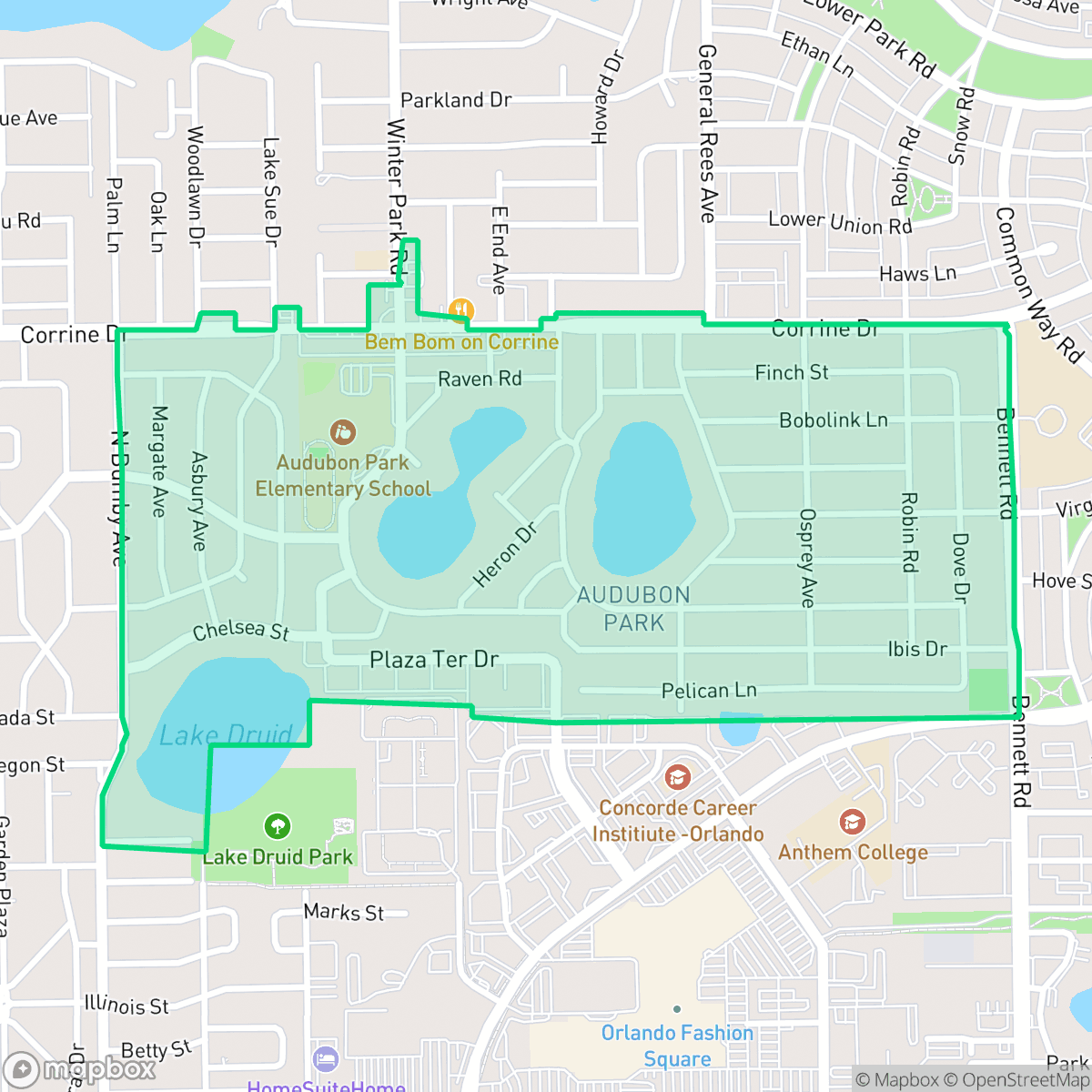
Audubon Park is a highly walkable community defined by its lush tree canopy and distinct mid-century modern architectural character. Centered around the vibrant Corrine Drive corridor, the area offers residents a semi-rural feel with convenient access to local commerce and well-maintained green spaces.
Key Highlights
About Audubon Park
Audubon Park, annexed by Orlando in 1953, was developed in the post-WWII era to house personnel from the nearby Orlando Air Force Base and Naval Training Center. Originally part of the Lakewood Estates, the land was once utilized for military maneuvers, a history famously underscored by the 1954 discovery of unexploded ordnance in local lakes. The neighborhood is defined by its mid-century modern architectural stock, featuring ranch-style homes and bird-themed street names honoring naturalist John James Audubon. Today, the area is anchored by the Corrine Drive corridor, which serves as a vibrant hub for local commerce, including the East End Market. Audubon Park is recognized for its commitment to sustainability, holding the distinction of being Central Florida's first certified Wildlife Habitat Community and the city's first designated EcoDistrict.
The area serves as a central hub for local activity, characterized by its manicured landscapes and a strong sense of community. Residents benefit from high walkability and an extensive network of sidewalks that connect quiet residential streets to active commercial pockets. The neighborhood maintains a distinct aesthetic, featuring large lots and significant tree cover that provides a semi-rural atmosphere despite its proximity to urban amenities.
Prospective residents will find a diverse demographic mix, ranging from young professionals to established families. While the area is generally quiet, some steady street noise from thoroughfares is present. According to iHuus data, the community experiences moderate flood risks, though it remains safer than the city average. With high health insurance coverage and a lack of industrial hazards, the neighborhood is well-suited for those prioritizing a stable and environmentally conscious lifestyle.
Neighborhood Scores Across 15 Qualities
Neighboring distances vary significantly across the area, ranging from closely packed apartment clusters to more spaced single-family homes. This level of residential density provides more personal buffer between neighbors than is typical for Orlando.
Continuous sidewalk networks and safe pedestrian crossings throughout the residential grid make this area significantly more walkable than the Orlando average. Many streets feature low traffic volumes and paved paths connecting to central park spaces, according to iHuus data.
Lush, well-maintained landscapes and large estate homes with private pools characterize this area. According to iHuus data, the visual quality of the neighborhood is significantly higher than the Orlando city average.
Abundant tree canopy, wide grass verges, and accessible lakefront parks provide much better walking conditions for pets than the Orlando average. Large public green spaces and fenced residential yards make this an ideal area for dog owners.
Established residential areas feature heavy tree cover and interspersed lakes, offering a more open landscape than the typical Orlando urban core. According to iHuus data, this mix of single-family homes and woodland provides a more semi-rural feel compared to the city average.
Vibrant pockets of cafes, restaurants, and parks create a much more energetic atmosphere than the typical Orlando average. While some residential streets remain quiet, many areas serve as active community centers with high walkability and diverse amenities.
Steady traffic sounds from nearby thoroughfares are present, though the acoustic environment remains noticeably quieter than much of Orlando. According to iHuus data, this level of sound is typical for an active urban residential area.
Air quality levels in Audubon Park are generally acceptable, though they slightly exceed the Orlando average with occasional days that may pose a concern for sensitive groups. According to iHuus data, residents may experience periodic fluctuations in air purity.
Heavy industrial facilities and manufacturing hazards are absent from this area, providing a significantly cleaner environment than the Orlando average. According to iHuus data, the landscape consists of residential and light commercial uses with no detectable warehouses or hazardous sites.
Health insurance coverage among residents is significantly higher than the Orlando average, according to iHuus data.
Political leanings in this area are notably more liberal than the Orlando average, according to iHuus data. A clear majority of residents align with liberal ideologies, though a modest opposing presence exists within the community.
A varied mix of young professionals, families, and older residents characterizes this area. According to iHuus data, the demographic spread is more balanced than the city average.
Residual flood risks exist within this area because parts of the neighborhood fall within a 500-year floodplain. According to iHuus data, the level of safety from flooding is notably higher than the Orlando city average.
Address-Level Insights for Audubon Park


iHuus Neighborhood Intelligence Insights
Get address-level neighborhood insights for Audubon Park
- Street-level scores — see how individual blocks compare, not just neighborhood averages
- Micro-zone boundaries — identify quiet pockets, flood boundaries, and walkable clusters before you visit
- 15 dimensions in full — walkability, noise, air quality, school quality, insurance coverage, population age profile, urban/rural index, and more
- Boundary risk alerts — know if your address sits near a block boundary where scores drop, the kind of detail no listing will ever mention
- School insights — individual school ratings and insights, not just district-level data
- Compare before you commit — side-by-side data across neighborhoods, down to block precision
No credit card required
Compare with Any Neighborhood
| Dimension | Audubon Park | 33rd St. Industrial |
|---|---|---|
| 🚶 Walkabilityavg 5.62 | ||
| 🔊 Acoustic Comfortavg 3.33 | ||
| 🤫 Privacy Indexavg 4.6 | ||
| 🎨 Visual Appealavg 5.36 | ||
| 🐕 Dog Friendlinessavg 5.01 | ||
| 🗺️ Urban-Rural Indexavg 5.48 | ||
| ✨ Neighborhood Vibeavg 2.98 | ||
| 🏥 Health Insurance Coverageavg 5.11 | ||
| 🌿 Air Qualityavg 5.87 | ||
| 🏭 Industrial Proximityavg 5.75 | ||
| 🌊 Flood Safetyavg 4.98 | ||
| 🗳️ Ideological Leanavg 5.62 | ||
| 👥 Population Age Profileavg 3.78 | ||
| 🔥 Fire Safety | ||
| 🏫 School Quality |
Audubon Park Rankings
School Districts Serving Audubon Park
School Insights for Audubon Park
Below average outcomes; significant attendance and academic challenges.
School Insights
See what's really behind every school rating near Audubon Park
- Individual school ratings — each school's own score with outcome context, not just a district average
- Enrollment & class size data — student-to-teacher ratio and how it compares to the state average
- Full demographics breakdown — ethnicity and gender composition for every school in the enrollment zone
- Every school in the district — all schools within the enrollment boundary ranked by rating, not just the closest one
- Grade levels & benchmarks — elementary through high school, with below/above state-average flags
No credit card required