Airport North, Orlando
Updated · 7,962 residents
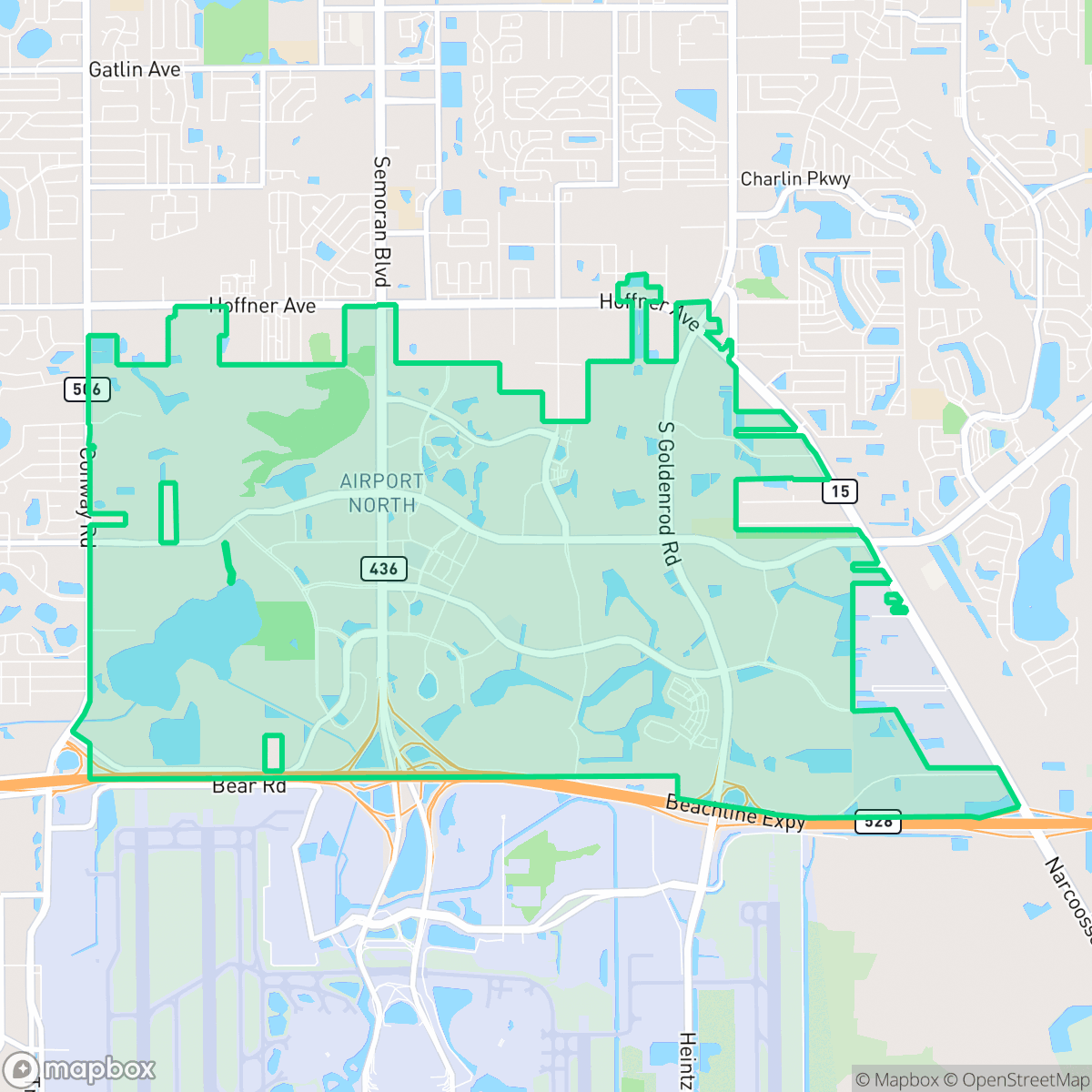
Airport North is a functional suburban neighborhood characterized by a blend of residential pockets and industrial logistics facilities. The area is defined by its proximity to major transit corridors and flight paths, resulting in consistent ambient noise and limited pedestrian infrastructure.
Key Highlights
About Airport North
Airport North serves as a practical, mixed-use environment where residential clusters exist alongside warehouses and logistics hubs. The local landscape is primarily composed of standard tract homes and multi-family complexes, reflecting a suburban density that prioritizes utility over aesthetic variety. According to iHuus data, the area is notably quiet and functional, with a demographic profile that leans toward young adults. Residents navigate an environment shaped by its proximity to major transportation routes and airport operations, which contribute to higher levels of ambient noise compared to the broader Orlando region.
Living in the area involves specific trade-offs, particularly regarding walkability and environmental factors. Pedestrian access is often hindered by a lack of continuous sidewalks and the presence of high-traffic arterial roads. Additionally, residents should be aware of variable air quality and moderate flood risk, as official studies for the area remain incomplete. Families in the neighborhood are served by the Orange County School District, which maintains stable leadership despite ongoing challenges related to student enrollment and facility consolidation across the county.
Neighborhood Scores Across 15 Qualities
Residential spacing varies significantly across the area, ranging from closely clustered multi-unit apartments to detached homes with small yards. This level of privacy is roughly in line with the Orlando average.
Walking is hindered by a lack of sidewalks in many areas, making navigation less convenient than the Orlando average. While some residential pockets and complexes offer connected paths, high-traffic arterial roads present significant safety challenges for pedestrians.
Uniform housing layouts and dense apartment clusters define the local landscape. The visual variety in this area is lower than the Orlando average, as most lots consist of standard tract homes, mobile home parks, and large multi-family complexes.
Walking paths for pets are mostly restricted to residential sidewalks and retention pond buffers. According to iHuus data, the availability of dedicated park space or wide green verges is slightly below the Orlando average.
Residential areas and commercial warehouses exist in roughly equal proportions, reflecting a suburban density that is nearly identical to the Orlando average. According to iHuus data, the landscape features a blend of multi-family housing, industrial zones, and single-family homes.
Activity levels are slightly below the city average, as much of the area consists of subdued residential pockets and semi-rural stretches. While some localized hubs near transit and hospitality offer moderate walkability and dining options, many streets lack significant commercial density or bustling points of interest.
Frequent sounds from nearby flight paths and major transit corridors create an environment significantly noisier than the Orlando average. According to iHuus data, residents can expect consistent auditory disturbances from adjacent roadways and rail activity.
Air quality levels in this area fluctuate between acceptable and unhealthy; according to iHuus data, these conditions are slightly worse than the Orlando average. Sensitive groups may experience occasional concern on certain days.
Logistics activity and heavy freight traffic are more prevalent here than in much of Orlando. Residents may experience intermittent operational noise from nearby warehouses, airport-related loading docks, and storage facilities.
Health insurance coverage among residents is notably lower than the Orlando average. According to iHuus data, a small portion of the population maintains active health coverage.
Political leanings in this area trend more conservative than the Orlando average. According to iHuus data, there is a conservative majority with a modest opposing presence.
Young adults make up the majority of the population here, though there is a small presence of families and older residents. This age profile is slightly lower than the Orlando average, according to iHuus data.
Flood risk in this area is slightly higher than the Orlando average; however, official FEMA studies for this specific zone remain incomplete. According to iHuus data, the lack of a detailed flood study means residents should exercise caution regarding potential drainage issues.
Address-Level Insights for Airport North


iHuus Neighborhood Intelligence Insights
Get address-level neighborhood insights for Airport North
- Street-level scores — see how individual blocks compare, not just neighborhood averages
- Micro-zone boundaries — identify quiet pockets, flood boundaries, and walkable clusters before you visit
- 15 dimensions in full — walkability, noise, air quality, school quality, insurance coverage, population age profile, urban/rural index, and more
- Boundary risk alerts — know if your address sits near a block boundary where scores drop, the kind of detail no listing will ever mention
- School insights — individual school ratings and insights, not just district-level data
- Compare before you commit — side-by-side data across neighborhoods, down to block precision
No credit card required
Compare with Any Neighborhood
| Dimension | Airport North | 33rd St. Industrial |
|---|---|---|
| 🚶 Walkabilityavg 5.62 | ||
| 🔊 Acoustic Comfortavg 3.33 | ||
| 🤫 Privacy Indexavg 4.6 | ||
| 🎨 Visual Appealavg 5.36 | ||
| 🐕 Dog Friendlinessavg 5.01 | ||
| 🗺️ Urban-Rural Indexavg 5.48 | ||
| ✨ Neighborhood Vibeavg 2.98 | ||
| 🏥 Health Insurance Coverageavg 5.11 | ||
| 🌿 Air Qualityavg 5.87 | ||
| 🏭 Industrial Proximityavg 5.75 | ||
| 🌊 Flood Safetyavg 4.98 | ||
| 🗳️ Ideological Leanavg 5.62 | ||
| 👥 Population Age Profileavg 3.78 | ||
| 🔥 Fire Safety | ||
| 🏫 School Quality |
Airport North Rankings
School Districts Serving Airport North
School Insights for Airport North
Below average outcomes; significant attendance and academic challenges.
School Insights
See what's really behind every school rating near Airport North
- Individual school ratings — each school's own score with outcome context, not just a district average
- Enrollment & class size data — student-to-teacher ratio and how it compares to the state average
- Full demographics breakdown — ethnicity and gender composition for every school in the enrollment zone
- Every school in the district — all schools within the enrollment boundary ranked by rating, not just the closest one
- Grade levels & benchmarks — elementary through high school, with below/above state-average flags
No credit card required