Lloyd Estates, Oakland Park
Updated · 1,462 residents
Lloyd Estates is a culturally diverse, mid-century residential enclave known for its quiet streets and strong community ties. While the area offers good walkability and access to local eateries, residents should be aware of high noise levels from nearby transit corridors and a significant flood risk.
Key Highlights
About Lloyd Estates
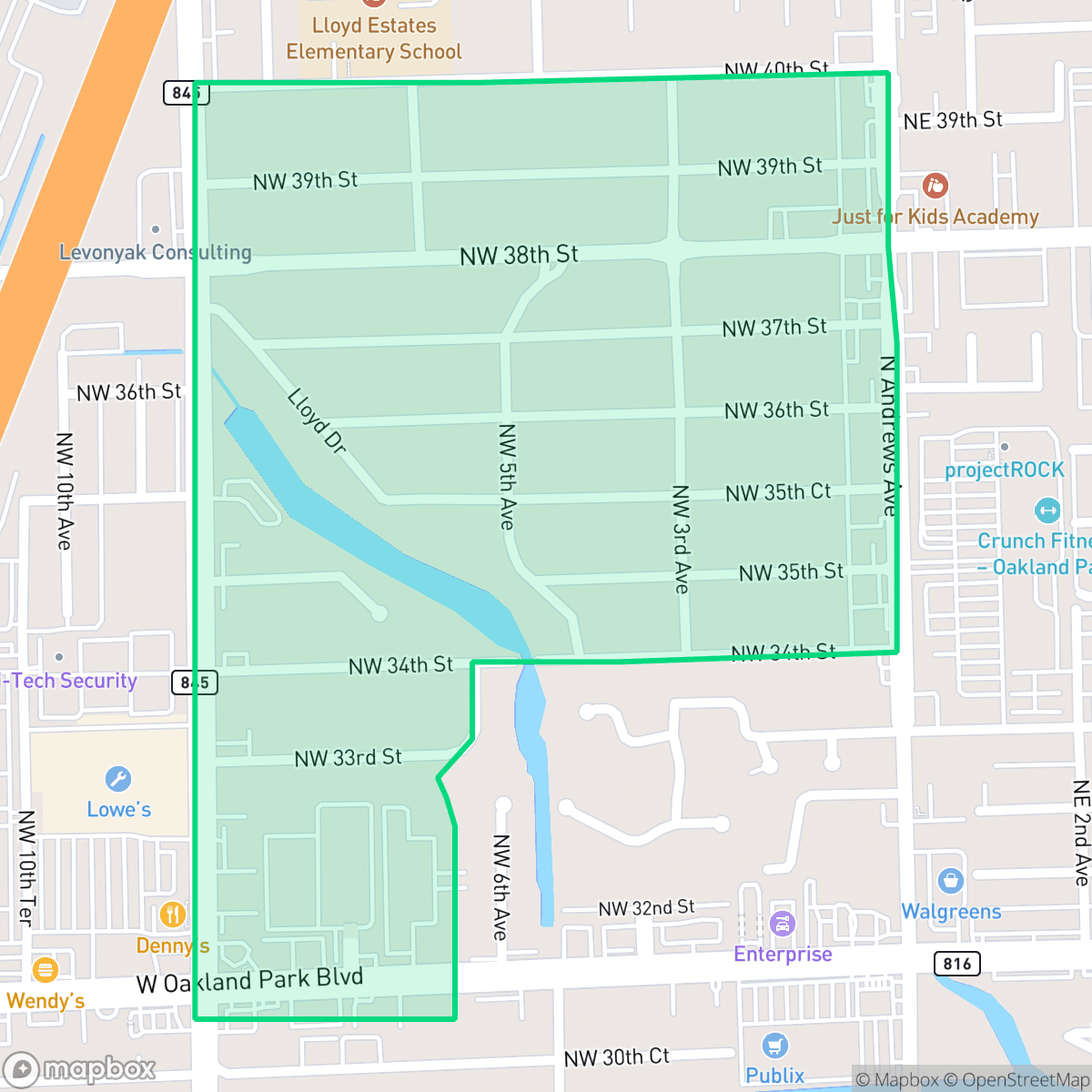
Lloyd Estates is an established residential neighborhood in southwestern Oakland Park, Florida, primarily developed between the 1940s and 1960s. The community is characterized by its mid-century housing stock and a distinct cultural identity, marked by a significant population of residents with Haitian ancestry. Anchored by the local Lloyd Estates Elementary School, the neighborhood is known for its quiet, tree-lined streets and a suburban atmosphere that emphasizes a close-knit, family-oriented lifestyle. While it functions as a tranquil residential enclave, the area maintains strong connectivity to the broader city’s recent growth, including proximity to the downtown Oakland Park Culinary Arts District.
The neighborhood features a dense mix of single-family homes and light industrial blocks, creating a varied suburban landscape. Residents benefit from a diverse age demographic and access to community hubs like the Collins Community Center, which provides a gathering point for local activities. Visually, the area is characterized by a blend of standard tract housing and well-maintained properties with private pools, reflecting the mid-century roots of the community. Living in this area involves balancing certain trade-offs. The high level of transit and flight path activity results in persistent noise, and the location within a designated floodplain necessitates careful consideration of insurance needs. Additionally, while the street grid supports walking, the neighborhood has limited public green space for pets, with most vegetation confined to private yards. Residents also report lower health insurance coverage rates compared to the city average, and the community maintains a strongly liberal political alignment.
Neighborhood Scores Across 15 Qualities
Residential spacing varies between closely positioned homes and multi-family structures, resulting in slightly less privacy than the Oakland Park average. According to iHuus data, frequent shared property lines and narrow side yards are common throughout parts of the neighborhood.
Sidewalks and crosswalks are accessible along much of the grid, making it slightly more walkable than the Oakland Park average. While residential side streets offer quiet paths, heavy traffic near western highways and industrial areas can create barriers for pedestrians.
Residential views vary between well-maintained waterfront properties with private pools and standard suburban tract housing. According to iHuus data, the visual quality of the area aligns with the city average.
Green spaces for walking pets are somewhat restricted, as residential verges are narrow and most greenery is confined to private backyards. While a nearby central park provides some access to fields and tracks, the area offers fewer public recreational options than the Oakland Park average.
Dense suburban development characterizes the area with a blend of single-family homes, apartment complexes, and light industrial blocks. This level of land use is consistent with the average seen across Oakland Park.
A mix of residential and industrial blocks creates a moderately active atmosphere with more dining variety than the Oakland Park average. Residents can access various local eateries and community hubs, such as the Collins Community Center, within a walkable suburban setting.
Persistent noise from nearby transit corridors and flight paths makes this area significantly louder than the Oakland Park average. Residents may experience frequent auditory disturbances due to proximity to major freeways and railroad tracks.
Air quality in Lloyd Estates fluctuates between acceptable and unhealthy levels, mirroring the broader Oakland Park average. Residents with respiratory sensitivities should monitor local conditions during periods of concern.
Light commercial activity and transit traffic are present near certain pockets, though overall industrial presence is slightly higher than the Oakland Park average. Residents should be aware of occasional utility odors or increased vehicle movement near local service stations and printing facilities.
Health insurance coverage among residents is notably lower than the Oakland Park average, according to iHuus data. This indicates a higher proportion of uninsured individuals within the community.
Voting patterns and census indicators show a predominantly liberal leaning, which is more pronounced than the average seen across Oakland Park. According to iHuus data, this area exhibits much stronger liberal political alignment than the city as a whole.
Residents live alongside a balanced mix of young adults, families, and seniors. This demographic distribution is slightly more varied than the average found throughout Oakland Park.
Located within a designated floodplain, this area faces significant flood risks that may necessitate specialized insurance coverage. According to iHuus data, the vulnerability in Lloyd Estates is higher than the Oakland Park average.
Address-Level Insights for Lloyd Estates


iHuus Neighborhood Intelligence Insights
Get address-level neighborhood insights for Lloyd Estates
- Street-level scores — see how individual blocks compare, not just neighborhood averages
- Micro-zone boundaries — identify quiet pockets, flood boundaries, and walkable clusters before you visit
- 15 dimensions in full — walkability, noise, air quality, school quality, insurance coverage, population age profile, urban/rural index, and more
- Boundary risk alerts — know if your address sits near a block boundary where scores drop, the kind of detail no listing will ever mention
- School insights — individual school ratings and insights, not just district-level data
- Compare before you commit — side-by-side data across neighborhoods, down to block precision
No credit card required
Compare with Any Neighborhood
| Dimension | Lloyd Estates | Andrews Gardens |
|---|---|---|
| 🚶 Walkabilityavg 6.86 | ||
| 🔊 Acoustic Comfortavg 3.24 | ||
| 🤫 Privacy Indexavg 5.54 | ||
| 🎨 Visual Appealavg 6.36 | ||
| 🐕 Dog Friendlinessavg 5.18 | ||
| 🗺️ Urban-Rural Indexavg 6.55 | ||
| ✨ Neighborhood Vibeavg 4.88 | ||
| 🏥 Health Insurance Coverageavg 5.61 | ||
| 🌿 Air Qualityavg 6.04 | ||
| 🏭 Industrial Proximityavg 6.08 | ||
| 🌊 Flood Safetyavg 3.7 | ||
| 🗳️ Ideological Leanavg 8.11 | ||
| 👥 Population Age Profileavg 5.13 | ||
| 🔥 Fire Safety | ||
| 🏫 School Quality |
Lloyd Estates Rankings
School Districts Serving Lloyd Estates
School Insights for Lloyd Estates
Below average outcomes; significant attendance and academic challenges.
School Insights
See what's really behind every school rating near Lloyd Estates
- Individual school ratings — each school's own score with outcome context, not just a district average
- Enrollment & class size data — student-to-teacher ratio and how it compares to the state average
- Full demographics breakdown — ethnicity and gender composition for every school in the enrollment zone
- Every school in the district — all schools within the enrollment boundary ranked by rating, not just the closest one
- Grade levels & benchmarks — elementary through high school, with below/above state-average flags
No credit card required