Historic Westside, New Smyrna Beach
Updated · 1,244 residents
The Historic Westside is a quiet, semi-rural community defined by its deep cultural roots and early 20th-century residential character. Residents enjoy clean air and a peaceful atmosphere, though the neighborhood lacks dedicated sidewalks and extensive pet amenities.
Key Highlights
About Historic Westside
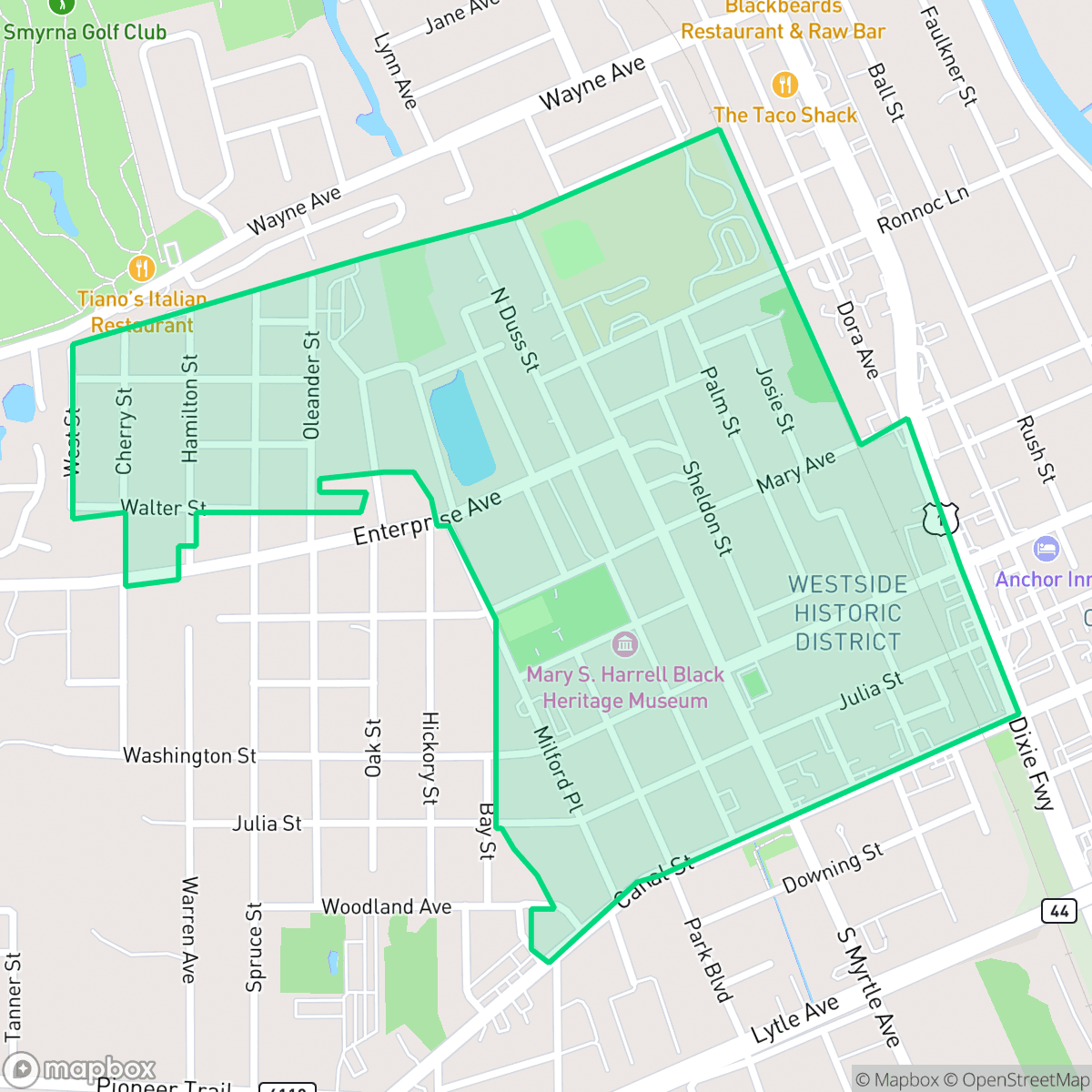
The Historic Westside in New Smyrna Beach is a historically African American neighborhood, with settlement patterns emerging in the 1880s. Roughly bounded by Wayne Avenue, US Highway 1, Canal Street, and the western city limits, the area is characterized by a collection of preserved early 20th-century homes. A central cultural landmark is the Mary S. Harrell Black Heritage Museum, housed in the former St. Rita’s Colored Catholic Mission Church. Built in 1899 and relocated to the neighborhood in 1956, the Carpenter Gothic structure served as a vital community hub for religious, educational, and health services during the segregation era. The neighborhood also features Lydia Pettis Park, dedicated to a prominent local civic leader, reflecting the area's long-standing tradition of community-driven activism and heritage preservation.
The area maintains a distinct, quiet residential atmosphere with a semi-rural feel where homes are interspersed with woodland and open space. It serves as a stable environment for a largely mature population, benefiting from clean air and minimal industrial interference. While the streets are generally peaceful, the lack of sidewalks requires pedestrians to share space with local vehicle traffic, according to iHuus data. The visual landscape is characterized by consistent residential housing and modest yards, contributing to a sense of privacy that is slightly higher than the city average.
Prospective residents should note that while the neighborhood offers reliable health insurance coverage and a conservative community environment, it does not provide extensive public parks or specialized pet facilities. The local school district, Volusia County Schools, currently balances academic progress against significant fiscal constraints and enrollment shifts. This area is well-suited for those prioritizing a settled, community-focused lifestyle over high-density urban conveniences.
Neighborhood Scores Across 15 Qualities
Residential spacing provides a moderate level of separation between neighbors, which is slightly higher than the average for New Smyrna Beach. According to iHuus data, the neighborhood features mixed density with some buffer zones between properties.
Low traffic volumes make for peaceful strolls, although the lack of sidewalks means pedestrians must share the road with vehicles. This level of walkability sits slightly above the New Smyrna Beach average according to iHuus data.
Visual scenery consists of conventional tract housing with modest yards and consistent rooflines. This level of visual variety is typical for the New Smyrna Beach area.
Access to public parks and wide green verges for walking pets is below the New Smyrna Beach average. According to iHuus data, residents may find fewer immediate outdoor spaces for dogs compared to other parts of the city.
Open land and woodland areas are common throughout this neighborhood, offering a setting very similar to the wider New Smyrna Beach area. Scattered homes sit among fields according to iHuus data.
Activity levels fluctuate between quiet residential streets and bustling suburban hubs containing diverse dining and cultural sites. This neighborhood offers a more active rhythm of services and social interest than the New Smyrna Beach average, according to iHuus data.
Steady hums from nearby busy streets are common in this area. According to iHuus data, acoustic comfort levels are higher than the New Smyrna Beach average.
Air remains mostly clean with rare instances of elevated readings, performing significantly better than the New Smyrna Beach average according to iHuus data.
Minimal industrial presence defines this area, which lacks heavy manufacturing and remains more residential than the New Smyrna Beach average. Occasional light commercial uses such as a gas station or printing service may introduce minor transit traffic.
Health insurance accessibility in this area is higher than the New Smyrna Beach average, according to iHuus data.
Conservative voters form the majority in this area, representing a more right-leaning political leaning than the New Smyrna Beach average.
Older adults represent the majority of residents in this area, reflecting a demographic that is notably older than the New Smyrna Beach average. According to iHuus data, there is only a modest presence of younger residents within the neighborhood.
Flood safety levels in this area are comparable to the New Smyrna Beach average, though specific risks remain undetermined because FEMA has not yet completed a detailed flood study for this location.
Address-Level Insights for Historic Westside


iHuus Neighborhood Intelligence Insights
Get address-level neighborhood insights for Historic Westside
- Street-level scores — see how individual blocks compare, not just neighborhood averages
- Micro-zone boundaries — identify quiet pockets, flood boundaries, and walkable clusters before you visit
- 15 dimensions in full — walkability, noise, air quality, school quality, insurance coverage, population age profile, urban/rural index, and more
- Boundary risk alerts — know if your address sits near a block boundary where scores drop, the kind of detail no listing will ever mention
- School insights — individual school ratings and insights, not just district-level data
- Compare before you commit — side-by-side data across neighborhoods, down to block precision
No credit card required
Compare with Any Neighborhood
| Dimension | Historic Westside | Airport Industrial |
|---|---|---|
| 🚶 Walkabilityavg 5.43 | ||
| 🔊 Acoustic Comfortavg 3.35 | ||
| 🤫 Privacy Indexavg 5.21 | ||
| 🎨 Visual Appealavg 5.97 | ||
| 🐕 Dog Friendlinessavg 5.86 | ||
| 🗺️ Urban-Rural Indexavg 6.69 | ||
| ✨ Neighborhood Vibeavg 1.9 | ||
| 🏥 Health Insurance Coverageavg 5.86 | ||
| 🌿 Air Qualityavg 6.51 | ||
| 🏭 Industrial Proximityavg 6.97 | ||
| 🌊 Flood Safetyavg 4.47 | ||
| 🗳️ Ideological Leanavg 1.41 | ||
| 👥 Population Age Profileavg 5.01 | ||
| 🔥 Fire Safety | ||
| 🏫 School Quality |
Historic Westside Rankings
School Districts Serving Historic Westside
School Insights for Historic Westside
Below average outcomes; significant attendance and academic challenges.
School Insights
See what's really behind every school rating near Historic Westside
- Individual school ratings — each school's own score with outcome context, not just a district average
- Enrollment & class size data — student-to-teacher ratio and how it compares to the state average
- Full demographics breakdown — ethnicity and gender composition for every school in the enrollment zone
- Every school in the district — all schools within the enrollment boundary ranked by rating, not just the closest one
- Grade levels & benchmarks — elementary through high school, with below/above state-average flags
No credit card required