Canal Downtown, New Smyrna Beach
Updated · 440 residents
Canal Downtown serves as a vibrant cultural and commercial hub, offering a blend of historic charm and active suburban amenities. While the area provides a moderately walkable environment with upscale visual appeal, residents should anticipate higher noise levels due to nearby transportation infrastructure.
Key Highlights
About Canal Downtown
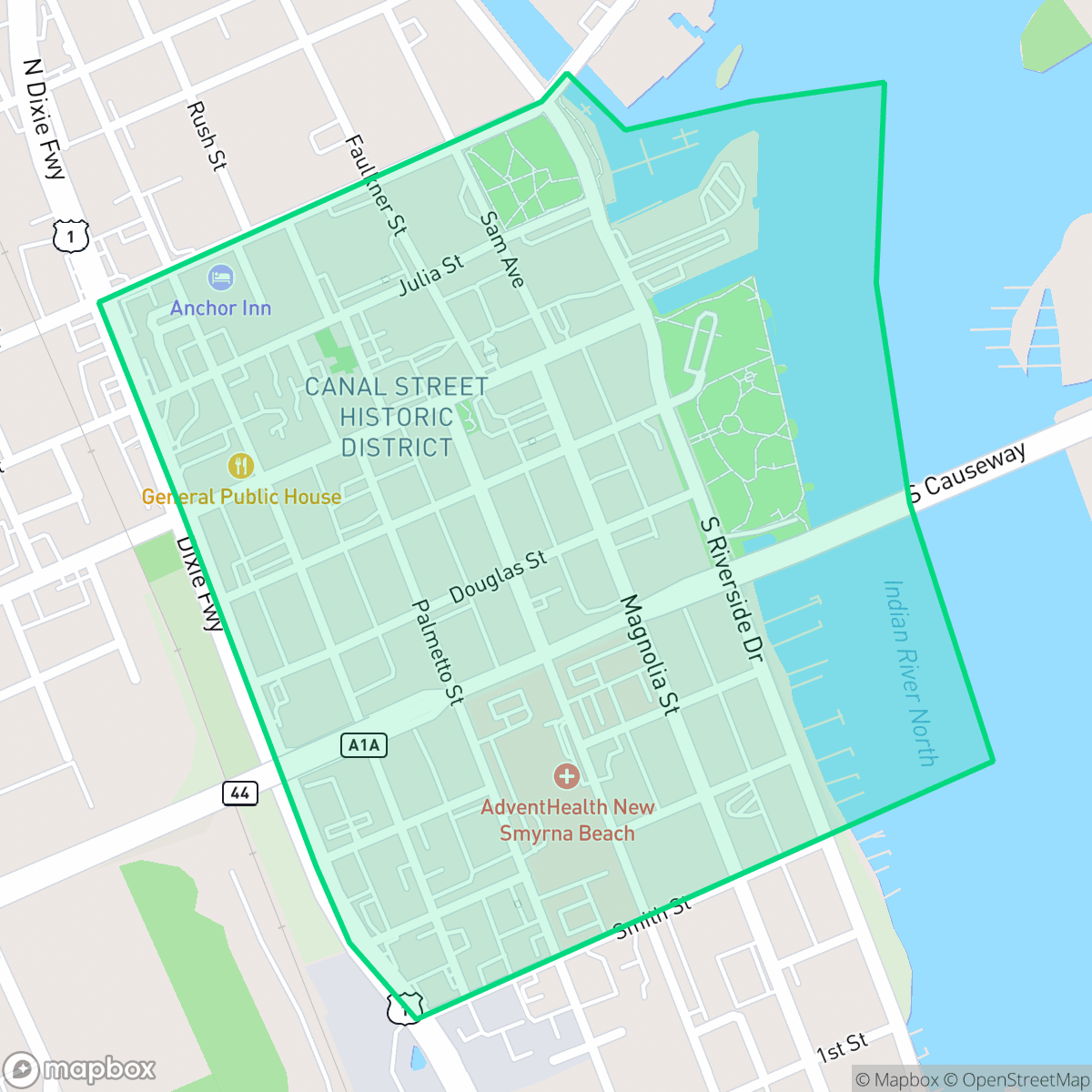
The Canal Street Historic District, the heart of downtown New Smyrna Beach, traces its origins to the 1768 settlement by Dr. Andrew Turnbull. The area is named for the hand-dug canals once used to transport sugar and indigo. Listed on the National Registry of Historic Places, the district features a collection of wood-frame and masonry buildings constructed between 1885 and 1935. Historically the city's primary commercial center, it remains a cultural hub today, anchored by landmarks like the New Smyrna Beach Museum of History and the long-standing Little Drug Company. The neighborhood’s character is defined by its pedestrian-friendly, tree-lined streets and a vibrant arts scene, including galleries like The Hub on Canal, which continue the area's legacy as a focal point for community life and local commerce.
The neighborhood stands out as a focal point for community life, blending its deep-rooted heritage with modern dining and retail options. It maintains a semi-rural character that feels less dense than other parts of the city, characterized by well-maintained properties and a polished landscape. The demographic profile is notably diverse, attracting a mix of young adults, families, and seniors who appreciate the active social scene and proximity to local civic institutions.
Prospective residents should consider the trade-offs of living in such a central location. While the area is more walkable than much of the city, it experiences persistent noise from surrounding transit paths. Additionally, pet owners may find limited outdoor green space for exercise, and those concerned with environmental factors should note that flood risk levels remain a variable to monitor. The local school district offers strong academic programs at flagship campuses, though it continues to navigate broader fiscal and enrollment adjustments.
Neighborhood Scores Across 15 Qualities
Moderate building density provides a reasonable buffer between neighbors, offering more personal space than the typical New Smyrna Beach residential area. According to iHuus data, the spacing between properties is mixed but generally offers more seclusion than the city average.
Pedestrian access is supported by sidewalks on one side of the street and safe crossings. This level of walkability is higher than the average for New Smyrna Beach, according to iHuus data.
Large residential properties and frequent upscale amenities create a more polished landscape than the New Smyrna Beach average. Satellite imagery analyzed by iHuus shows spacious driveways and well-maintained surroundings throughout the area.
Opportunities for pet exercise are restricted due to a lack of nearby public parks and wide green spaces. According to iHuus data, the availability of dog-friendly infrastructure is below the New Smyrna Beach average.
Scattered homes situated among woodland and open fields provide a semi-rural feel that is slightly less dense than the New Smyrna Beach average, according to iHuus data.
Bustling streets and a diverse selection of dining, retail, and civic institutions provide significantly more activity than the New Smyrna Beach average. This area serves as a local focal point where residents can access various services and cultural landmarks within a moderately walkable environment.
Persistent acoustic disturbances from nearby transportation infrastructure are common in this area. Residents may experience significantly more noise than the average New Smyrna Beach neighborhood due to proximity to heavy traffic or transit paths, according to iHuus data.
Air quality remains consistently high with infrequent instances of pollution, performing significantly better than the New Smyrna Beach average according to iHuus data.
Residential life blends with light commercial uses like breweries and gyms, though no heavy industry exists in this area. This level of industrial proximity is consistent with the average for New Smyrna Beach.
Health insurance enrollment in Canal Downtown is consistent with the city average. According to iHuus data, a moderate portion of the local population maintains active coverage.
Political leanings in this area skew more conservative than the New Smyrna Beach average, featuring a clear majority with a small opposing presence according to iHuus data.
Residents experience a balanced demographic spread of young adults, families, and seniors. This age distribution is more varied than the average found across New Smyrna Beach, according to iHuus data.
Flood risk in this area is higher than the New Smyrna Beach average, though official FEMA studies for this specific zone remain incomplete. Residents should exercise caution as flood levels are currently undetermined by federal authorities.
Address-Level Insights for Canal Downtown


iHuus Neighborhood Intelligence Insights
Get address-level neighborhood insights for Canal Downtown
- Street-level scores — see how individual blocks compare, not just neighborhood averages
- Micro-zone boundaries — identify quiet pockets, flood boundaries, and walkable clusters before you visit
- 15 dimensions in full — walkability, noise, air quality, school quality, insurance coverage, population age profile, urban/rural index, and more
- Boundary risk alerts — know if your address sits near a block boundary where scores drop, the kind of detail no listing will ever mention
- School insights — individual school ratings and insights, not just district-level data
- Compare before you commit — side-by-side data across neighborhoods, down to block precision
No credit card required
Compare with Any Neighborhood
| Dimension | Canal Downtown | Airport Industrial |
|---|---|---|
| 🚶 Walkabilityavg 5.43 | ||
| 🔊 Acoustic Comfortavg 3.35 | ||
| 🤫 Privacy Indexavg 5.21 | ||
| 🎨 Visual Appealavg 5.97 | ||
| 🐕 Dog Friendlinessavg 5.86 | ||
| 🗺️ Urban-Rural Indexavg 6.69 | ||
| ✨ Neighborhood Vibeavg 1.9 | ||
| 🏥 Health Insurance Coverageavg 5.86 | ||
| 🌿 Air Qualityavg 6.51 | ||
| 🏭 Industrial Proximityavg 6.97 | ||
| 🌊 Flood Safetyavg 4.47 | ||
| 🗳️ Ideological Leanavg 1.41 | ||
| 👥 Population Age Profileavg 5.01 | ||
| 🔥 Fire Safety | ||
| 🏫 School Quality |
Canal Downtown Rankings
School Districts Serving Canal Downtown
School Insights for Canal Downtown
Below average outcomes; significant attendance and academic challenges.
School Insights
See what's really behind every school rating near Canal Downtown
- Individual school ratings — each school's own score with outcome context, not just a district average
- Enrollment & class size data — student-to-teacher ratio and how it compares to the state average
- Full demographics breakdown — ethnicity and gender composition for every school in the enrollment zone
- Every school in the district — all schools within the enrollment boundary ranked by rating, not just the closest one
- Grade levels & benchmarks — elementary through high school, with below/above state-average flags
No credit card required