Airport Industrial, New Smyrna Beach
Updated · 359 residents
The Airport Industrial area balances its functional roots as an aviation hub with a quiet, semi-rural residential landscape. Residents enjoy upscale visual appeal and spacious surroundings, though the neighborhood experiences frequent noise from nearby flight paths and transit corridors.
Key Highlights
About Airport Industrial
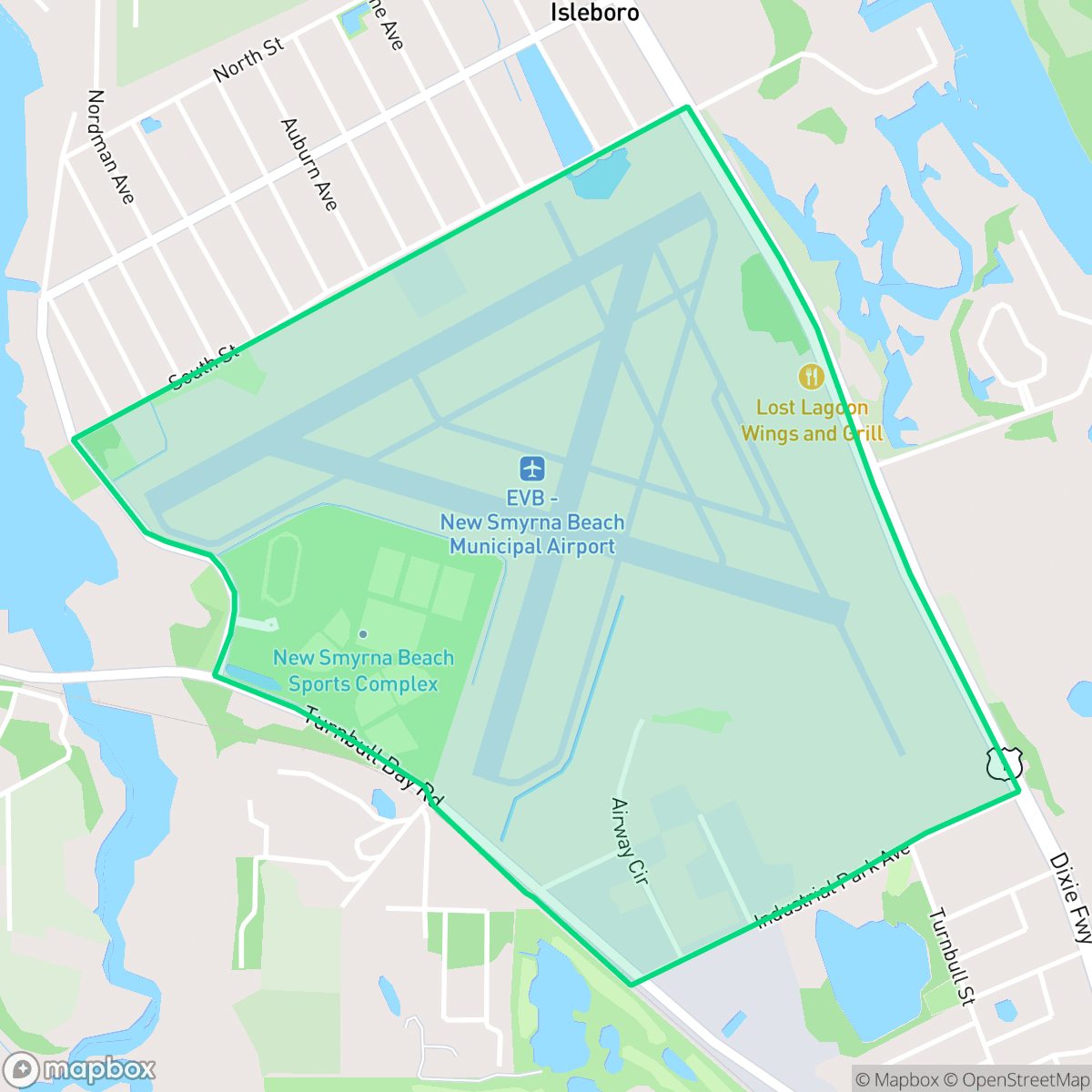
The Airport Industrial area of New Smyrna Beach is defined by its origins as a World War II military facility. Originally a grass strip within an orange grove, the site was acquired by the U.S. Navy in 1942 and developed into a military airfield to support wartime operations. Following the war, the property was transferred to the City of New Smyrna Beach in 1947, transitioning into the New Smyrna Beach Municipal Airport. Today, the district functions as a key economic hub, housing aviation-related services, light manufacturing, and high-tech industries. Bounded by South Street, U.S. Highway 1, and the Florida East Coast Railway, the area serves as a primary center for aviation support and industrial development, distinguishing its functional, utilitarian character from the city's historic residential and coastal districts.
This neighborhood serves as a unique transition zone where light manufacturing and aviation services meet scattered residential pockets. The area maintains a semi-rural character defined by open landscapes and woodlands, which provides a sense of seclusion that is uncommon in more developed parts of the city. While the presence of the municipal airport creates a utilitarian backdrop, the physical environment features high-quality residential architecture and a visual landscape that feels more upscale than many surrounding districts.
Potential residents should consider the trade-offs associated with this location. While the streets are generally quiet with low traffic volumes, the lack of sidewalks limits traditional walkability. Acoustic comfort is notably impacted by the proximity to flight paths and heavy transit routes. The area is best suited for those who prioritize privacy and a semi-rural atmosphere over proximity to urban amenities, and who are comfortable with the periodic noise levels inherent to an active aviation-adjacent district.
Neighborhood Scores Across 15 Qualities
Residential spacing provides a moderate level of seclusion with some buffer between neighbors. This degree of separation is slightly higher than the average found throughout New Smyrna Beach.
Low traffic volumes make streets pleasant for a stroll, though the lack of sidewalks makes this area slightly less walkable than the New Smyrna Beach average according to iHuus data.
Large homes and frequent upscale amenities provide a more pleasant visual landscape than the New Smyrna Beach average, according to iHuus data.
Accessible green spaces and wide paths provide more opportunities for pet owners compared to the New Smyrna Beach average. According to iHuus data, these areas remain largely separated from heavy traffic.
Open landscapes and scattered residential pockets define this area, which feels more rural than the New Smyrna Beach average. According to iHuus data, frequent woodlands and fields replace dense urban development here.
Minimal commercial activity and a lack of local landmarks define this area, which offers less vibrancy than the New Smyrna Beach average. According to iHuus data, the landscape is primarily semi-rural or suburban with very few nearby amenities or restaurants.
Frequent disturbances from nearby flight paths and heavy transit corridors characterize this area. According to iHuus data, acoustic comfort in this neighborhood is slightly below the New Smyrna Beach average.
Air quality remains mostly clean with rare instances of elevated readings. This level of air purity is higher than the New Smyrna Beach average, according to iHuus data.
Light commercial units and local services coexist with residential areas, though the presence of heavy industrial zones and transit-related odors makes the industrial density lower than the New Smyrna Beach average.
Health insurance access in this area is roughly in line with the New Smyrna Beach average. According to iHuus data, a significant portion of the resident population remains uninsured.
Voting patterns and census indicators show a predominantly conservative leaning, which is slightly more pronounced than the New Smyrna Beach average according to iHuus data.
A varied mix of young adults, families, and older residents characterizes this area. According to iHuus data, the population age profile is more diverse than the New Smyrna Beach average.
Flood safety levels in this area are roughly comparable to the New Smyrna Beach average. Precise risk assessments are currently unavailable because FEMA has not yet finished a detailed flood study for this specific location.
Address-Level Insights for Airport Industrial


iHuus Neighborhood Intelligence Insights
Get address-level neighborhood insights for Airport Industrial
- Street-level scores — see how individual blocks compare, not just neighborhood averages
- Micro-zone boundaries — identify quiet pockets, flood boundaries, and walkable clusters before you visit
- 15 dimensions in full — walkability, noise, air quality, school quality, insurance coverage, population age profile, urban/rural index, and more
- Boundary risk alerts — know if your address sits near a block boundary where scores drop, the kind of detail no listing will ever mention
- School insights — individual school ratings and insights, not just district-level data
- Compare before you commit — side-by-side data across neighborhoods, down to block precision
No credit card required
Compare with Any Neighborhood
| Dimension | Airport Industrial | Canal Downtown |
|---|---|---|
| 🚶 Walkabilityavg 5.43 | ||
| 🔊 Acoustic Comfortavg 3.35 | ||
| 🤫 Privacy Indexavg 5.21 | ||
| 🎨 Visual Appealavg 5.97 | ||
| 🐕 Dog Friendlinessavg 5.86 | ||
| 🗺️ Urban-Rural Indexavg 6.69 | ||
| ✨ Neighborhood Vibeavg 1.9 | ||
| 🏥 Health Insurance Coverageavg 5.86 | ||
| 🌿 Air Qualityavg 6.51 | ||
| 🏭 Industrial Proximityavg 6.97 | ||
| 🌊 Flood Safetyavg 4.47 | ||
| 🗳️ Ideological Leanavg 1.41 | ||
| 👥 Population Age Profileavg 5.01 | ||
| 🔥 Fire Safety | ||
| 🏫 School Quality |
Airport Industrial Rankings
School Districts Serving Airport Industrial
School Insights for Airport Industrial
Below average outcomes; significant attendance and academic challenges.
School Insights
See what's really behind every school rating near Airport Industrial
- Individual school ratings — each school's own score with outcome context, not just a district average
- Enrollment & class size data — student-to-teacher ratio and how it compares to the state average
- Full demographics breakdown — ethnicity and gender composition for every school in the enrollment zone
- Every school in the district — all schools within the enrollment boundary ranked by rating, not just the closest one
- Grade levels & benchmarks — elementary through high school, with below/above state-average flags
No credit card required