Wynwood - Edgewater, Miami
Updated · 16,824 residents
Wynwood and Edgewater form a vibrant, high-energy urban corridor defined by world-class street art and a dense, walkable street grid. While the area offers exceptional access to nightlife and cultural hubs, residents should expect a fast-paced environment with significant noise from nearby transit corridors.
Key Highlights
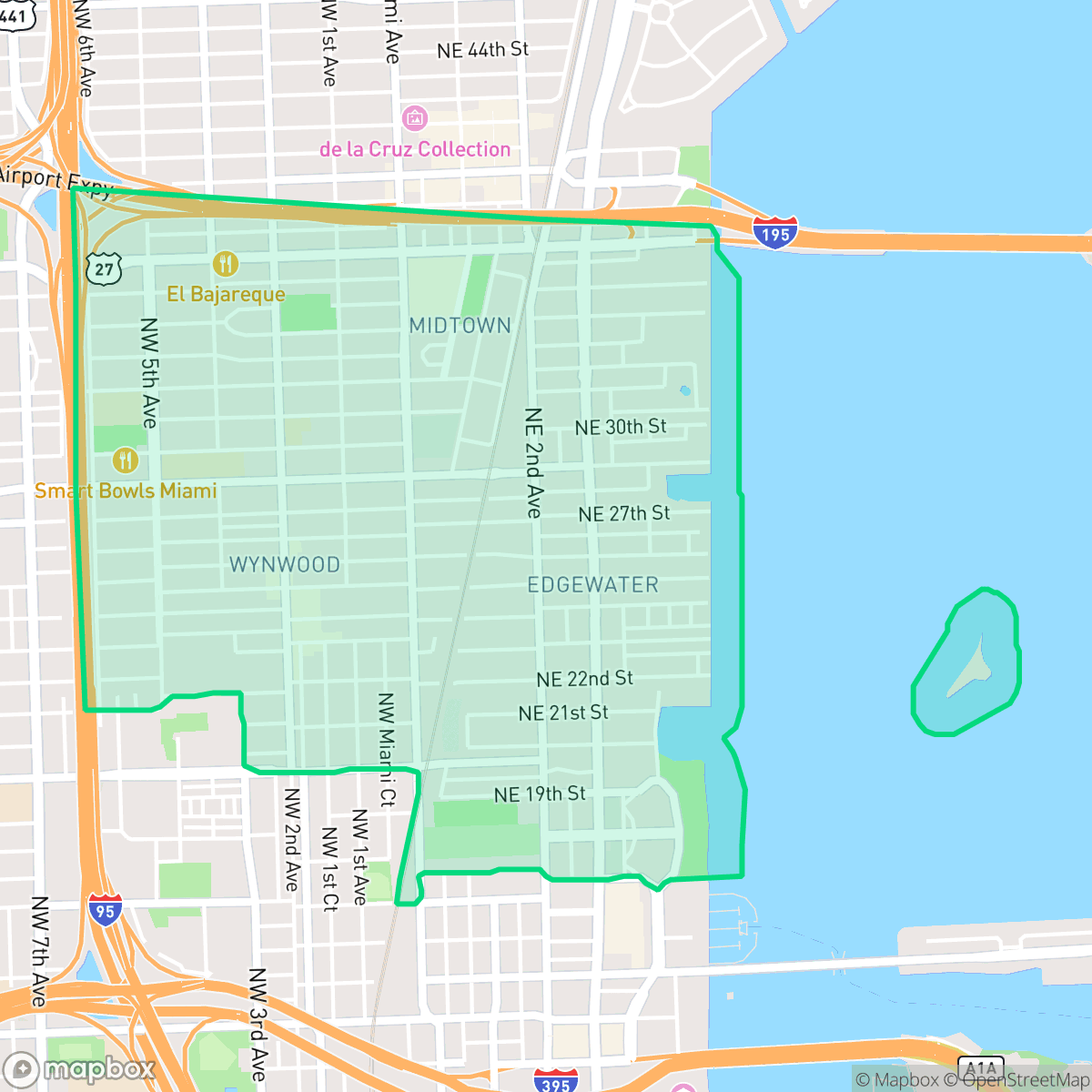
About Wynwood - Edgewater
Wynwood and Edgewater share a history of dramatic urban transformation. Wynwood evolved from a 1920s garment district and a mid-century Puerto Rican enclave known as "Little San Juan" into a world-renowned arts district, defined by industrial warehouse architecture now adorned with murals like the Wynwood Walls. Edgewater, historically one of Miami’s earliest residential suburbs, began as a collection of early 20th-century homes and small apartment buildings. While Wynwood transitioned from manufacturing to a creative hub, Edgewater shifted from low-density residential roots to a dense high-rise corridor along Biscayne Bay. Both neighborhoods reflect Miami’s broader pattern of rapid development, moving from mid-century industrial and suburban origins to their current status as high-density, culturally vibrant urban centers.
The area functions as a central hub for Miami's creative and social life, characterized by a dense concentration of dining, nightlife, and cultural venues. The landscape is a mix of luxury waterfront high-rises in Edgewater and industrial-style architecture in the arts district. This high-density environment fosters a lively street scene, making it a preferred destination for those who prioritize proximity to urban amenities and pedestrian connectivity.
Prospective residents should consider the trade-offs of living in a densely developed urban center. Acoustic comfort is often challenged by the proximity to major freeways, and the area features limited private buffer zones between residential units. While the neighborhood offers diverse housing options, including waterfront living, it is best suited for individuals who thrive in high-energy, walkable environments and are comfortable with the noise levels inherent to such a central location.
Neighborhood Scores Across 15 Qualities
Residential structures and multi-unit buildings are tightly packed with very little separation between walls or lots. This creates a much higher level of density than the Miami average, resulting in limited private buffer zones between neighbors.
Dense street grids and waterfront promenades offer excellent sidewalk connectivity, making most local trips possible on foot. While certain areas near the central highway interchange present significant barriers, the overall walkability remains above the Miami average.
Visual variety ranges from luxury waterfront high-rises with manicured amenities to older, utilitarian industrial structures and dense apartment blocks. This landscape reflects a level of aesthetic diversity that is consistent with the city average.
Access to green space for pets varies significantly by street, as some areas feature large waterfront parks and grassy squares while others consist of dense concrete urban environments. According to iHuus data, the availability of dog walking options in this area is slightly above the city average.
High-rise corridors and significant grey infrastructure define this area, resulting in a much more built-up environment than the Miami average. Large building footprints and extensive paved surfaces predominate over natural green space.
Vibrant street life and a dense concentration of dining, nightlife, and cultural venues make this area significantly more active than the city average. According to iHuus data, the neighborhood functions as a major local hotspot with highly walkable corridors filled with social hubs and commercial activity.
Frequent acoustic disturbances arise from the proximity to major freeways and transit corridors. According to iHuus data, the level of noise in this area is notably higher than the Miami average.
Air quality levels fluctuate between acceptable and unhealthy, presenting occasional concerns for sensitive groups. This area maintains a profile similar to the rest of Miami according to iHuus data.
Light industrial activities, logistics corridors, and utility infrastructure are present alongside residential zones; this creates slightly more commercial traffic and utility-related noise than the Miami average.
Health insurance access among residents is slightly higher than the Miami average, according to iHuus data. While coverage levels are stable, a notable portion of the population remains uninsured.
Political leanings in this area are significantly more liberal than the Miami average, according to iHuus data. Residents will find a community shaped by progressive values with a modest presence of opposing viewpoints.
A balanced mix of young adults, families, and older residents characterizes this area; according to iHuus data, this demographic spread is slightly more varied than the Miami average.
Flood risk levels in this area are slightly higher than the Miami average, though current assessments remain inconclusive due to pending federal flood studies. According to iHuus data, residents should account for potential uncertainty regarding detailed flood zone designations.
Address-Level Insights for Wynwood - Edgewater


iHuus Neighborhood Intelligence Insights
Get address-level neighborhood insights for Wynwood - Edgewater
- Street-level scores — see how individual blocks compare, not just neighborhood averages
- Micro-zone boundaries — identify quiet pockets, flood boundaries, and walkable clusters before you visit
- 15 dimensions in full — walkability, noise, air quality, school quality, insurance coverage, population age profile, urban/rural index, and more
- Boundary risk alerts — know if your address sits near a block boundary where scores drop, the kind of detail no listing will ever mention
- School insights — individual school ratings and insights, not just district-level data
- Compare before you commit — side-by-side data across neighborhoods, down to block precision
No credit card required
Compare with Any Neighborhood
| Dimension | Wynwood - Edgewater | Alameda - West Flagler |
|---|---|---|
| 🚶 Walkabilityavg 6.81 | ||
| 🔊 Acoustic Comfortavg 3.72 | ||
| 🤫 Privacy Indexavg 4.25 | ||
| 🎨 Visual Appealavg 6.05 | ||
| 🐕 Dog Friendlinessavg 4.71 | ||
| 🗺️ Urban-Rural Indexavg 5.07 | ||
| ✨ Neighborhood Vibeavg 4.83 | ||
| 🏥 Health Insurance Coverageavg 4.76 | ||
| 🌿 Air Qualityavg 3.78 | ||
| 🏭 Industrial Proximityavg 6.31 | ||
| 🌊 Flood Safetyavg 3.97 | ||
| 🗳️ Ideological Leanavg 4.66 | ||
| 👥 Population Age Profileavg 4.38 | ||
| 🔥 Fire Safety | ||
| 🏫 School Quality |
Wynwood - Edgewater Rankings
School Districts Serving Wynwood - Edgewater
School Insights for Wynwood - Edgewater
Below average outcomes; significant attendance and academic challenges.
School Insights
See what's really behind every school rating near Wynwood - Edgewater
- Individual school ratings — each school's own score with outcome context, not just a district average
- Enrollment & class size data — student-to-teacher ratio and how it compares to the state average
- Full demographics breakdown — ethnicity and gender composition for every school in the enrollment zone
- Every school in the district — all schools within the enrollment boundary ranked by rating, not just the closest one
- Grade levels & benchmarks — elementary through high school, with below/above state-average flags
No credit card required