Watson Island, Miami
Updated · 183 residents
Watson Island is a distinct man-made enclave situated along the MacArthur Causeway, known for its upscale aesthetic and quiet, sparse atmosphere. While the area offers a unique coastal setting, residents experience significant challenges regarding high noise levels from transit corridors, limited pedestrian infrastructure, and recurring flood risks.
Key Highlights
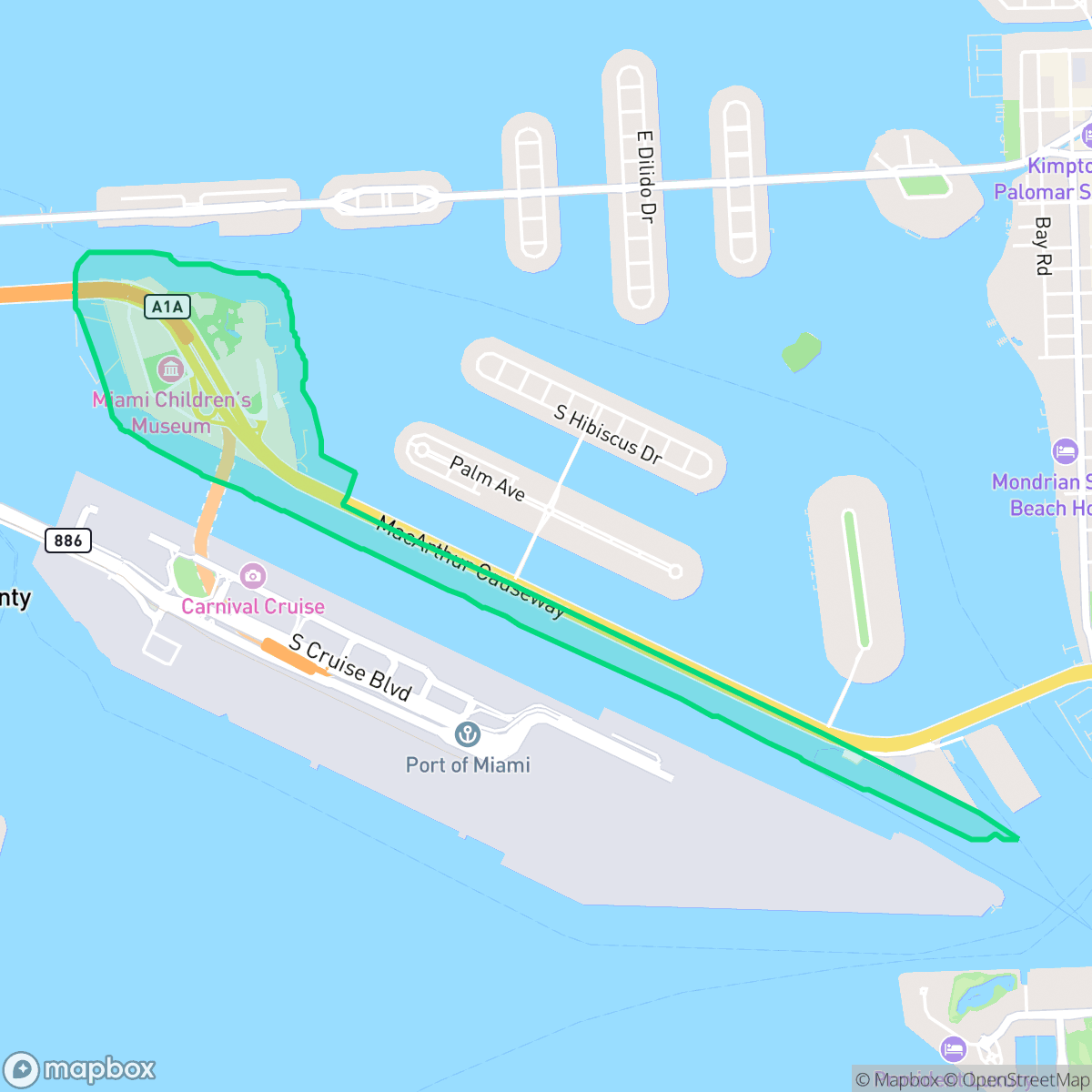
About Watson Island
Watson Island is a man-made island in Biscayne Bay, created through extensive dredging and land reclamation projects between 1926 and 1931 to facilitate the deepening of the Port of Miami's ship channel. Originally named Causeway Island, it was later renamed to honor John W. Watson Sr., a prominent Miami pioneer who served as the city's mayor. Deeded to the city in 1919 with strict mandates for public or municipal use, the island has historically served as a site for notable landmarks including a Goodyear Blimp base (1930–1978), Chalk's International Airlines seaplane base, the Ichimura Miami Japanese Garden, and the zoological park Jungle Island. Despite its prime location along the MacArthur Causeway, much of the island remained largely undeveloped for decades, frequently serving as a focal point for debates regarding urban planning and public land use.
The neighborhood serves as a quiet, visually polished corridor between mainland Miami and South Beach. It is characterized by high-end developments and a demographic dominated by young adults, offering a more tranquil environment compared to the dense urban centers nearby. The landscape maintains a balanced urban feel, blending paved access with open coastal areas, though it lacks the high-energy retail and dense commercial activity found in other parts of the city. According to data, the area provides a moderate level of privacy, offering a more secluded experience than the average Miami neighborhood.
Living in this area requires navigating specific environmental and infrastructure trade-offs. The neighborhood faces notable concerns regarding air quality and frequent flood vulnerability, and the limited availability of sidewalks makes it less accessible for those who rely on walking as a primary mode of transit. Additionally, prospective residents should note that pet-friendly amenities are sparse and health insurance coverage rates are lower than the city average. It is best suited for individuals who prioritize a quiet, upscale coastal setting over traditional urban walkability and convenience.
Neighborhood Scores Across 15 Qualities
Residential spacing offers some buffer between neighbors, providing a slightly higher level of privacy than the Miami average.
Walking is primarily restricted to quiet streets due to a lack of sidewalks; this makes the area significantly less walkable than most parts of Miami. According to iHuus data, the infrastructure is not optimized for pedestrian transit.
Large homes and premium amenities characterize the area, providing a more polished aesthetic than most of Miami. According to iHuus data, the landscape features frequent high-end developments and spacious residential lots.
Fewer green spaces and public parks are available for pets compared to the rest of Miami. According to iHuus data, dog owners may find fewer accessible walking areas within this specific area.
An even mix of paved streets and green space defines the area, offering a landscape slightly less dense than the Miami average according to iHuus data.
Commercial activity is significantly lower than the Miami average, leaving the area primarily characterized by quiet coastal stretches and civic institutions with few local amenities. While some waterfront dining and entertainment exist near transit hubs, much of the neighborhood lacks dense retail or high-energy urban density.
Frequent noise from nearby transit routes and flight paths makes the area significantly louder than the Miami average. Residents may experience consistent disruptions due to its proximity to busy roadways and aerial corridors.
Frequent unhealthy air quality levels pose a significant risk to sensitive groups. According to iHuus data, the atmospheric conditions in Watson Island are slightly worse than the Miami average.
Light commercial activities and small service businesses are present alongside residential spaces, making the industrial presence roughly equivalent to the Miami average. Residents may notice occasional daytime traffic from nearby printing services or commercial loading, though heavy industry is absent.
Health insurance access among residents is significantly lower than the Miami average, according to iHuus data. This lack of coverage represents a notable disparity compared to most other areas in the city.
Political views in this area are evenly split between conservative and liberal leanings. This creates a more politically diverse environment than the average Miami neighborhood, according to iHuus data.
Residents here are predominantly young adults, with a much lower presence of families and seniors compared to the rest of Miami. According to iHuus data, this creates a demographic profile that is significantly younger than the city average.
Frequent flooding is a significant concern here as the area sits within a designated floodplain. According to iHuus data, this level of vulnerability is notably higher than the Miami average.
Address-Level Insights for Watson Island


iHuus Neighborhood Intelligence Insights
Get address-level neighborhood insights for Watson Island
- Street-level scores — see how individual blocks compare, not just neighborhood averages
- Micro-zone boundaries — identify quiet pockets, flood boundaries, and walkable clusters before you visit
- 15 dimensions in full — walkability, noise, air quality, school quality, insurance coverage, population age profile, urban/rural index, and more
- Boundary risk alerts — know if your address sits near a block boundary where scores drop, the kind of detail no listing will ever mention
- School insights — individual school ratings and insights, not just district-level data
- Compare before you commit — side-by-side data across neighborhoods, down to block precision
No credit card required
Compare with Any Neighborhood
| Dimension | Watson Island | Alameda - West Flagler |
|---|---|---|
| 🚶 Walkabilityavg 6.81 | ||
| 🔊 Acoustic Comfortavg 3.72 | ||
| 🤫 Privacy Indexavg 4.25 | ||
| 🎨 Visual Appealavg 6.05 | ||
| 🐕 Dog Friendlinessavg 4.71 | ||
| 🗺️ Urban-Rural Indexavg 5.07 | ||
| ✨ Neighborhood Vibeavg 4.83 | ||
| 🏥 Health Insurance Coverageavg 4.76 | ||
| 🌿 Air Qualityavg 3.78 | ||
| 🏭 Industrial Proximityavg 6.31 | ||
| 🌊 Flood Safetyavg 3.97 | ||
| 🗳️ Ideological Leanavg 4.66 | ||
| 👥 Population Age Profileavg 4.38 | ||
| 🔥 Fire Safety | ||
| 🏫 School Quality |
Watson Island Rankings
School Districts Serving Watson Island
School Insights for Watson Island
Below average outcomes; significant attendance and academic challenges.
School Insights
See what's really behind every school rating near Watson Island
- Individual school ratings — each school's own score with outcome context, not just a district average
- Enrollment & class size data — student-to-teacher ratio and how it compares to the state average
- Full demographics breakdown — ethnicity and gender composition for every school in the enrollment zone
- Every school in the district — all schools within the enrollment boundary ranked by rating, not just the closest one
- Grade levels & benchmarks — elementary through high school, with below/above state-average flags
No credit card required