Virginia Key, Miami
Updated · 95 residents
Virginia Key is a quiet, isolated barrier island defined by its expansive natural landscapes and significant civil rights history. While the area offers a serene environment away from industrial activity, it faces challenges with limited walkability, high flood risks, and poor air quality.
Key Highlights
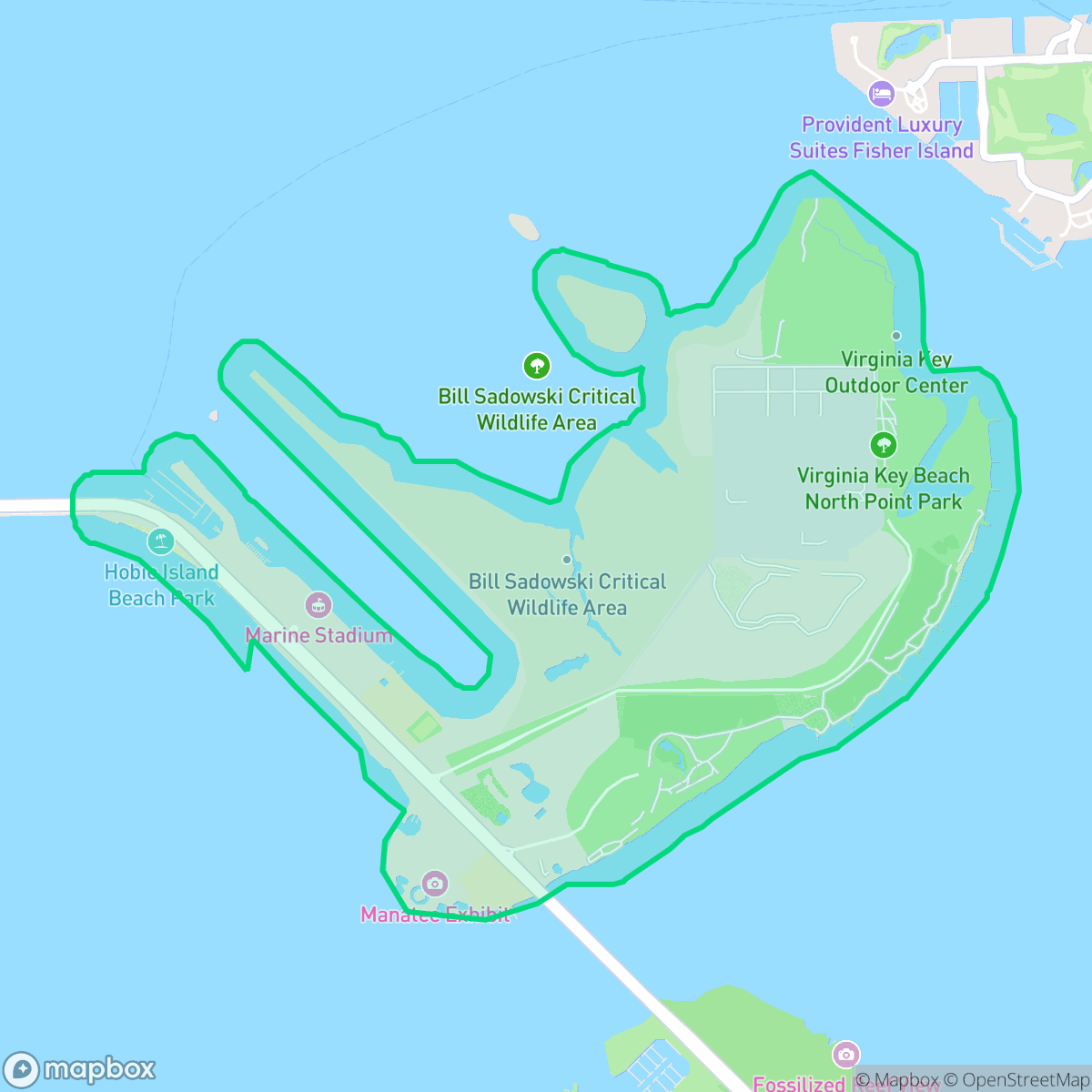
About Virginia Key
Virginia Key, a barrier island formed by hurricane activity in the 1830s, holds profound significance in Miami's civil rights history. During the era of segregation, it served as an unofficial refuge for Black Miamians before becoming the county's first officially designated 'colored-only' beach in 1945, following peaceful 'wade-in' protests at white-only beaches. Accessible initially only by boat from the Miami River, the island became a vital cultural hub for religious services, baptisms, and community gatherings. The site, now the Historic Virginia Key Beach Park, was listed on the National Register of Historic Places in 2002. It features restored mid-century structures, including a bathhouse, carousel, and miniature train station, and remains recognized for its ecological importance as home to one of Florida's largest mangrove wetlands.
The neighborhood is a tranquil, low-density environment that prioritizes natural space over urban development. It is defined by its open landscapes rather than high-density architecture, providing a reprieve from the typical bustle of Miami. Despite its quiet nature, the area remains isolated, with minimal retail or commercial amenities to support daily needs. This setting is best suited for those who prioritize a serene, natural environment over proximity to urban conveniences and social density.
Living here requires navigating significant environmental and infrastructure constraints. According to iHuus data, the area is highly susceptible to coastal flooding, and residents must contend with limited sidewalk infrastructure that makes walking difficult. The proximity of residential structures results in restricted personal privacy, and air quality can frequently reach unhealthy levels for sensitive groups. Families should consider that while the local school district maintains high graduation rates, it is currently navigating budget deficits and shifting leadership. Prospective residents should also note that, according to iHuus data, the lack of sufficient green space makes the area less suitable for pet owners.
Neighborhood Scores Across 15 Qualities
Residential structures are situated in close proximity to one another with minimal separation between properties. This lack of distance results in a level of privacy that is notably lower than the Miami average, according to iHuus data.
Limited sidewalk infrastructure and high vehicle traffic make navigating the area on foot uncomfortable. According to iHuus data, walkability in this neighborhood is significantly lower than the Miami average.
Sparse landscaping and high density residential structures characterize the area. According to iHuus data, the lack of greenery and amenities makes this neighborhood significantly less visually appealing than the Miami average.
Sparse greenery and predominantly fenced areas make finding open space for pets difficult. This level of accessibility is significantly lower than the average found throughout Miami.
Low building density and abundant natural vegetation characterize this area, making it significantly less urbanized than the Miami average. According to iHuus data, the landscape is defined by open spaces rather than multi-storey structures.
Primarily composed of rural residential areas, this neighborhood lacks the commercial activity and social density found in most parts of Miami. Most residents will find the environment significantly more subdued than the city average due to sparse local destinations and minimal retail presence.
Acoustic levels are notably lower than the Miami average, with noise limited to infrequent distant traffic. According to iHuus data, this area provides a tranquil environment characterized by minimal sound disturbance.
Frequent unhealthy air quality levels pose a significant risk to sensitive groups; according to iHuus data, these conditions are substantially worse than the Miami average.
Industrial activity and heavy commercial operations are significantly lower here than the Miami average. Most areas consist of residential spaces, green areas, and small-scale service businesses like libraries or restaurants.
Coastal hazards and wave action make this area significantly more vulnerable to flooding than most of Miami. According to iHuus data, residents should expect much higher insurance costs due to the location's high-hazard zone designation.
Address-Level Insights for Virginia Key


iHuus Neighborhood Intelligence Insights
Get address-level neighborhood insights for Virginia Key
- Street-level scores — see how individual blocks compare, not just neighborhood averages
- Micro-zone boundaries — identify quiet pockets, flood boundaries, and walkable clusters before you visit
- 15 dimensions in full — walkability, noise, air quality, school quality, insurance coverage, population age profile, urban/rural index, and more
- Boundary risk alerts — know if your address sits near a block boundary where scores drop, the kind of detail no listing will ever mention
- School insights — individual school ratings and insights, not just district-level data
- Compare before you commit — side-by-side data across neighborhoods, down to block precision
No credit card required
Compare with Any Neighborhood
| Dimension | Virginia Key | Alameda - West Flagler |
|---|---|---|
| 🚶 Walkabilityavg 6.81 | ||
| 🔊 Acoustic Comfortavg 3.72 | ||
| 🤫 Privacy Indexavg 4.25 | ||
| 🎨 Visual Appealavg 6.05 | ||
| 🐕 Dog Friendlinessavg 4.71 | ||
| 🗺️ Urban-Rural Indexavg 5.07 | ||
| ✨ Neighborhood Vibeavg 4.83 | ||
| 🏥 Health Insurance Coverageavg 4.76 | ||
| 🌿 Air Qualityavg 3.78 | ||
| 🏭 Industrial Proximityavg 6.31 | ||
| 🌊 Flood Safetyavg 3.97 | ||
| 🗳️ Ideological Leanavg 4.66 | ||
| 👥 Population Age Profileavg 4.38 | ||
| 🔥 Fire Safety | ||
| 🏫 School Quality |
Virginia Key Rankings
School Districts Serving Virginia Key
School Insights for Virginia Key
Below average outcomes; significant attendance and academic challenges.
School Insights
See what's really behind every school rating near Virginia Key
- Individual school ratings — each school's own score with outcome context, not just a district average
- Enrollment & class size data — student-to-teacher ratio and how it compares to the state average
- Full demographics breakdown — ethnicity and gender composition for every school in the enrollment zone
- Every school in the district — all schools within the enrollment boundary ranked by rating, not just the closest one
- Grade levels & benchmarks — elementary through high school, with below/above state-average flags
No credit card required