Overtown, Miami
Updated · 11,638 residents
Overtown is a culturally significant urban hub defined by its dense, high-energy atmosphere and proximity to central transit corridors. While the area offers high walkability and a vibrant local scene, residents should expect notable noise levels from nearby freeways and a compact living environment with limited private outdoor space.
Key Highlights
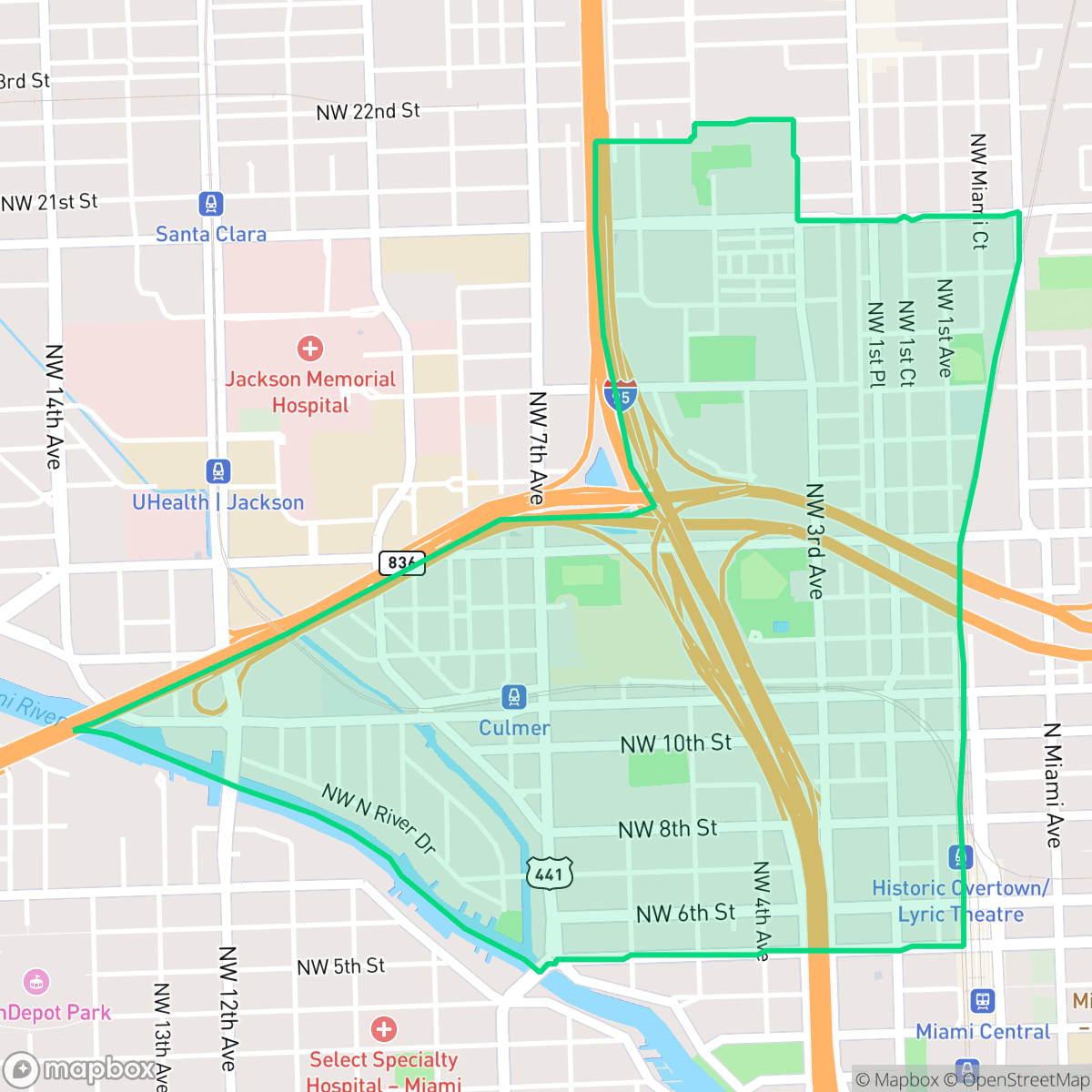
About Overtown
Originally established in the late 19th century as 'Colored Town,' Overtown served as the segregated residential hub for Black workers constructing the Florida East Coast Railway. During its mid-20th-century peak, the neighborhood became known as the 'Harlem of the South' and 'Little Broadway,' a vibrant cultural epicenter where legendary performers like Ella Fitzgerald and Count Basie played at the Historic Lyric Theater. However, the community suffered profound disruption in the 1960s when the construction of I-95 and I-395 bisected the neighborhood, leading to significant displacement and economic decline. Despite these challenges, Overtown remains a resilient symbol of Black history in Miami, defined by its preserved architectural landmarks, such as the 1913 Lyric Theater, and its enduring legacy as a center for civil rights activism and Black entrepreneurship.
The area functions as a dense urban center characterized by a mix of modern high-rise developments and older, utilitarian architecture. It maintains a high level of activity, supported by a dense concentration of dining and cultural venues that contribute to its energetic atmosphere. The grid-based layout provides good sidewalk connectivity, making it convenient for pedestrians to navigate toward transit hubs and nearby educational institutions. Prospective residents should consider the trade-offs of living in such a highly urbanized setting. The proximity to major highway infrastructure and rail lines results in frequent noise disturbances and variable air quality. Additionally, the neighborhood features tightly packed residential structures with limited green space, making it better suited for those who prioritize central access and urban intensity over quiet, suburban-style privacy. Families should note that while local schools are part of a district with high graduation rates, the area faces challenges related to enrollment shifts and an achievement gap between magnet programs and neighborhood schools.
Neighborhood Scores Across 15 Qualities
Buildings and residential units are positioned very closely together with frequent shared walls or narrow alleys. This level of density results in significantly less separation between structures than is typical for the rest of Miami.
Sidewalk connectivity is generally higher than the Miami average, though massive multi-lane highways and rail corridors create significant physical barriers for pedestrians. While many blocks feature a consistent grid of crossings and proximity to transit hubs, high-traffic industrial roads can fragment the network.
The skyline presents a blend of modern high-rises and older, utilitarian structures. This visual variety is slightly below the Miami average due to the prevalence of industrial warehouses and institutional buildings alongside newer luxury condos.
Fragmented green spaces and significant highway infrastructure make finding accessible areas for walking pets difficult. According to iHuus data, the availability of parks and grassy verges in Overtown is below the city average.
Dense-scale development and extensive highway infrastructure define this area, making it significantly more urbanized than the Miami average. High-rise structures and large commercial footprints dominate the landscape with very little green space available.
High activity levels and a dense concentration of dining, nightlife, and cultural institutions make this area significantly more lively than the Miami average. According to iHuus data, the neighborhood serves as an intense urban hub with high walkability near major transit and college campuses.
Frequent disturbances from nearby railroad tracks and major freeways characterize the area. According to iHuus data, acoustic comfort in Overtown is lower than the Miami city average.
Air quality levels fluctuate between acceptable and unhealthy, presenting occasional concerns for sensitive groups. According to iHuus data, conditions in this area are slightly more problematic than the Miami average.
Light commercial activity and logistics corridors create pockets of heavy truck traffic and utility noise, though the area lacks significant heavy manufacturing. According to iHuus data, industrial proximity is slightly higher than the city average due to nearby warehouses and transit infrastructure.
Health insurance access among residents is slightly above the Miami average. According to iHuus data, a significant portion of the population remains uninsured.
Political leanings in this area are notably more liberal than the Miami average, characterized by a significant liberal majority with some opposing presence according to iHuus data.
Residents live alongside a balanced mix of young professionals, families, and seniors. According to iHuus data, this demographic spread is more varied than the average seen across Miami.
Flood risk levels in this area are higher than the Miami average, though specific risk assessments remain undetermined by federal authorities. Residents should remain cautious as official detailed flood studies for this section of Overtown have not yet been completed.
Address-Level Insights for Overtown


iHuus Neighborhood Intelligence Insights
Get address-level neighborhood insights for Overtown
- Street-level scores — see how individual blocks compare, not just neighborhood averages
- Micro-zone boundaries — identify quiet pockets, flood boundaries, and walkable clusters before you visit
- 15 dimensions in full — walkability, noise, air quality, school quality, insurance coverage, population age profile, urban/rural index, and more
- Boundary risk alerts — know if your address sits near a block boundary where scores drop, the kind of detail no listing will ever mention
- School insights — individual school ratings and insights, not just district-level data
- Compare before you commit — side-by-side data across neighborhoods, down to block precision
No credit card required
Compare with Any Neighborhood
| Dimension | Overtown | Alameda - West Flagler |
|---|---|---|
| 🚶 Walkabilityavg 6.81 | ||
| 🔊 Acoustic Comfortavg 3.72 | ||
| 🤫 Privacy Indexavg 4.25 | ||
| 🎨 Visual Appealavg 6.05 | ||
| 🐕 Dog Friendlinessavg 4.71 | ||
| 🗺️ Urban-Rural Indexavg 5.07 | ||
| ✨ Neighborhood Vibeavg 4.83 | ||
| 🏥 Health Insurance Coverageavg 4.76 | ||
| 🌿 Air Qualityavg 3.78 | ||
| 🏭 Industrial Proximityavg 6.31 | ||
| 🌊 Flood Safetyavg 3.97 | ||
| 🗳️ Ideological Leanavg 4.66 | ||
| 👥 Population Age Profileavg 4.38 | ||
| 🔥 Fire Safety | ||
| 🏫 School Quality |
Overtown Rankings
School Districts Serving Overtown
School Insights for Overtown
Below average outcomes; significant attendance and academic challenges.
School Insights
See what's really behind every school rating near Overtown
- Individual school ratings — each school's own score with outcome context, not just a district average
- Enrollment & class size data — student-to-teacher ratio and how it compares to the state average
- Full demographics breakdown — ethnicity and gender composition for every school in the enrollment zone
- Every school in the district — all schools within the enrollment boundary ranked by rating, not just the closest one
- Grade levels & benchmarks — elementary through high school, with below/above state-average flags
No credit card required