Oakland Grove, Miami
Updated · 563 residents
Oakland Grove is a highly walkable residential enclave that balances a semi-rural atmosphere with a vibrant, socially active local scene. While residents enjoy easy pedestrian access to diverse eateries and neighborhood hubs, the area experiences notable traffic noise and requires awareness regarding its designated flood zone status.
Key Highlights
About Oakland Grove
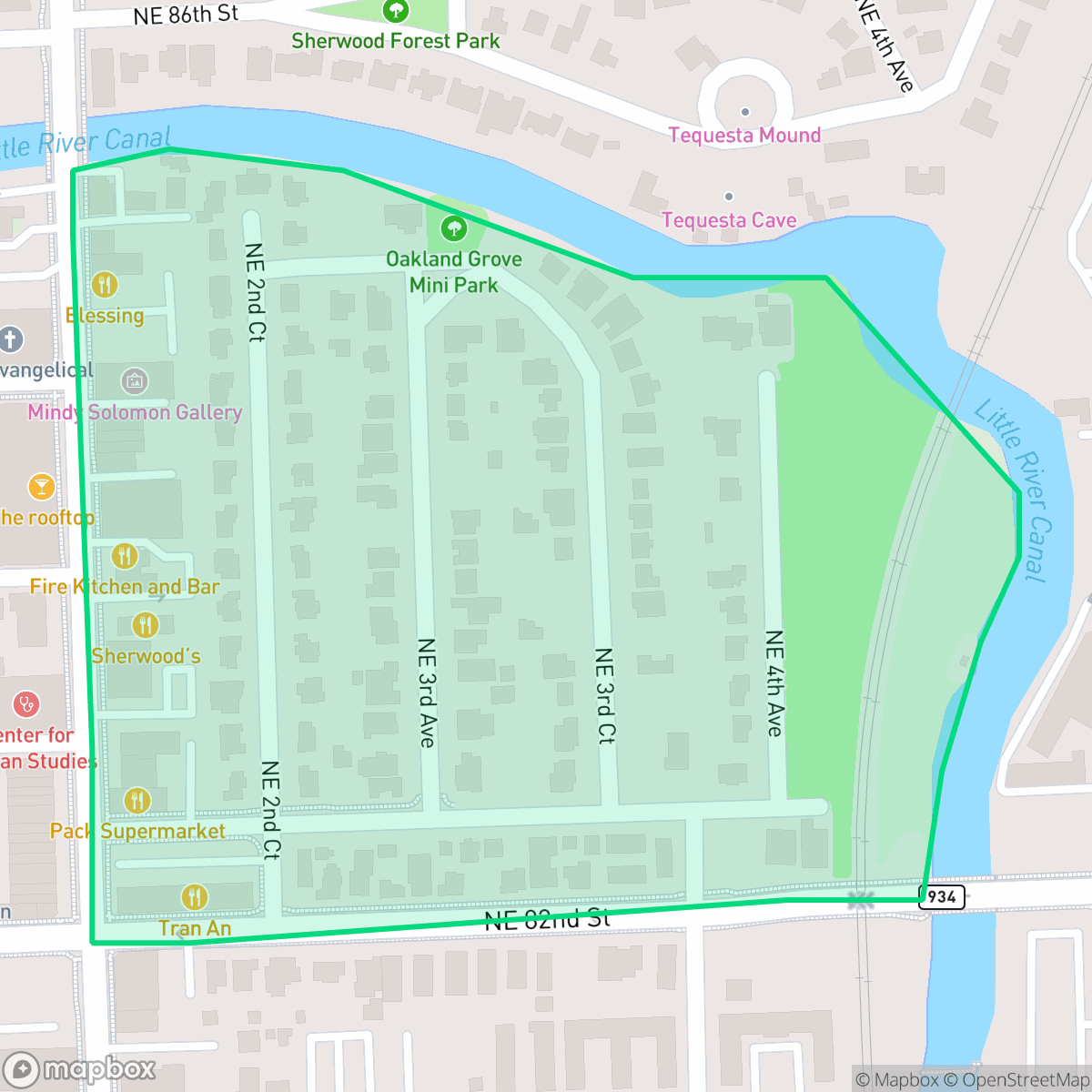
Oakland Grove is a 40-acre residential neighborhood in Miami, Florida, bounded by the Little River to the north and east, the Florida East Coast Railway, Northeast 82nd Street, and Northeast 2nd Avenue. Historically a low-density community of single-family homes and duplexes, the area is defined by its residents' active engagement in urban planning, particularly through the 'Neighbors of Oakland Grove' association. The community has frequently mobilized to resist developers' efforts to increase residential density, aiming to preserve the neighborhood's established character. Situated adjacent to the Little Haiti business district, the area features limited vehicular access points, creating a distinct, self-contained residential enclave. The neighborhood also contains a small municipal park that provides direct access to the Little River, serving as a focal point for the community’s connection to the local waterfront.
Oakland Grove serves as a distinct residential pocket defined by its exceptional walkability and a semi-rural aesthetic that feels removed from the typical density of Miami. The community maintains a lively social atmosphere, bolstered by local art galleries, wellness studios, and a diverse range of dining options. This environment attracts a varied demographic, ranging from young professionals to families and seniors, all of whom benefit from the area's grid layout and accessible pedestrian infrastructure. Prospective residents should consider certain trade-offs, including higher levels of traffic noise and the necessity of navigating a designated floodplain. While the neighborhood offers a more private living environment than many parts of the city, the presence of light commercial activity and industrial proximity introduces occasional transit traffic. Those considering the area will find a strongly liberal community that values its established character, though they should also account for the broader challenges facing the local Dade County school district, such as shifting enrollment trends and budget constraints.
Neighborhood Scores Across 15 Qualities
Residential spacing provides a more private living environment than much of Miami. Houses generally feature consistent buffers between neighbors, though density increases near local commercial clusters according to iHuus data.
Pedestrian access is excellent due to a consistent grid layout with wide sidewalks and clearly marked crossings. This level of walkability is significantly higher than the Miami average, making it easy to navigate the area on foot.
Standard residential lots feature tidy yards and boxy rooflines typical of middle-class suburban architecture. This visual profile aligns with the broader Miami average for residential areas.
Walking paths along the adjacent canal offer pleasant routes for pet owners. While greenery is present, many residential streets have narrow grass verges compared to the city average, according to iHuus data.
Frequent open land and scattered homes amid woodland provide a more semi-rural atmosphere than the typical Miami urban density. This landscape features a low-density mix of single-family residences and light industrial sites, according to iHuus data.
Local dining, art galleries, and wellness studios create a highly active atmosphere that is significantly more lively than the Miami average. This walkable landscape features a concentrated mix of social hubs and diverse eateries, according to iHuus data.
Frequent noise from nearby transit corridors and major roadways impacts the area. According to iHuus data, acoustic comfort levels in Oakland Grove are lower than the typical experience found across Miami.
Air quality levels fluctuate between acceptable and unhealthy periods, which may pose a concern for sensitive groups. According to iHuus data, conditions in Oakland Grove are better than the Miami average.
Occasional light commercial activity, such as a brewery and gas station, introduces some transit traffic and utility odors to the area. This level of industrial proximity is slightly higher than the Miami average, though no heavy or hazardous industry is present.
Health insurance accessibility in Oakland Grove is roughly comparable to the broader Miami area. According to iHuus data, a significant portion of the resident population lacks coverage.
Political voting patterns and census indicators reflect a much more liberal leaning than the typical Miami neighborhood, according to iHuus data.
A balanced demographic of young professionals, families, and seniors characterizes this area. According to iHuus data, the age distribution is more varied than the typical Miami profile.
Located within a designated floodplain, this area faces higher flood risks than the Miami average. Residents should account for potential requirements for flood insurance when considering properties here.
Address-Level Insights for Oakland Grove


iHuus Neighborhood Intelligence Insights
Get address-level neighborhood insights for Oakland Grove
- Street-level scores — see how individual blocks compare, not just neighborhood averages
- Micro-zone boundaries — identify quiet pockets, flood boundaries, and walkable clusters before you visit
- 15 dimensions in full — walkability, noise, air quality, school quality, insurance coverage, population age profile, urban/rural index, and more
- Boundary risk alerts — know if your address sits near a block boundary where scores drop, the kind of detail no listing will ever mention
- School insights — individual school ratings and insights, not just district-level data
- Compare before you commit — side-by-side data across neighborhoods, down to block precision
No credit card required
Compare with Any Neighborhood
| Dimension | Oakland Grove | Alameda - West Flagler |
|---|---|---|
| 🚶 Walkabilityavg 6.81 | ||
| 🔊 Acoustic Comfortavg 3.72 | ||
| 🤫 Privacy Indexavg 4.25 | ||
| 🎨 Visual Appealavg 6.05 | ||
| 🐕 Dog Friendlinessavg 4.71 | ||
| 🗺️ Urban-Rural Indexavg 5.07 | ||
| ✨ Neighborhood Vibeavg 4.83 | ||
| 🏥 Health Insurance Coverageavg 4.76 | ||
| 🌿 Air Qualityavg 3.78 | ||
| 🏭 Industrial Proximityavg 6.31 | ||
| 🌊 Flood Safetyavg 3.97 | ||
| 🗳️ Ideological Leanavg 4.66 | ||
| 👥 Population Age Profileavg 4.38 | ||
| 🔥 Fire Safety | ||
| 🏫 School Quality |
Oakland Grove Rankings
School Districts Serving Oakland Grove
School Insights for Oakland Grove
Below average outcomes; significant attendance and academic challenges.
School Insights
See what's really behind every school rating near Oakland Grove
- Individual school ratings — each school's own score with outcome context, not just a district average
- Enrollment & class size data — student-to-teacher ratio and how it compares to the state average
- Full demographics breakdown — ethnicity and gender composition for every school in the enrollment zone
- Every school in the district — all schools within the enrollment boundary ranked by rating, not just the closest one
- Grade levels & benchmarks — elementary through high school, with below/above state-average flags
No credit card required