Little Havana, Miami
Updated · 52,946 residents
Little Havana is a vibrant, highly walkable urban enclave renowned for its deep-rooted cultural heritage and energetic street life. While residents enjoy easy access to local dining and social hubs, the area experiences persistent noise from transit corridors and limited public green space.
Key Highlights
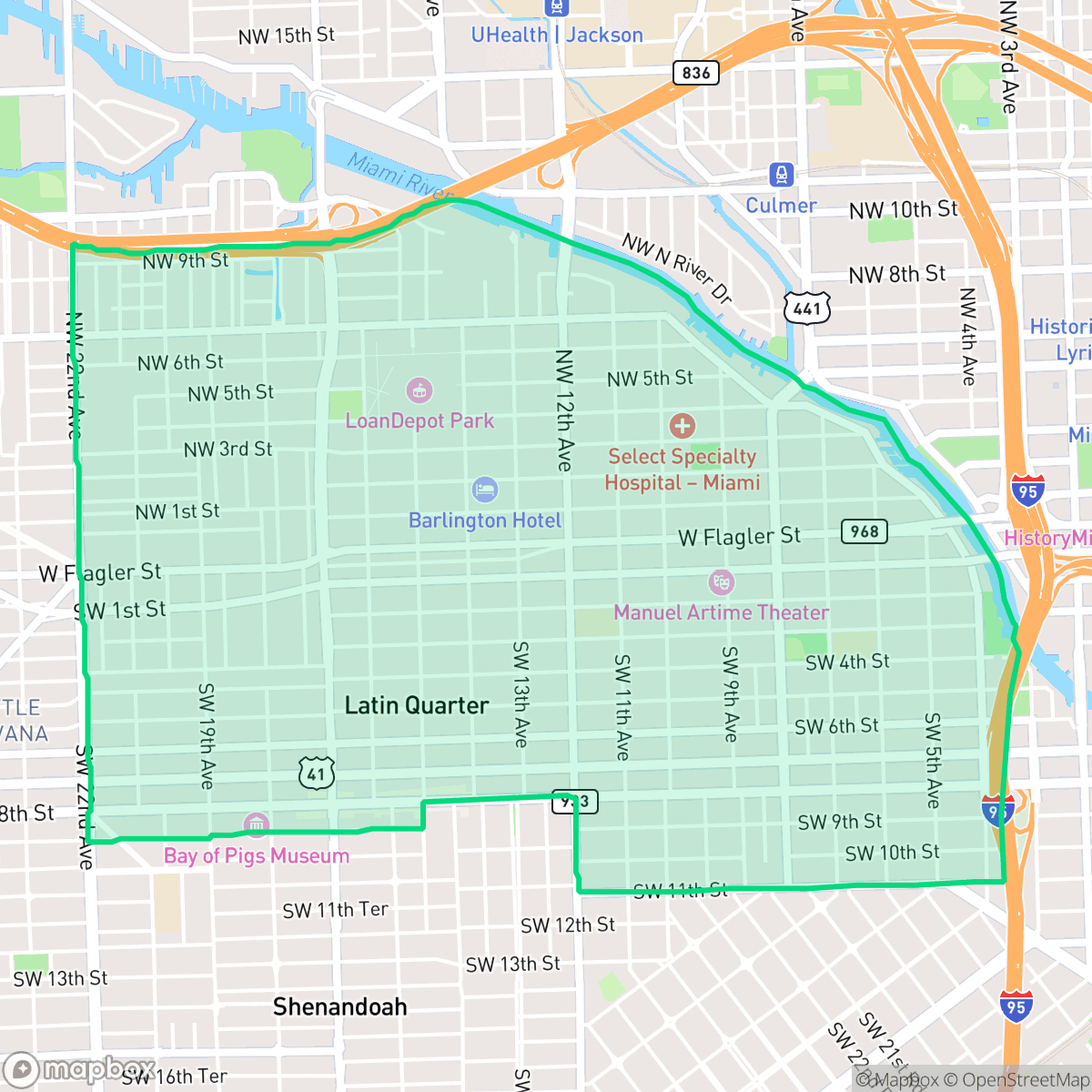
About Little Havana
Little Havana emerged as the cultural epicenter for Cuban exiles arriving in Miami during the 1960s, transforming the former Riverside and Shenandoah neighborhoods into a vibrant enclave. The neighborhood is defined by its signature thoroughfare, Calle Ocho (SW 8th Street), which hosts the annual Calle Ocho Music Festival. Key landmarks include Maximo Gomez Park, known as 'Domino Park,' a social hub for residents, and the Cuban Memorial Boulevard, home to the Bay of Pigs Memorial. The architectural landscape features a mix of early 20th-century Mediterranean Revival homes and mid-century commercial buildings. The neighborhood's identity is deeply rooted in its preservation of Cuban traditions, evidenced by its iconic cigar shops, art galleries, and historic venues like the Tower Theater, which has served as a cultural anchor since 1926. This district remains a critical symbol of the Cuban-American experience.
The neighborhood functions as a dense, pedestrian-friendly hub where the street grid facilitates easy navigation between local businesses and community centers. According to iHuus data, the area maintains a lively atmosphere that distinguishes it from quieter parts of the city. The landscape is characterized by a mix of residential and commercial zones, featuring a diverse age demographic that spans from young professionals to long-term senior residents.
Prospective residents should consider the trade-offs of living in such a central urban environment. The close proximity of homes and the prevalence of major roadways result in limited privacy and consistent traffic noise. While the district offers a rich social experience, those prioritizing quiet surroundings or expansive private gardens may find the dense urban layout challenging. Additionally, local health insurance coverage rates remain below the city average, and the nearby school district is currently navigating significant budgetary shifts and enrollment changes according to iHuus data.
Neighborhood Scores Across 15 Qualities
Residential structures are densely clustered with limited setbacks between neighbors, mirroring the privacy levels found across the broader Miami area. According to iHuus data, many homes feature shared walls or narrow gaps that offer minimal separation from adjacent properties.
Extensive sidewalk networks and a continuous street grid make most errands easy to complete on foot. This area offers much better connectivity for pedestrians than the Miami average, although a major highway does create some fragmentation in the network.
Typical urban density dominates the landscape, featuring a mix of single-family homes and multi-family apartment blocks. While the area lacks large private estates, the visual environment remains slightly more polished than the Miami average due to well-maintained landscaping and frequent private backyard pools.
Public parks and grassy sidewalk verges are sparse throughout much of the neighborhood, making it slightly below the city average for pet owners. Walking dogs often requires navigating narrow sidewalks with very little accessible public greenery.
Streetscapes consist of an even distribution of greenery and paved infrastructure, mirroring the city average. This layout features a mix of low-rise residential blocks and commercial corridors according to iHuus data.
High levels of activity and a dense concentration of dining, culture, and educational institutions make this area significantly more lively than the Miami average. According to iHuus data, many blocks serve as energetic, walkable hubs for local residents and students alike.
Persistent sounds from nearby heavy traffic and transit corridors make this area noisier than the Miami average. Residents should expect frequent auditory disturbances from adjacent major roadways.
Air conditions fluctuate between acceptable and unhealthy levels, presenting occasional concerns for sensitive groups. This quality remains slightly worse than the average seen across Miami.
Minimal heavy industry and manufacturing are found within the area, which is notably lower than the city average. Most land use consists of residential and light commercial zones; however, proximity to major highways and transit corridors can introduce some related noise and traffic.
Health insurance access among residents is significantly below the Miami average, according to iHuus data.
Political preferences in this area lean more conservative than the Miami average. According to iHuus data, a conservative majority exists within the community with a modest opposing presence.
A balanced mix of young professionals, families, and seniors characterizes the local demographic. This age distribution is more varied than the city average according to iHuus data.
Flood safety levels in this area are slightly above the Miami average, though a lack of detailed federal studies means specific vulnerabilities remain undetermined. Residents should remain aware of potential risks during heavy rain events according to iHuus data.
Address-Level Insights for Little Havana


iHuus Neighborhood Intelligence Insights
Get address-level neighborhood insights for Little Havana
- Street-level scores — see how individual blocks compare, not just neighborhood averages
- Micro-zone boundaries — identify quiet pockets, flood boundaries, and walkable clusters before you visit
- 15 dimensions in full — walkability, noise, air quality, school quality, insurance coverage, population age profile, urban/rural index, and more
- Boundary risk alerts — know if your address sits near a block boundary where scores drop, the kind of detail no listing will ever mention
- School insights — individual school ratings and insights, not just district-level data
- Compare before you commit — side-by-side data across neighborhoods, down to block precision
No credit card required
Compare with Any Neighborhood
| Dimension | Little Havana | Alameda - West Flagler |
|---|---|---|
| 🚶 Walkabilityavg 6.81 | ||
| 🔊 Acoustic Comfortavg 3.72 | ||
| 🤫 Privacy Indexavg 4.25 | ||
| 🎨 Visual Appealavg 6.05 | ||
| 🐕 Dog Friendlinessavg 4.71 | ||
| 🗺️ Urban-Rural Indexavg 5.07 | ||
| ✨ Neighborhood Vibeavg 4.83 | ||
| 🏥 Health Insurance Coverageavg 4.76 | ||
| 🌿 Air Qualityavg 3.78 | ||
| 🏭 Industrial Proximityavg 6.31 | ||
| 🌊 Flood Safetyavg 3.97 | ||
| 🗳️ Ideological Leanavg 4.66 | ||
| 👥 Population Age Profileavg 4.38 | ||
| 🔥 Fire Safety | ||
| 🏫 School Quality |
Little Havana Rankings
School Districts Serving Little Havana
School Insights for Little Havana
Below average outcomes; significant attendance and academic challenges.
School Insights
See what's really behind every school rating near Little Havana
- Individual school ratings — each school's own score with outcome context, not just a district average
- Enrollment & class size data — student-to-teacher ratio and how it compares to the state average
- Full demographics breakdown — ethnicity and gender composition for every school in the enrollment zone
- Every school in the district — all schools within the enrollment boundary ranked by rating, not just the closest one
- Grade levels & benchmarks — elementary through high school, with below/above state-average flags
No credit card required