Little Haiti, Miami
Updated · 31,010 residents
Little Haiti is a culturally significant neighborhood defined by its deep Caribbean roots and a walkable grid of streets. While it offers a vibrant atmosphere with a mix of local businesses, residents should expect higher noise levels from nearby transit corridors and moderate flood risks.
Key Highlights
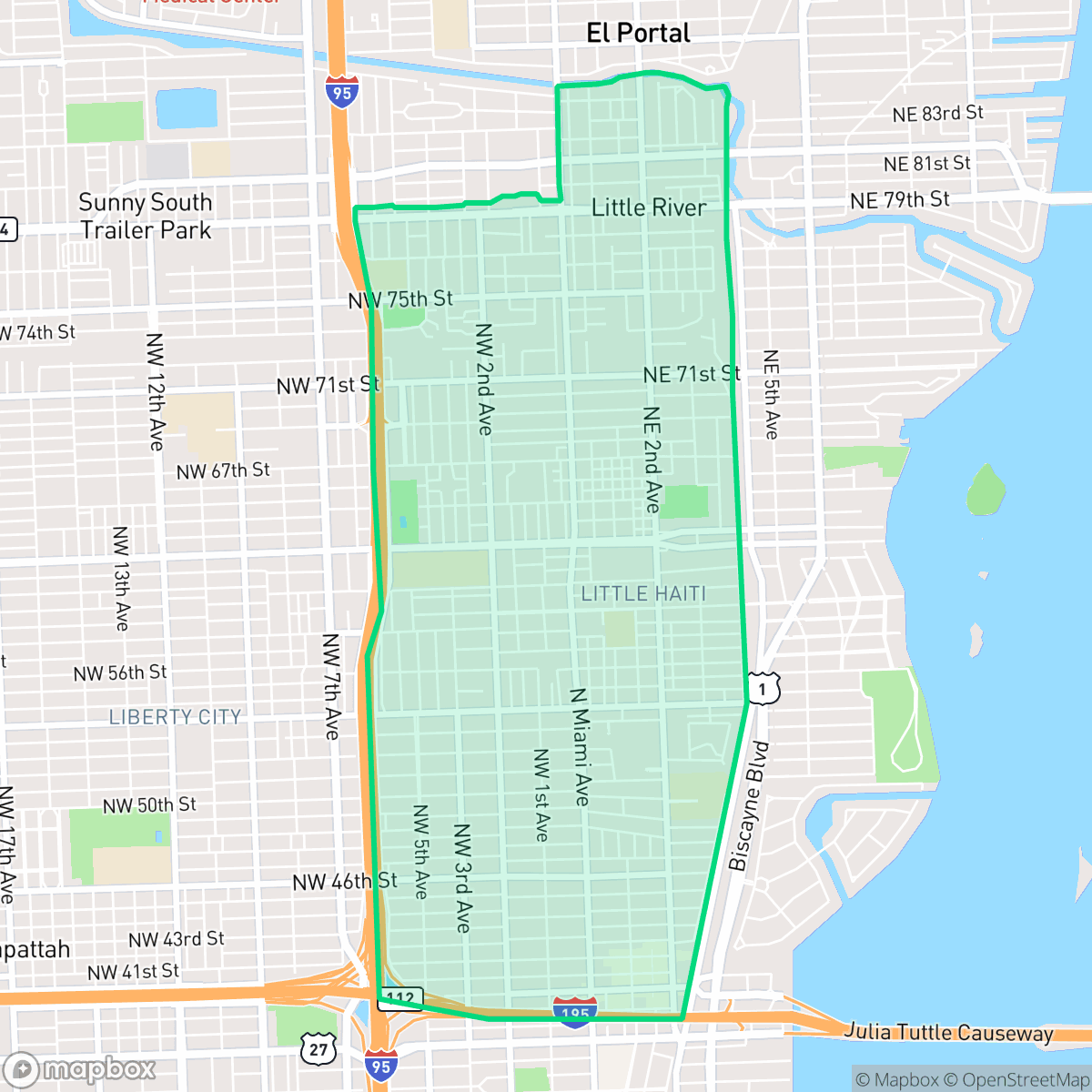
About Little Haiti
Little Haiti, historically known as Lemon City, was one of the earliest settlements in the Miami area, dating back to the 1870s. In the 1970s, the neighborhood became the primary residential and cultural anchor for Haitian immigrants fleeing political instability. The name 'Little Haiti' was coined by community leader Viter Juste, who sought to create a centralized space for the diaspora. The area is defined by its vibrant Caribbean identity, characterized by Creole-language signage, Haitian-owned businesses, and the 'French-Creole' architectural influence. Key landmarks include the Caribbean Marketplace, modeled after Port-au-Prince's Iron Market, and the Little Haiti Cultural Complex. Today, the neighborhood remains a hub for Haitian heritage, featuring murals by artists like Serge Toussaint and the historic Libreri Mapou bookstore, while navigating the challenges of urban revitalization and gentrification.
The area maintains a unique urban-suburban blend, characterized by a diverse demographic and a strong sense of community. The neighborhood features a mix of residential housing and light industrial activity, including local breweries and creative spaces. Its walkability is a standout feature, allowing residents to navigate the dense sidewalk network to access local amenities, though major thoroughfares and industrial zones create occasional barriers to movement.
Prospective residents should weigh the benefits of the neighborhood's energetic vibe against certain livability trade-offs. The area experiences notable noise from nearby highways and rail lines, and the housing stock offers limited private green space. While the local school district provides access to high-performing magnet programs, families should be aware of the broader challenges facing the district, including budget shifts and achievement gaps. It is best suited for those who value cultural proximity and a central location over quiet, secluded suburban living.
Neighborhood Scores Across 15 Qualities
Residential spacing varies between tightly packed houses and more buffered structures, offering slightly more separation than the typical Miami neighborhood. According to iHuus data, many homes feature small setbacks and minimal vegetation between neighbors.
A dense grid of sidewalks and pedestrian crossings makes many areas easy to navigate on foot, though major highways and industrial corridors create significant barriers to movement. According to iHuus data, the sidewalk network is more consistent than the average for Miami.
Residential landscapes consist primarily of uniform tract housing and dense apartment complexes with limited private greenery. This level of visual variety sits slightly below the Miami city average.
Access to dog walking space varies significantly across the area, as some residents benefit from large central parks and canal-side trails while others live in dense residential sections with narrow street verges. This level of pet friendliness is slightly above the Miami average according to iHuus data.
A balanced blend of residential streets and green space exists alongside dense industrial warehouses and major transit corridors. This layout provides a more suburban feel than the typical Miami urban density, according to iHuus data.
An energetic mix of diverse dining, cultural institutions, and local amenities provides a level of activity that sits above the city average. Residents can find a steady rhythm of life ranging from bustling commercial hubs to more low-key residential pockets.
Traffic and transit sounds are prominent due to the proximity of major highways and rail lines. According to iHuus data, acoustic comfort in this area is lower than the typical experience found across Miami.
Air quality levels fluctuate between acceptable and unhealthy, presenting occasional concerns for sensitive groups. This neighborhood maintains a slightly better air quality profile than the Miami average according to iHuus data.
Light industrial and commercial activities, such as breweries and printing services, are present alongside residential areas, resulting in lower industrial density than the Miami average. Residents should be aware of proximity to a Superfund site and potential utility odors or increased transit traffic from nearby warehouses and gas stations.
Health insurance coverage among residents is lower than the Miami average. According to iHuus data, a significant portion of the local population remains uninsured.
Voting patterns and census indicators in Little Haiti reflect a much more liberal political leaning than the Miami average, according to iHuus data.
Residents live alongside a broad range of age groups, including young professionals, families, and seniors. This demographic variety is slightly more balanced than the average found across Miami.
Flood safety levels in this area are slightly higher than the Miami average, though a lack of detailed FEMA studies means certain risks remain undetermined. Residents should note that official flood assessments for this specific location have not yet been finalized.
Address-Level Insights for Little Haiti


iHuus Neighborhood Intelligence Insights
Get address-level neighborhood insights for Little Haiti
- Street-level scores — see how individual blocks compare, not just neighborhood averages
- Micro-zone boundaries — identify quiet pockets, flood boundaries, and walkable clusters before you visit
- 15 dimensions in full — walkability, noise, air quality, school quality, insurance coverage, population age profile, urban/rural index, and more
- Boundary risk alerts — know if your address sits near a block boundary where scores drop, the kind of detail no listing will ever mention
- School insights — individual school ratings and insights, not just district-level data
- Compare before you commit — side-by-side data across neighborhoods, down to block precision
No credit card required
Compare with Any Neighborhood
| Dimension | Little Haiti | Alameda - West Flagler |
|---|---|---|
| 🚶 Walkabilityavg 6.81 | ||
| 🔊 Acoustic Comfortavg 3.72 | ||
| 🤫 Privacy Indexavg 4.25 | ||
| 🎨 Visual Appealavg 6.05 | ||
| 🐕 Dog Friendlinessavg 4.71 | ||
| 🗺️ Urban-Rural Indexavg 5.07 | ||
| ✨ Neighborhood Vibeavg 4.83 | ||
| 🏥 Health Insurance Coverageavg 4.76 | ||
| 🌿 Air Qualityavg 3.78 | ||
| 🏭 Industrial Proximityavg 6.31 | ||
| 🌊 Flood Safetyavg 3.97 | ||
| 🗳️ Ideological Leanavg 4.66 | ||
| 👥 Population Age Profileavg 4.38 | ||
| 🔥 Fire Safety | ||
| 🏫 School Quality |
Little Haiti Rankings
School Districts Serving Little Haiti
School Insights for Little Haiti
Below average outcomes; significant attendance and academic challenges.
School Insights
See what's really behind every school rating near Little Haiti
- Individual school ratings — each school's own score with outcome context, not just a district average
- Enrollment & class size data — student-to-teacher ratio and how it compares to the state average
- Full demographics breakdown — ethnicity and gender composition for every school in the enrollment zone
- Every school in the district — all schools within the enrollment boundary ranked by rating, not just the closest one
- Grade levels & benchmarks — elementary through high school, with below/above state-average flags
No credit card required