Coral Way, Miami
Updated · 43,046 residents
Coral Way is a highly walkable neighborhood defined by its lush, tree-lined streets and diverse architectural heritage. Residents benefit from an energetic local dining scene and well-maintained properties, though the area experiences frequent noise from transit corridors and flight paths.
Key Highlights
About Coral Way
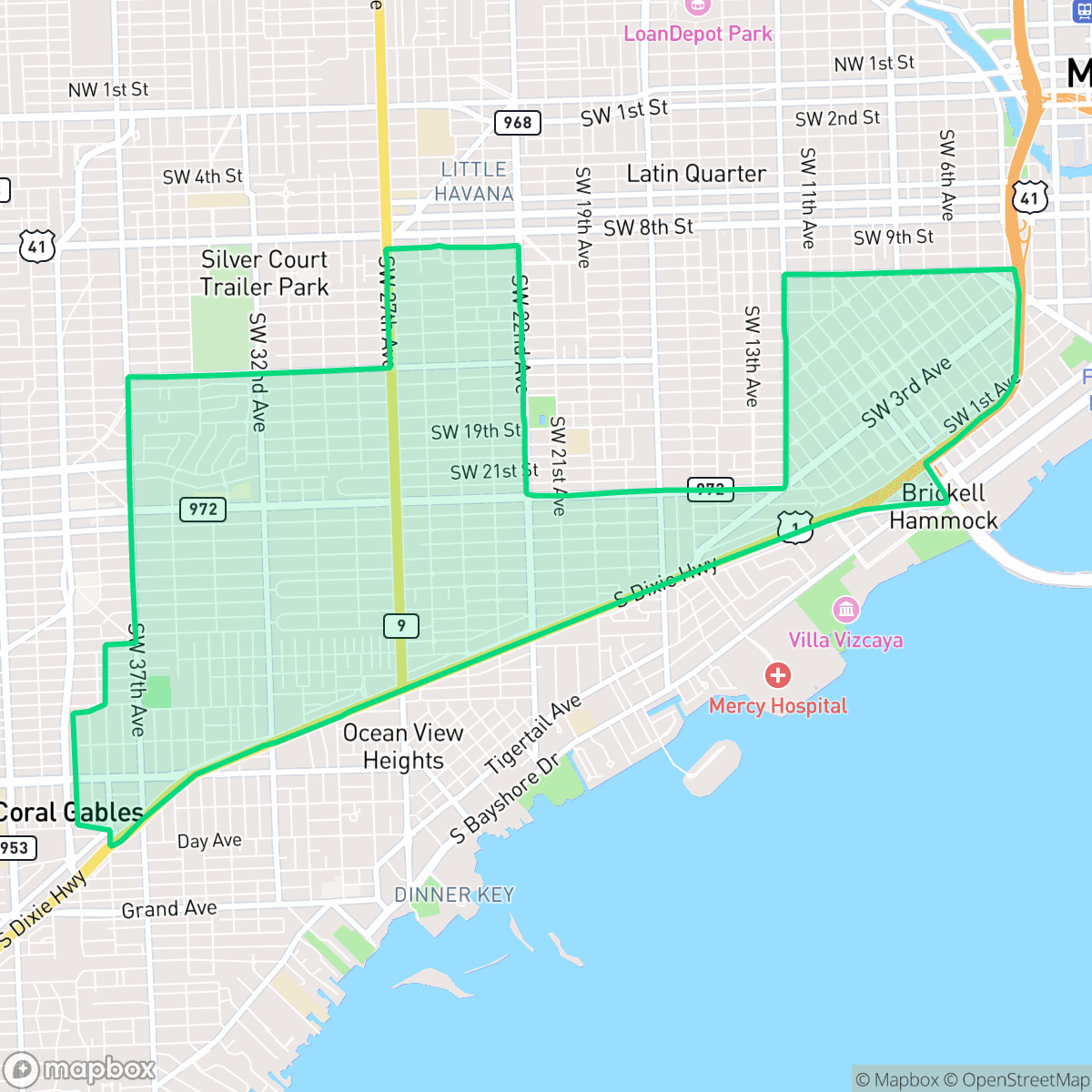
The Coral Way neighborhood, established in the 1920s by developer George E. Merrick, serves as a historic corridor connecting downtown Miami to Coral Gables. Its character is defined by the iconic SW 22nd Street, which features a lush canopy of over 1,200 banyan trees planted in 1929 as part of a roadside beautification program. The neighborhood’s architectural landscape is a diverse reflection of early 20th-century development, showcasing a mix of 1920s Mission Revival and bungalow homes, 1930s Art Deco styles, and post-World War II residences. Comprising distinct sub-neighborhoods such as Shenandoah, Silver Bluff, and The Roads, the area remains a vital cultural and residential link, blending historic preservation with its role as a scenic, tree-lined thoroughfare.
The area offers a balanced suburban environment characterized by its grid layout and high pedestrian accessibility. With a mix of single-family homes and mid-rise apartments, it maintains a visually appealing aesthetic through mature tropical landscaping and well-kept private lawns. The local atmosphere is active, supported by a variety of wellness studios and neighborhood eateries that foster a connected community feel. According to iHuus data, the neighborhood provides a unique blend of privacy buffers and urban density, making it a distinct residential pocket within the city.
Prospective residents should consider that the neighborhood experiences noticeable noise from nearby transit routes and flight paths, which may impact those sensitive to sound. While the area provides stable flood safety and high rates of health insurance coverage, air quality can fluctuate. It is well-suited for individuals and families who prioritize walkability and a mature, established setting over absolute quiet, and who appreciate a community with diverse political and age demographics.
Neighborhood Scores Across 15 Qualities
Residential spacing varies between dense urban clusters with shared walls and more detached homes. According to iHuus data, this neighborhood offers greater privacy buffers than the typical Miami average due to the presence of mature tree cover and wider lots in certain sections.
A complete sidewalk network and a structured grid system provide much safer and more convenient pedestrian access than the Miami average. Most residential and commercial blocks feature continuous sidewalks on both sides of the street with clearly marked crossings.
Large homes with private pools and well-maintained tropical landscaping characterize this area, offering a more upscale aesthetic than the Miami average. Many properties feature expansive lawns and mature greenery, according to iHuus data.
Frequent street trees and wide grassy verges provide ample space for pet walking, making this area more dog friendly than the Miami average. Many residential blocks feature continuous green sidewalks and proximity to local athletic fields or public parks.
A blend of residential streets and green space creates a suburban environment that is more balanced than the Miami average. Residents will find a mix of single-family homes, mid-rise apartments, and established tree canopies throughout the area.
Local dining, wellness studios, and social hubs create a more active atmosphere than the Miami average. Residents can expect a high level of activity within a walkable network of shops and restaurants.
Frequent noise from nearby transit corridors and flight paths is common in this area. According to iHuus data, acoustic comfort levels are slightly lower than the Miami average.
Air quality levels fluctuate between acceptable and unhealthy, posing occasional concerns for sensitive groups. This status is roughly in line with the average for Miami.
Primarily residential and light commercial, this area avoids heavy industrial hazards. While a major rail corridor and some utility structures introduce occasional noise and transit traffic, the level of industrial activity is notably lower than the Miami average according to iHuus data.
Health insurance access among residents is significantly higher than the Miami average, according to iHuus data.
Political leanings in this area are evenly split between conservative and liberal perspectives, reflecting a landscape that is slightly less progressive than the Miami average according to iHuus data.
Residents experience a balanced mix of young adults, families, and seniors. This age distribution is more varied than the typical profile found across Miami.
Flood risk in this area remains undetermined due to incomplete local studies, though it appears more stable than the average for Miami. According to iHuus data, the neighborhood sits at a higher level of safety regarding flood potential compared to many other parts of the city.
Address-Level Insights for Coral Way


iHuus Neighborhood Intelligence Insights
Get address-level neighborhood insights for Coral Way
- Street-level scores — see how individual blocks compare, not just neighborhood averages
- Micro-zone boundaries — identify quiet pockets, flood boundaries, and walkable clusters before you visit
- 15 dimensions in full — walkability, noise, air quality, school quality, insurance coverage, population age profile, urban/rural index, and more
- Boundary risk alerts — know if your address sits near a block boundary where scores drop, the kind of detail no listing will ever mention
- School insights — individual school ratings and insights, not just district-level data
- Compare before you commit — side-by-side data across neighborhoods, down to block precision
No credit card required
Compare with Any Neighborhood
| Dimension | Coral Way | Alameda - West Flagler |
|---|---|---|
| 🚶 Walkabilityavg 6.81 | ||
| 🔊 Acoustic Comfortavg 3.72 | ||
| 🤫 Privacy Indexavg 4.25 | ||
| 🎨 Visual Appealavg 6.05 | ||
| 🐕 Dog Friendlinessavg 4.71 | ||
| 🗺️ Urban-Rural Indexavg 5.07 | ||
| ✨ Neighborhood Vibeavg 4.83 | ||
| 🏥 Health Insurance Coverageavg 4.76 | ||
| 🌿 Air Qualityavg 3.78 | ||
| 🏭 Industrial Proximityavg 6.31 | ||
| 🌊 Flood Safetyavg 3.97 | ||
| 🗳️ Ideological Leanavg 4.66 | ||
| 👥 Population Age Profileavg 4.38 | ||
| 🔥 Fire Safety | ||
| 🏫 School Quality |
Coral Way Rankings
School Districts Serving Coral Way
School Insights for Coral Way
Below average outcomes; significant attendance and academic challenges.
School Insights
See what's really behind every school rating near Coral Way
- Individual school ratings — each school's own score with outcome context, not just a district average
- Enrollment & class size data — student-to-teacher ratio and how it compares to the state average
- Full demographics breakdown — ethnicity and gender composition for every school in the enrollment zone
- Every school in the district — all schools within the enrollment boundary ranked by rating, not just the closest one
- Grade levels & benchmarks — elementary through high school, with below/above state-average flags
No credit card required