Brickell, Miami
Updated · 24,062 residents
Brickell is a dense, high-energy urban core defined by its towering skyline and status as a major financial center. Residents benefit from exceptional walkability and a vibrant selection of dining and social options, though the area is characterized by high ambient noise and limited natural green space.
Key Highlights
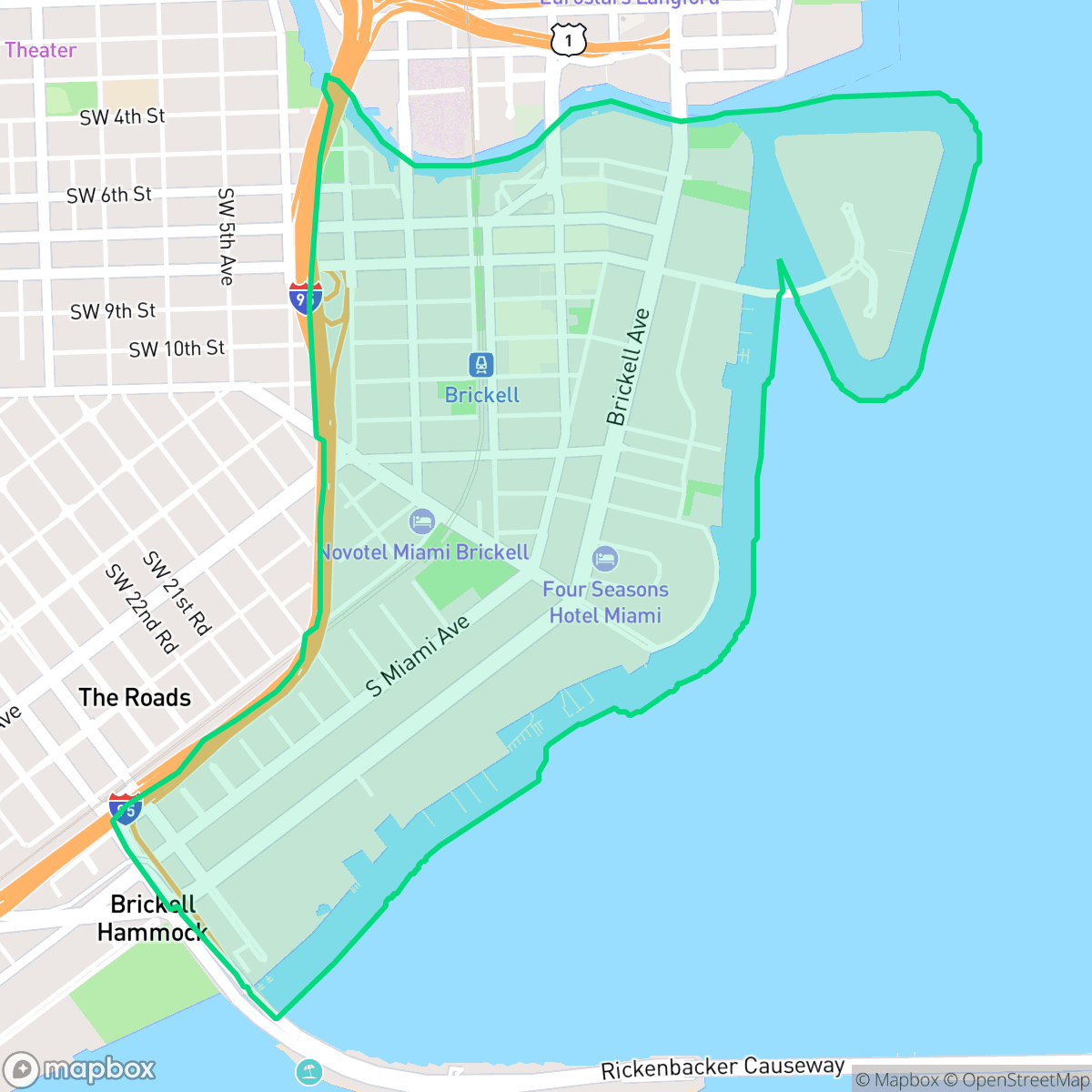
About Brickell
Originally settled in 1871 by William and Mary Brickell, the neighborhood was famously known as "Millionaires' Row" in the early 20th century due to the opulent mansions lining Brickell Avenue. The area underwent a dramatic transformation beginning in the 1970s, evolving from an exclusive residential enclave into a high-density international financial hub often called the "Wall Street of the South." A significant historical landmark is the Miami Circle, an archaeological site discovered in 1998 that preserves remnants of the Tequesta people, who inhabited the mouth of the Miami River centuries before European arrival. Today, Brickell is defined by its dense skyline of glass skyscrapers and major banking institutions, reflecting its transition into a global business center while maintaining deep connections to its indigenous and early pioneer history.
The area serves as a primary hub for international business and luxury high-rise living, offering a polished urban environment with immediate access to diverse amenities. The streetscape is dominated by modern architecture and extensive pedestrian infrastructure, making it one of the most accessible neighborhoods in the city for those who prefer to navigate by foot. The atmosphere remains active throughout the day and night, supported by a wide array of wellness, retail, and transit opportunities that cater to a demographic mix of professionals and families.
Prospective residents should weigh these benefits against the realities of a high-density urban environment. The neighborhood experiences frequent ambient noise from traffic and transit corridors, and the close proximity of residential units results in minimal privacy. Air quality and flood risk are notable concerns, and the area lacks significant natural greenery. While the local school district offers elite magnet programs, families should consider the broader challenges facing the public school system, including budget constraints and achievement gaps between specialized and neighborhood schools.
Neighborhood Scores Across 15 Qualities
High-density towers and closely spaced structures result in minimal separation between buildings. Residents may experience reduced privacy due to shared walls and the close proximity of adjacent residential units, which is noticeably lower than the Miami average.
Extensive sidewalk networks and waterfront promenades make most daily errands achievable on foot. This level of pedestrian infrastructure is significantly higher than the Miami average, particularly within the high-density core.
Modern high-rise towers and manicured waterfront developments create a visually upscale environment that sits above the city average. Residents can expect a skyline defined by luxury amenities, including rooftop pools and private marinas.
Access to green space for pets is primarily concentrated around waterfront promenades and Bayfront Park, though much of the dense urban grid consists of paved surfaces. According to iHuus data, dog friendliness in this area is slightly above the city average.
High-rise towers and extensive paved surfaces create an intense urban environment with significantly more concrete coverage than the Miami average. Residents will find a landscape dominated by skyscrapers, massive infrastructure, and very little natural greenery.
Dense high-rise corridors and a vast variety of dining, wellness, and transit options create an environment that is significantly more active than the Miami average. This walkable urban core remains lively after dark with a constant pulse of commercial and social activity.
Frequent noise from nearby transit corridors and heavy traffic patterns defines the acoustic environment. This level of disturbance is slightly higher than the average found throughout Miami.
Frequent unhealthy air quality levels pose significant risks to sensitive groups. According to iHuus data, the pollution levels in this area are notably worse than the Miami average.
Light industrial and logistics activity, such as nearby storage facilities and port-related warehouses, contributes to some heavy freight traffic and noise. According to iHuus data, this level of industrial proximity is slightly higher than the Miami average.
Health insurance access among residents is notably lower than the Miami average. According to iHuus data, a small minority of the local population maintains active health coverage.
Political leanings in this area are split fairly evenly between conservative and liberal viewpoints, closely mirroring the broader Miami metropolitan average.
Residents inhabit a demographic mix of young professionals, families, and older adults. This age distribution is slightly more balanced across different generations than the Miami average, according to iHuus data.
Frequent flooding concerns exist due to being situated within a designated floodplain; according to iHuus data, this vulnerability is higher than the typical level seen across Miami.
Address-Level Insights for Brickell


iHuus Neighborhood Intelligence Insights
Get address-level neighborhood insights for Brickell
- Street-level scores — see how individual blocks compare, not just neighborhood averages
- Micro-zone boundaries — identify quiet pockets, flood boundaries, and walkable clusters before you visit
- 15 dimensions in full — walkability, noise, air quality, school quality, insurance coverage, population age profile, urban/rural index, and more
- Boundary risk alerts — know if your address sits near a block boundary where scores drop, the kind of detail no listing will ever mention
- School insights — individual school ratings and insights, not just district-level data
- Compare before you commit — side-by-side data across neighborhoods, down to block precision
No credit card required
Compare with Any Neighborhood
| Dimension | Brickell | Alameda - West Flagler |
|---|---|---|
| 🚶 Walkabilityavg 6.81 | ||
| 🔊 Acoustic Comfortavg 3.72 | ||
| 🤫 Privacy Indexavg 4.25 | ||
| 🎨 Visual Appealavg 6.05 | ||
| 🐕 Dog Friendlinessavg 4.71 | ||
| 🗺️ Urban-Rural Indexavg 5.07 | ||
| ✨ Neighborhood Vibeavg 4.83 | ||
| 🏥 Health Insurance Coverageavg 4.76 | ||
| 🌿 Air Qualityavg 3.78 | ||
| 🏭 Industrial Proximityavg 6.31 | ||
| 🌊 Flood Safetyavg 3.97 | ||
| 🗳️ Ideological Leanavg 4.66 | ||
| 👥 Population Age Profileavg 4.38 | ||
| 🔥 Fire Safety | ||
| 🏫 School Quality |
Brickell Rankings
School Districts Serving Brickell
School Insights for Brickell
Below average outcomes; significant attendance and academic challenges.
School Insights
See what's really behind every school rating near Brickell
- Individual school ratings — each school's own score with outcome context, not just a district average
- Enrollment & class size data — student-to-teacher ratio and how it compares to the state average
- Full demographics breakdown — ethnicity and gender composition for every school in the enrollment zone
- Every school in the district — all schools within the enrollment boundary ranked by rating, not just the closest one
- Grade levels & benchmarks — elementary through high school, with below/above state-average flags
No credit card required