Biscayne Island, Miami
Updated · 162 residents
Biscayne Island is a scenic residential enclave known for its luxury waterfront estates and panoramic views of the Downtown Miami skyline. While the area offers a balanced suburban atmosphere with beautiful surroundings, residents should be prepared for potential flood risks and consistent background noise from nearby traffic.
Key Highlights
About Biscayne Island
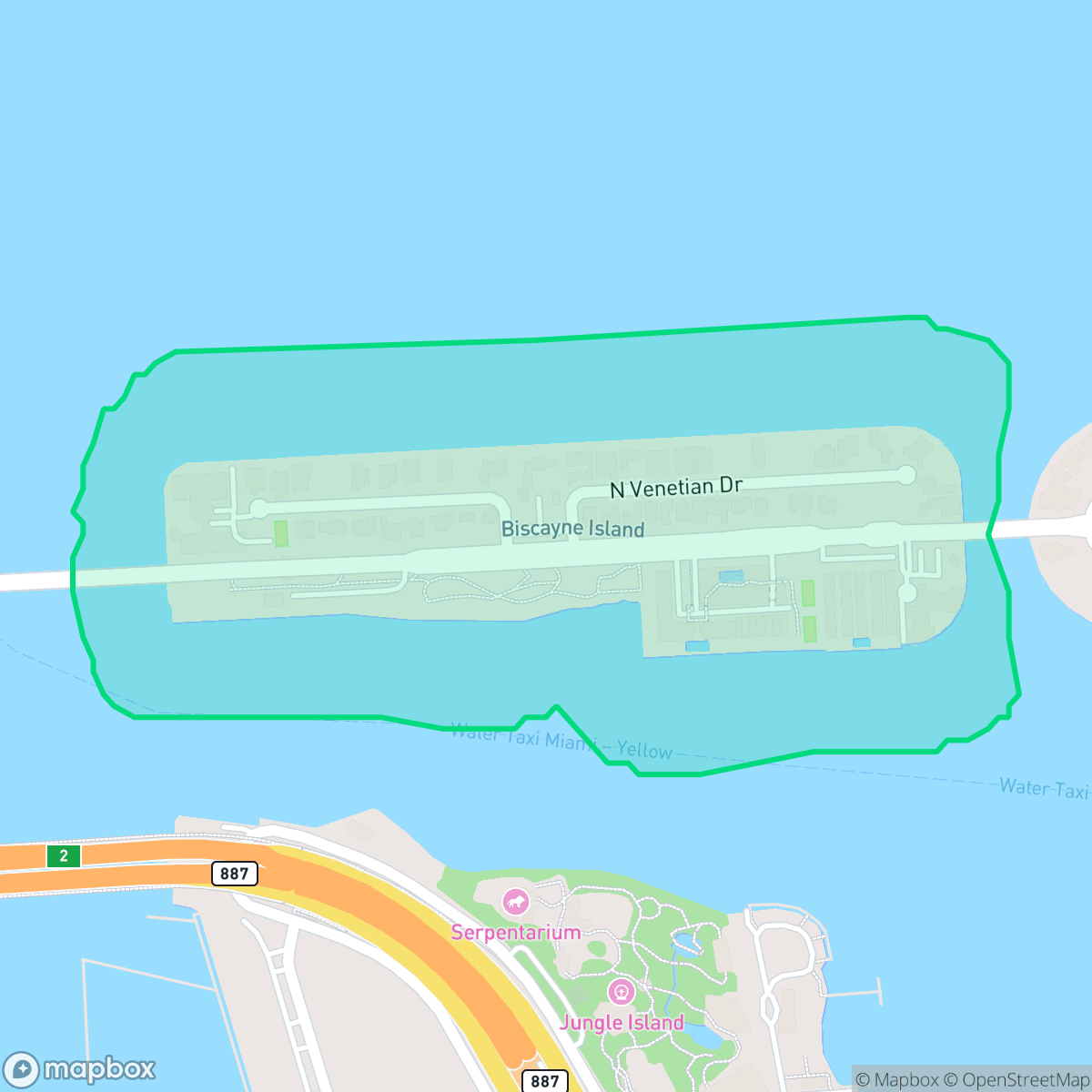
Biscayne Island is the westernmost of the Venetian Islands and holds the unique distinction of being the only island in the chain located entirely within the city limits of Miami. Unlike its neighbors, which were developed during the 1920s land boom, Biscayne Island was created in the 1930s through dredging. Its early history is defined by its role as the site of the Viking Field Airport, a private aviation facility featuring a hangar and a 260-foot sod runway primarily used by seaplanes. Following the closure of the airport in 1937, the island transitioned into a residential enclave in the 1940s. Today, it serves as the primary gateway to the Venetian Causeway and is characterized by exclusive, luxury waterfront estates that offer privacy and panoramic views of the Downtown Miami skyline.
Biscayne Island serves as a premier gateway to the Venetian Causeway, offering a highly manicured landscape defined by custom architecture and private marinas. The area maintains a balanced suburban feel, where well-maintained green spaces and waterfront promenades provide a scenic environment that stands out from the typical Miami cityscape. Residents here tend to be younger adults who value the combination of privacy and proximity to the urban core. Prospective residents should consider the trade-offs of living in this coastal environment, including a notable risk of flooding and fluctuating air quality. While the neighborhood provides a peaceful residential experience with minimal industrial presence, the consistent hum of traffic from nearby thoroughfares is a regular feature of the acoustic environment. Families should note that the local school district offers elite magnet programs, though it currently faces significant budget challenges and shifting enrollment trends.
Neighborhood Scores Across 15 Qualities
Residential spacing offers some separation between neighbors, though certain high-density towers experience much lower privacy levels. This level of seclusion is slightly higher than the city average according to iHuus data.
Dedicated sidewalks and waterfront promenades are readily available throughout the area. According to iHuus data, walkability in this neighborhood is consistent with the city average.
Custom architecture, private marinas, and lush privacy buffers create a highly manicured landscape that is significantly more aesthetically pleasing than the Miami average. Luxury amenities and waterfront views contribute to an exceptionally high level of visual quality throughout the area.
Waterfront parks provide moderate green space for pets, though much of the neighborhood consists of high-rise buildings and concrete surfaces. According to iHuus data, this level of access is slightly higher than the city average.
Street layouts and green spaces are distributed in nearly equal measure, offering a suburban character that is slightly less dense than the Miami average. While some pockets contain high-rise buildings with significant grey cover, much of the area maintains a balance between built structures and vegetation according to iHuus data.
Activity levels in this area align with the broader Miami average, offering a mix of high-density coastal hotspots and quieter residential stretches. Residents can experience both bustling dining hubs near the waterfront and much more subdued, low-key suburban pockets.
A consistent level of noise persists due to local traffic from nearby busy streets. This acoustic environment is slightly more active than the typical experience found across Miami.
Air quality in this area fluctuates between acceptable and unhealthy levels, presenting occasional concerns for sensitive groups. This level of air quality is slightly above the Miami average according to iHuus data.
Residential tranquility dominates the area, with far less heavy industry than the Miami average. While most streets are quiet and green, certain pockets near the airport introduce localized freight traffic and loading activity.
Health insurance access among residents is notably higher than the Miami average. According to iHuus data, a significant portion of the population maintains coverage, though a substantial group remains uninsured.
Political leanings in this area trend notably more liberal than the Miami average. Residents will find a community with a significant liberal majority and a small presence of opposing viewpoints, according to iHuus data.
A significant majority of residents are in the young adult demographic, with a smaller proportion of families and seniors. This age distribution is notably lower than the Miami city average according to iHuus data.
Frequent flood risk exists for this area as it sits within a designated floodplain. According to iHuus data, the susceptibility to flooding is notably higher than the Miami average.
Address-Level Insights for Biscayne Island


iHuus Neighborhood Intelligence Insights
Get address-level neighborhood insights for Biscayne Island
- Street-level scores — see how individual blocks compare, not just neighborhood averages
- Micro-zone boundaries — identify quiet pockets, flood boundaries, and walkable clusters before you visit
- 15 dimensions in full — walkability, noise, air quality, school quality, insurance coverage, population age profile, urban/rural index, and more
- Boundary risk alerts — know if your address sits near a block boundary where scores drop, the kind of detail no listing will ever mention
- School insights — individual school ratings and insights, not just district-level data
- Compare before you commit — side-by-side data across neighborhoods, down to block precision
No credit card required
Compare with Any Neighborhood
| Dimension | Biscayne Island | Alameda - West Flagler |
|---|---|---|
| 🚶 Walkabilityavg 6.81 | ||
| 🔊 Acoustic Comfortavg 3.72 | ||
| 🤫 Privacy Indexavg 4.25 | ||
| 🎨 Visual Appealavg 6.05 | ||
| 🐕 Dog Friendlinessavg 4.71 | ||
| 🗺️ Urban-Rural Indexavg 5.07 | ||
| ✨ Neighborhood Vibeavg 4.83 | ||
| 🏥 Health Insurance Coverageavg 4.76 | ||
| 🌿 Air Qualityavg 3.78 | ||
| 🏭 Industrial Proximityavg 6.31 | ||
| 🌊 Flood Safetyavg 3.97 | ||
| 🗳️ Ideological Leanavg 4.66 | ||
| 👥 Population Age Profileavg 4.38 | ||
| 🔥 Fire Safety | ||
| 🏫 School Quality |
Biscayne Island Rankings
School Districts Serving Biscayne Island
School Insights for Biscayne Island
Below average outcomes; significant attendance and academic challenges.
School Insights
See what's really behind every school rating near Biscayne Island
- Individual school ratings — each school's own score with outcome context, not just a district average
- Enrollment & class size data — student-to-teacher ratio and how it compares to the state average
- Full demographics breakdown — ethnicity and gender composition for every school in the enrollment zone
- Every school in the district — all schools within the enrollment boundary ranked by rating, not just the closest one
- Grade levels & benchmarks — elementary through high school, with below/above state-average flags
No credit card required