Allapattah, Miami
Updated · 43,977 residents
Allapattah is a culturally diverse neighborhood defined by its industrial roots and an evolving, vibrant arts scene. While the area offers a dynamic mix of local dining and social spaces, residents should expect frequent noise from heavy traffic and limited access to public green space.
Key Highlights
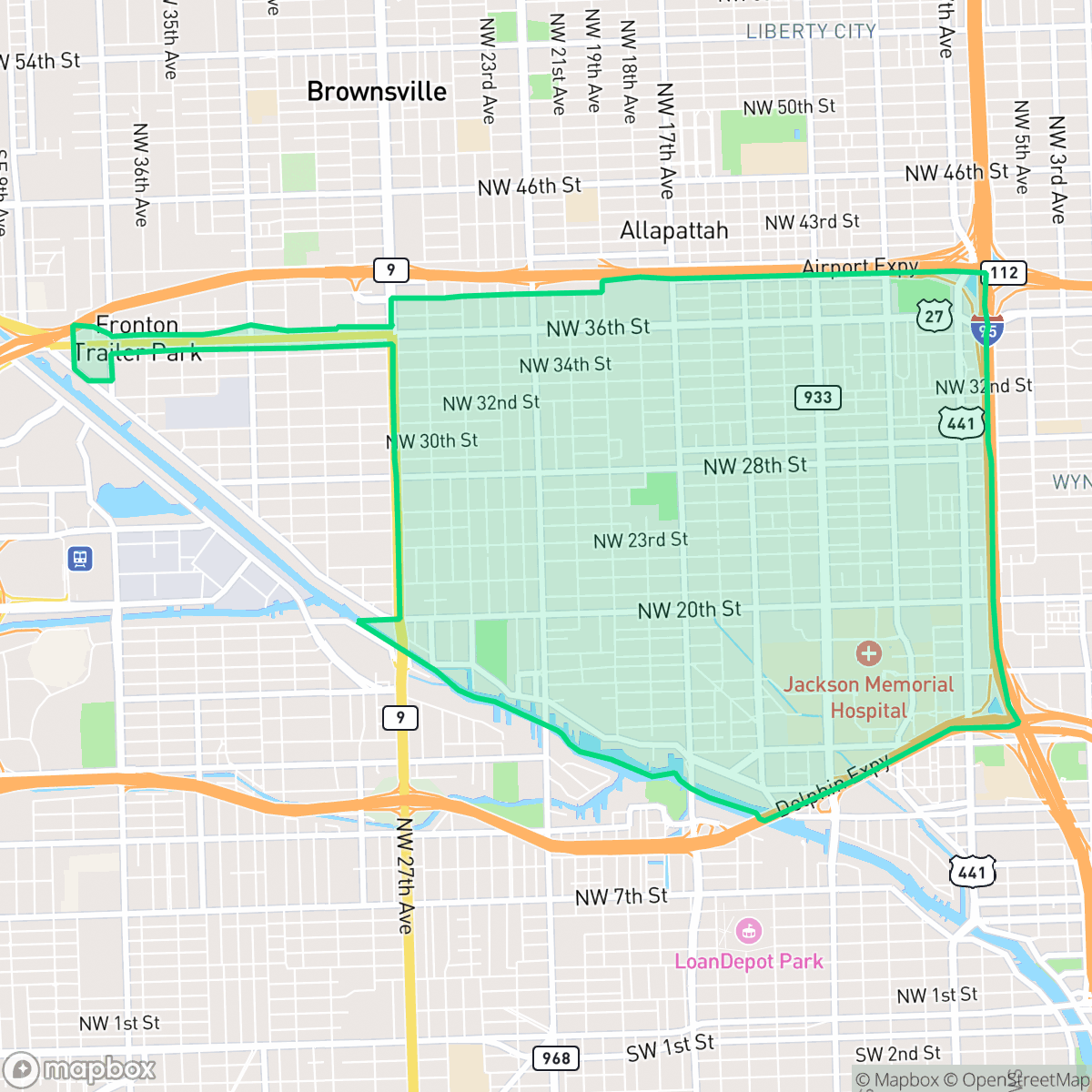
About Allapattah
The Allapattah neighborhood, whose name derives from the Seminole word for "alligator," traces its origins to the 1856 homestead of William P. Wagner. Development accelerated in the early 20th century with the arrival of the Florida East Coast Railway. Historically a working-class residential and industrial hub, Allapattah underwent significant demographic shifts in the mid-20th century, notably following the displacement of African American residents during the construction of I-95 and subsequent waves of Cuban, Dominican, and Central American migration. This heritage earned portions of the area the nickname "Little Santo Domingo." The neighborhood is defined by its industrial roots, evidenced by its textile markets and repurposed warehouse art spaces like the Rubell Museum, alongside local cultural fixtures such as Club Típico Dominicano. Today, it remains a diverse, evolving community bridging Miami’s industrial history with its modern cultural identity.
The area functions as a central hub where industrial warehouses sit alongside residential blocks, creating a utilitarian landscape that prioritizes accessibility over manicured aesthetics. It features a dense urban environment with a high level of activity, supported by a variety of local cafes and cultural venues that contribute to a lively social atmosphere. Its central position in Miami makes it a practical choice for those who value proximity to major transit corridors and an authentic, diverse community feel.
Prospective residents should weigh these benefits against the realities of living in a high-density industrial zone. The neighborhood experiences significant auditory disturbances from nearby railroad tracks and highway traffic, and the lack of expansive parks limits opportunities for outdoor recreation. Furthermore, the local school district is currently navigating a period of leadership transition and budget adjustments. While the area provides a unique, unvarnished look at the city's working landscape, it is best suited for individuals who prioritize central location and cultural character over quiet, suburban living.
Neighborhood Scores Across 15 Qualities
Residential spacing is comparable to the city average, featuring a mix of closely packed houses and larger institutional lots that provide occasional buffers. Some areas contain high-density structures with minimal separation between neighbors.
Sidewalk connectivity is inconsistent due to major highway interchanges and industrial roads that act as physical barriers. While residential streets often feature a structured grid with sidewalks, the presence of massive transit corridors makes walking across certain sections difficult compared to the city average.
A mix of industrial warehouses and tightly packed residential blocks defines the landscape, which lacks the lush greenery or luxury estates found more frequently across Miami. Most housing consists of uniform, modest structures with small yards and limited private amenities.
Access to public greenery and off-leash areas is restricted due to a dense urban landscape dominated by highways and industrial lots. While some athletic fields provide occasional open space, the area lacks the widespread green verges and park access found elsewhere in Miami.
A balance of residential streets and paved infrastructure defines this area, offering a blend of single-family homes and large commercial blocks. This density is slightly higher than the Miami average, as according to iHuus data, the neighborhood features significant grey cover alongside low-rise apartment units.
Dynamic commercial hubs and walkable pockets offer more activity than the city average, providing a diverse array of dining, cultural venues, and transit-oriented amenities. While some residential stretches remain quiet, many areas feature a high density of cafes, restaurants, and lively social spaces.
Frequent auditory disturbances from nearby railroad tracks and heavy freeway traffic characterize the area. According to iHuus data, acoustic comfort in Allapattah is notably lower than the Miami average.
Air quality levels fluctuate between acceptable and unhealthy periods, which may pose occasional concerns for sensitive groups. According to iHuus data, these conditions are slightly better than the average found across Miami.
Active logistics corridors and light industrial warehouses introduce frequent truck traffic and intermittent noise to the area. Residents should also note the presence of a nearby EPA Superfund site, which according to iHuus data, involves potential soil and groundwater contamination risks.
Health insurance coverage among residents is lower than the Miami average. According to iHuus data, a significant portion of the population lacks employer-sponsored or private medical coverage.
Political perspectives are evenly distributed across the area, representing a more balanced ideological split than the broader Miami average according to iHuus data.
Residents live alongside a balanced mix of young professionals, families, and seniors. According to iHuus data, this demographic distribution is slightly more varied than the average found across Miami.
Flood safety levels in Allapattah are roughly comparable to the city average, though specific risk assessments remain inconclusive due to a lack of detailed federal studies. Residents should exercise caution as current data does not provide a definitive flood profile for this area.
Address-Level Insights for Allapattah


iHuus Neighborhood Intelligence Insights
Get address-level neighborhood insights for Allapattah
- Street-level scores — see how individual blocks compare, not just neighborhood averages
- Micro-zone boundaries — identify quiet pockets, flood boundaries, and walkable clusters before you visit
- 15 dimensions in full — walkability, noise, air quality, school quality, insurance coverage, population age profile, urban/rural index, and more
- Boundary risk alerts — know if your address sits near a block boundary where scores drop, the kind of detail no listing will ever mention
- School insights — individual school ratings and insights, not just district-level data
- Compare before you commit — side-by-side data across neighborhoods, down to block precision
No credit card required
Compare with Any Neighborhood
| Dimension | Allapattah | Alameda - West Flagler |
|---|---|---|
| 🚶 Walkabilityavg 6.81 | ||
| 🔊 Acoustic Comfortavg 3.72 | ||
| 🤫 Privacy Indexavg 4.25 | ||
| 🎨 Visual Appealavg 6.05 | ||
| 🐕 Dog Friendlinessavg 4.71 | ||
| 🗺️ Urban-Rural Indexavg 5.07 | ||
| ✨ Neighborhood Vibeavg 4.83 | ||
| 🏥 Health Insurance Coverageavg 4.76 | ||
| 🌿 Air Qualityavg 3.78 | ||
| 🏭 Industrial Proximityavg 6.31 | ||
| 🌊 Flood Safetyavg 3.97 | ||
| 🗳️ Ideological Leanavg 4.66 | ||
| 👥 Population Age Profileavg 4.38 | ||
| 🔥 Fire Safety | ||
| 🏫 School Quality |
Allapattah Rankings
School Districts Serving Allapattah
School Insights for Allapattah
Below average outcomes; significant attendance and academic challenges.
School Insights
See what's really behind every school rating near Allapattah
- Individual school ratings — each school's own score with outcome context, not just a district average
- Enrollment & class size data — student-to-teacher ratio and how it compares to the state average
- Full demographics breakdown — ethnicity and gender composition for every school in the enrollment zone
- Every school in the district — all schools within the enrollment boundary ranked by rating, not just the closest one
- Grade levels & benchmarks — elementary through high school, with below/above state-average flags
No credit card required