Star island, Miami Beach
Updated · 1,187 residents
Star Island is a secluded, gated residential enclave known for its expansive waterfront estates and manicured landscapes. While it offers a quiet, suburban atmosphere, residents should anticipate high flood risks and a reliance on personal vehicles for transportation.
Key Highlights
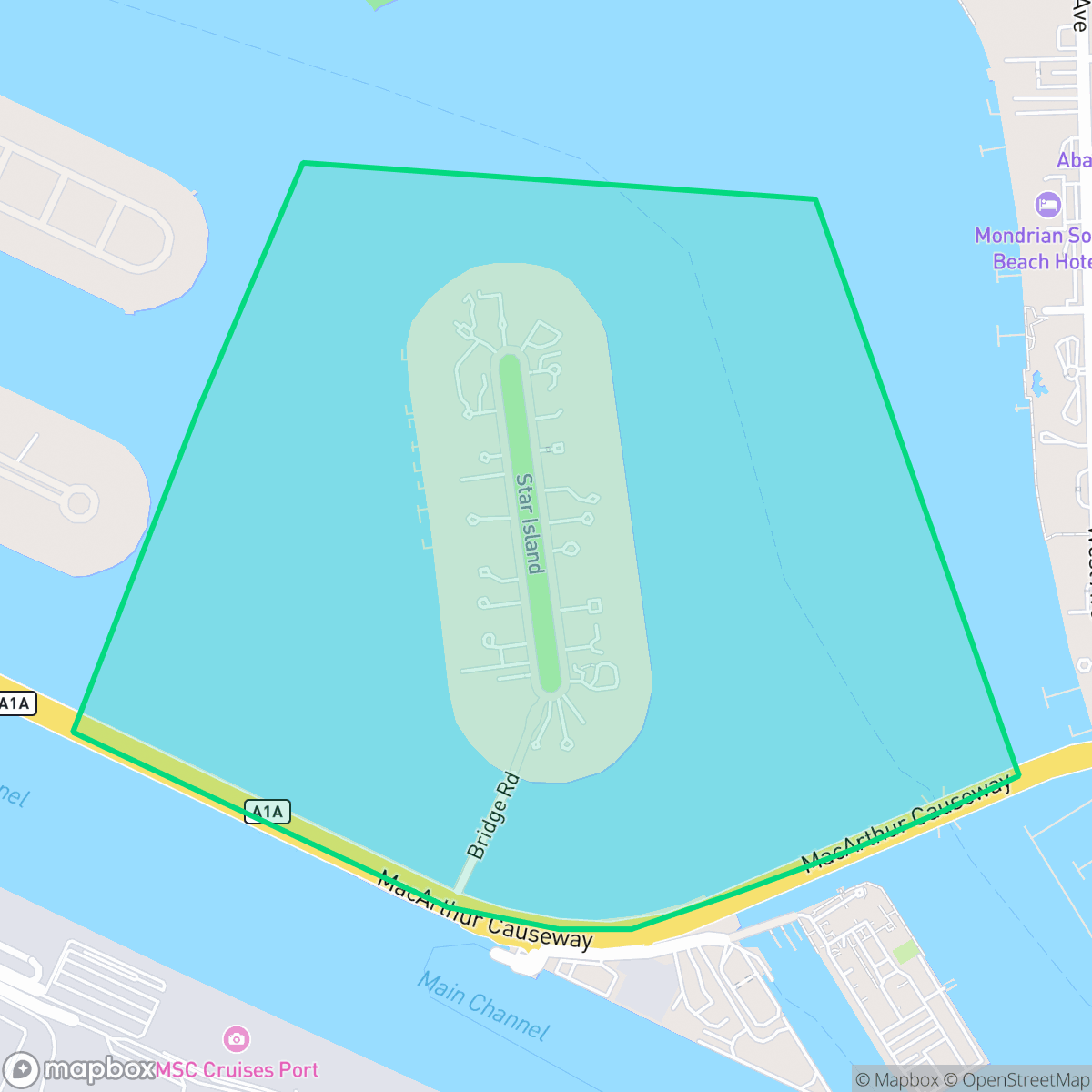
About Star island
Star Island is an exclusive, man-made residential enclave in Miami Beach, developed by visionary Carl Fisher and completed in 1922. Created through extensive dredging operations by the U.S. Army Corps of Engineers, the island was designed as a private sanctuary for the wealthy. Its architectural heritage is anchored by early 20th-century Mediterranean Revival and Mission Revival homes, many designed by architect Walter De Garmo, characterized by stucco facades and red-tiled roofs. Over the decades, the island has evolved into one of the most prestigious addresses in the United States, defined by its high-security gated access, waterfront mega-mansions, and a long-standing reputation as a secluded haven for celebrities and business moguls. Its history reflects the rapid transformation of Biscayne Bay’s submerged lands into a symbol of extreme luxury and privacy.
The area functions as a quiet retreat, characterized by low building density and significant greenery that creates a suburban feel within the broader Miami Beach landscape. It is defined by its focus on private residential life, lacking the commercial activity and social energy found in more central parts of the city. The visual landscape is dominated by large, manicured waterfront estates that prioritize privacy and exclusivity.
Potential residents should be aware of several environmental and logistical considerations. The neighborhood faces significant flood risks and exhibits poor air quality levels that may impact sensitive groups. Acoustic comfort is also a factor, as the area experiences noticeable noise from nearby transit corridors and flight paths. Furthermore, while the streets are quiet, the lack of sidewalks makes the area less pedestrian-friendly, necessitating a car for most daily errands. It is best suited for those who prioritize privacy and quiet residential living over walkability or proximity to urban amenities.
Neighborhood Scores Across 15 Qualities
Living arrangements vary between dense mainland structures with shared walls and more isolated estate homes on the island. According to iHuus data, this level of privacy is roughly comparable to the broader Miami Beach area.
Walking is possible along the quiet residential streets, though the lack of sidewalks makes it less pedestrian friendly than much of Miami Beach. Most trips will require a vehicle due to limited connectivity for those on foot.
Upscale waterfront estates and luxury high-rise condos define the landscape, though the overall visual variety is slightly below the Miami Beach average. Large lots with private docks and manicured greenery characterize much of the area according to iHuus data.
Access to dedicated green spaces and public parks for pets is below the Miami Beach average. While waterfront promenades provide some walking options, there is a lack of extensive parkland within this specific area.
Low building density and significant greenery provide a more suburban feel than the typical Miami Beach urban core. According to iHuus data, this area features a balance of residential space and open landscape that is less dense than the city average.
Residential life here is tranquil and subdued, lacking the commercial activity and social energy found in more central parts of Miami Beach. According to iHuus data, this area is significantly less bustling than the city average due to its minimal retail presence and focus on private residential landscapes.
Frequent sounds from nearby transit corridors and flight paths characterize the area. This level of acoustic disturbance is slightly higher than the Miami Beach average, according to iHuus data.
Frequent unhealthy air quality levels pose a significant risk to sensitive groups. According to iHuus data, conditions in this area are slightly worse than the Miami Beach average.
Residential life here remains largely undisturbed by heavy industry, as the area lacks large-scale warehouses or hazardous facilities. While some light commercial activity exists, the level of industrial proximity is notably lower than the Miami Beach average.
Health insurance enrollment among residents is notably lower than the Miami Beach average, according to iHuus data.
Political perspectives on Star Island are evenly split, representing a more balanced ideological landscape than the more liberal leaning average of Miami Beach. According to iHuus data, no single political orientation dominates the local community.
Young adults comprise the majority of the resident population, making the area notably younger than the Miami Beach average. According to iHuus data, there is a relatively small presence of families or older residents in this area.
Located within a designated floodplain, this area faces significant inundation risks and likely requires flood insurance. According to iHuus data, the vulnerability to flooding is slightly higher than the Miami Beach average.
Address-Level Insights for Star island


iHuus Neighborhood Intelligence Insights
Get address-level neighborhood insights for Star island
- Street-level scores — see how individual blocks compare, not just neighborhood averages
- Micro-zone boundaries — identify quiet pockets, flood boundaries, and walkable clusters before you visit
- 15 dimensions in full — walkability, noise, air quality, school quality, insurance coverage, population age profile, urban/rural index, and more
- Boundary risk alerts — know if your address sits near a block boundary where scores drop, the kind of detail no listing will ever mention
- School insights — individual school ratings and insights, not just district-level data
- Compare before you commit — side-by-side data across neighborhoods, down to block precision
No credit card required
Compare with Any Neighborhood
| Dimension | Star island | Bayshore |
|---|---|---|
| 🚶 Walkabilityavg 7.83 | ||
| 🔊 Acoustic Comfortavg 4 | ||
| 🤫 Privacy Indexavg 4.76 | ||
| 🎨 Visual Appealavg 8.17 | ||
| 🐕 Dog Friendlinessavg 5.83 | ||
| 🗺️ Urban-Rural Indexavg 4.39 | ||
| ✨ Neighborhood Vibeavg 4.49 | ||
| 🏥 Health Insurance Coverageavg 6.26 | ||
| 🌿 Air Qualityavg 3.72 | ||
| 🏭 Industrial Proximityavg 8.28 | ||
| 🌊 Flood Safetyavg 2.65 | ||
| 🗳️ Ideological Leanavg 4.64 | ||
| 👥 Population Age Profileavg 4.7 | ||
| 🔥 Fire Safety | ||
| 🏫 School Quality |
Star island Rankings
School Districts Serving Star island
School Insights for Star island
Below average outcomes; significant attendance and academic challenges.
School Insights
See what's really behind every school rating near Star island
- Individual school ratings — each school's own score with outcome context, not just a district average
- Enrollment & class size data — student-to-teacher ratio and how it compares to the state average
- Full demographics breakdown — ethnicity and gender composition for every school in the enrollment zone
- Every school in the district — all schools within the enrollment boundary ranked by rating, not just the closest one
- Grade levels & benchmarks — elementary through high school, with below/above state-average flags
No credit card required