Rivo Alto Island, Miami Beach
Updated · 504 residents
Rivo Alto Island is a quiet residential enclave defined by its luxury waterfront estates and serene, low-traffic environment. While it provides a peaceful sanctuary away from the bustle of the mainland, prospective residents should consider the area's significant flood risk and limited pedestrian infrastructure.
Key Highlights
About Rivo Alto Island
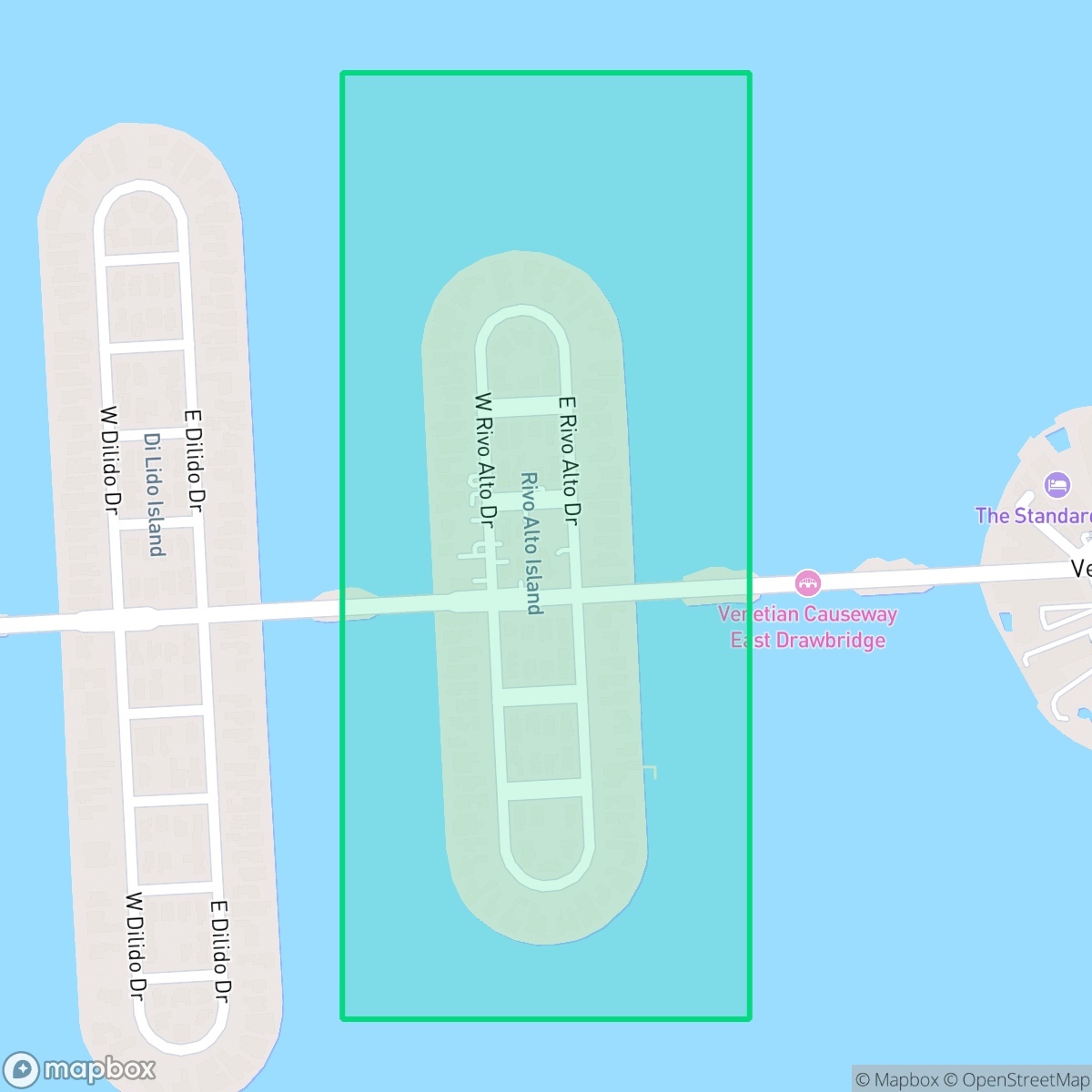
Rivo Alto Island is one of the six man-made Venetian Islands in Biscayne Bay, constructed in 1926 through dredging as part of a development project led by John S. Collins and Carl Fisher. Designed to evoke the allure of Venice, Italy, its name pays homage to the historic Rivoalto settlement. The island is an exclusively residential enclave featuring a mix of Mediterranean-style villas and contemporary luxury estates. Connected to the mainland and Miami Beach by the historic Venetian Causeway, the island remains a quiet, tree-lined sanctuary without commercial development. Its history is defined by the 1920s Florida land boom, which transformed shallow bay sandbars into prime waterfront real estate, establishing a legacy of privacy and prestige that continues to attract residents today.
The neighborhood serves as a secluded retreat, characterized by its low density and minimal industrial activity. Residents enjoy a tranquil atmosphere where the primary ambient noise consists of distant traffic, creating a distinct sense of calm that is rare in the broader Miami Beach area. The architectural landscape is composed of a mix of Mediterranean villas and contemporary luxury homes, many of which feature private docks that take advantage of the waterfront location.
Living here requires adjusting to specific trade-offs, particularly regarding environmental and accessibility factors. The area faces a higher risk of flooding than many surrounding locations, and air quality can occasionally be a concern for sensitive groups. While the streets are quiet, the lack of extensive sidewalks and limited green space makes the neighborhood less accessible for pet owners or those who prioritize high walkability. Families residing here fall within the Dade County School District, which offers access to elite magnet programs despite broader challenges with enrollment and budget management.
Neighborhood Scores Across 15 Qualities
Residential spacing fluctuates significantly due to the presence of both high-density condo towers and low-density luxury estates. This mix results in a level of privacy that is slightly below the Miami Beach average.
Low traffic levels on residential loops provide a calm environment for pedestrians, though the lack of consistent sidewalks makes it less walkable than the Miami Beach average. Continuous paths are primarily restricted to the main causeway.
Waterfront estates and luxury high-rise towers define the local landscape, though the overall visual variety is slightly below the Miami Beach average. According to iHuus data, many properties feature private docks and premium amenities.
Limited green space and narrow sidewalks make pet walking difficult; this area offers significantly less accessibility for dogs than the rest of Miami Beach. While some residential streets feature wider verges and a central park, most of the landscape consists of sparse greenery and fenced areas.
A mix of high-rise condominiums and dense residential islands creates an urban coastal setting that is slightly more suburban than the Miami Beach average. This layout provides a comparable balance of built structures and green space across the area.
Low-key residential activity and sparse commercial density make this area significantly quieter than the Miami Beach average. Most residents will find a subdued atmosphere characterized by limited local services and primarily suburban-style housing blocks.
Acoustic levels are notably lower than the Miami Beach average, consisting primarily of infrequent distant traffic. According to iHuus data, residents can expect a peaceful environment with very little ambient noise.
Frequent unhealthy air quality levels pose a significant risk to sensitive groups. According to iHuus data, the pollution levels in this area are worse than the Miami Beach average.
Minimal industrial activity characterizes this area, which consists primarily of residential streets and recreational green spaces. While some light commercial use exists, the presence of heavy industry is lower than the Miami Beach average according to iHuus data.
Health insurance coverage among residents is consistent with the city average. According to iHuus data, most inhabitants in this area maintain access to medical coverage.
Political leanings in this area are split relatively evenly between conservative and liberal perspectives, making it more ideologically diverse than the Miami Beach city average according to iHuus data.
Residents experience a balanced mix of young adults, families, and seniors, though the area leans slightly more toward an older demographic than the Miami Beach average.
Significant flood risk exists because this area sits within a designated floodplain; according to iHuus data, this vulnerability is higher than the Miami Beach average and typically necessitates flood insurance.
Address-Level Insights for Rivo Alto Island


iHuus Neighborhood Intelligence Insights
Get address-level neighborhood insights for Rivo Alto Island
- Street-level scores — see how individual blocks compare, not just neighborhood averages
- Micro-zone boundaries — identify quiet pockets, flood boundaries, and walkable clusters before you visit
- 15 dimensions in full — walkability, noise, air quality, school quality, insurance coverage, population age profile, urban/rural index, and more
- Boundary risk alerts — know if your address sits near a block boundary where scores drop, the kind of detail no listing will ever mention
- School insights — individual school ratings and insights, not just district-level data
- Compare before you commit — side-by-side data across neighborhoods, down to block precision
No credit card required
Compare with Any Neighborhood
| Dimension | Rivo Alto Island | Bayshore |
|---|---|---|
| 🚶 Walkabilityavg 7.83 | ||
| 🔊 Acoustic Comfortavg 4 | ||
| 🤫 Privacy Indexavg 4.76 | ||
| 🎨 Visual Appealavg 8.17 | ||
| 🐕 Dog Friendlinessavg 5.83 | ||
| 🗺️ Urban-Rural Indexavg 4.39 | ||
| ✨ Neighborhood Vibeavg 4.49 | ||
| 🏥 Health Insurance Coverageavg 6.26 | ||
| 🌿 Air Qualityavg 3.72 | ||
| 🏭 Industrial Proximityavg 8.28 | ||
| 🌊 Flood Safetyavg 2.65 | ||
| 🗳️ Ideological Leanavg 4.64 | ||
| 👥 Population Age Profileavg 4.7 | ||
| 🔥 Fire Safety | ||
| 🏫 School Quality |
Rivo Alto Island Rankings
School Districts Serving Rivo Alto Island
School Insights for Rivo Alto Island
Below average outcomes; significant attendance and academic challenges.
School Insights
See what's really behind every school rating near Rivo Alto Island
- Individual school ratings — each school's own score with outcome context, not just a district average
- Enrollment & class size data — student-to-teacher ratio and how it compares to the state average
- Full demographics breakdown — ethnicity and gender composition for every school in the enrollment zone
- Every school in the district — all schools within the enrollment boundary ranked by rating, not just the closest one
- Grade levels & benchmarks — elementary through high school, with below/above state-average flags
No credit card required