Palm Island, Miami Beach
Updated · 210 residents
Palm Island is an exclusive, gated enclave in Biscayne Bay defined by its high-value waterfront estates and secluded, tranquil atmosphere. While the neighborhood offers significant privacy and scenic beauty, it lacks extensive local amenities and faces higher-than-average flood risks.
Key Highlights
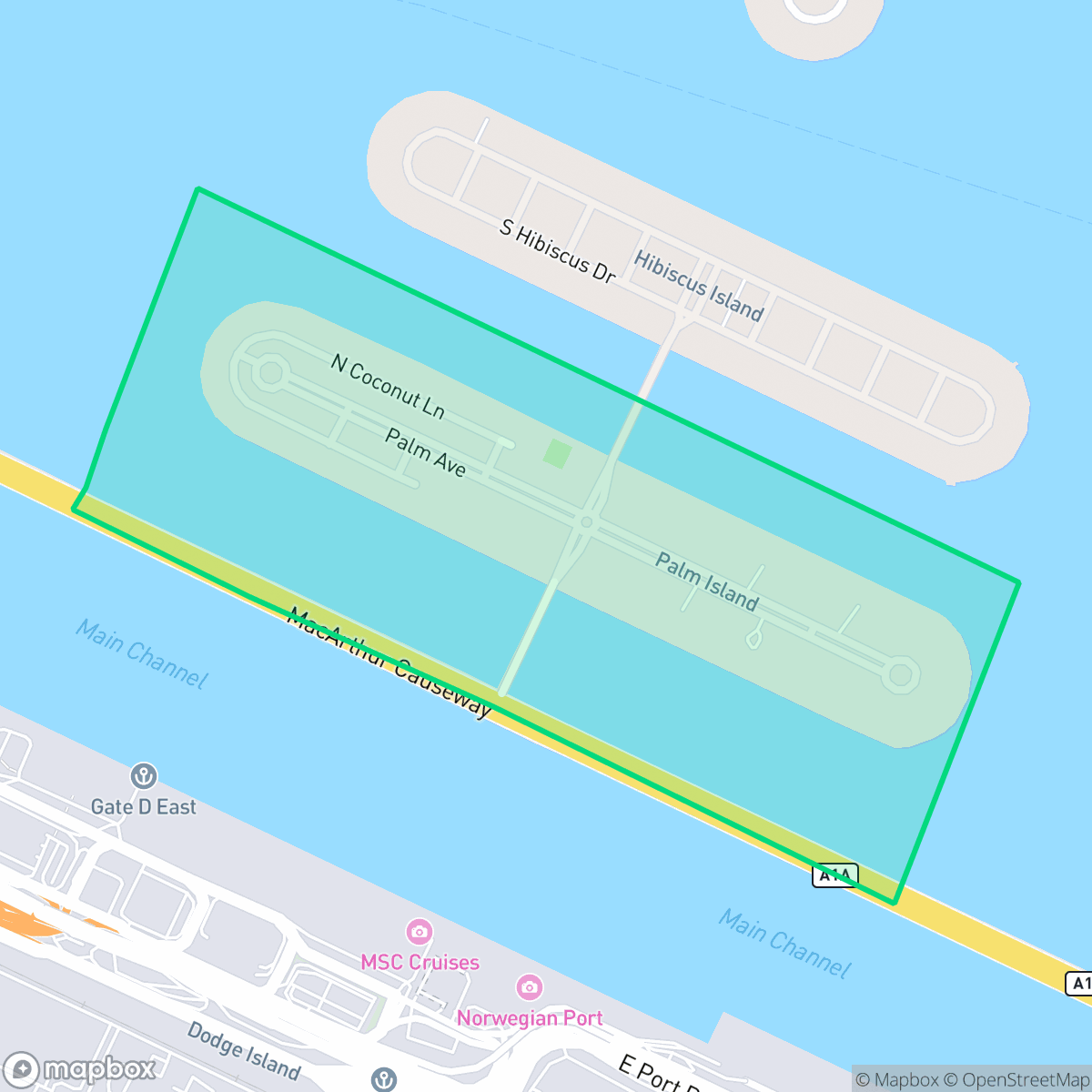
About Palm Island
Palm Island is an 82-acre man-made neighborhood in Biscayne Bay, created in 1922 by the Army Corps of Engineers through the dredging of bay-bottom sand. Developed as an exclusive residential enclave, it quickly became a symbol of the Roaring Twenties' opulence. The island gained notoriety for the Palm Island Club, a Prohibition-era casino that later became the famous Latin Quarter nightclub, a premier entertainment venue that hosted stars like Frank Sinatra and Sammy Davis Jr. until it burned down in 1959. The neighborhood is perhaps best known as the longtime residence of mobster Al Capone, who purchased a waterfront estate there in 1928. Today, the island remains a secure, gated residential community, characterized by its high-value waterfront properties and its history as a secluded retreat for the elite.
The neighborhood offers a distinct semi-rural character within the heart of Miami Beach, defined by its spacious lots and high-end, custom residential architecture. This quiet, gated environment provides a level of privacy that is rare for the region, creating a secluded retreat for those seeking a tranquil lifestyle away from the dense urban core. The area maintains a low industrial presence, focusing instead on green spaces and residential streets that prioritize visual appeal over commercial activity. Prospective residents should consider that the area is primarily populated by young adults and lacks the extensive local businesses or pet-friendly amenities found in more central parts of the city. While the streets are calm, the lack of sidewalks can limit walkability, and the neighborhood is situated within a designated floodplain. Families should evaluate the local school district, which features high-performing magnet programs but faces ongoing budget and enrollment challenges. According to iHuus data, the area also experiences variable air quality and moderate noise from nearby traffic thoroughfares, making it a better fit for those prioritizing privacy and aesthetics over immediate access to urban conveniences.
Neighborhood Scores Across 15 Qualities
Residential spacing offers a balanced level of separation between neighbors. This degree of privacy is higher than the average found across Miami Beach, according to iHuus data.
Low traffic volumes and calm streets allow for easy strolling, though the lack of sidewalks makes this area less walkable than much of Miami Beach.
Low density architecture and significant privacy buffers create a highly aesthetic environment that is notably more visually appealing than the Miami Beach average. According to iHuus data, the landscape is characterized by custom estates and high-end amenities.
Public park access and green spaces for walking dogs are less common here than in the rest of Miami Beach. According to iHuus data, pet owners may find fewer nearby options for outdoor exercise compared to other city neighborhoods.
Frequent open land and scattered residences provide a more semi-rural feel than the typical Miami Beach landscape, according to iHuus data.
Low-key residential life defines this area, which lacks the commercial activity and points of interest found elsewhere in Miami Beach. According to iHuus data, the neighborhood offers a subdued atmosphere with very few local amenities or businesses.
Steady traffic sounds from nearby thoroughfares are present. This level of acoustic activity is roughly in line with the average noise levels found throughout Miami Beach, according to iHuus data.
Air conditions in Palm Island fluctuate between acceptable and unhealthy levels, though quality remains slightly better than the Miami Beach average according to iHuus data. Sensitive groups may experience occasional concern during certain periods.
Residential life remains largely undisturbed by heavy industry, though there is slightly more commercial activity than found in the broader Miami Beach area. According to iHuus data, the neighborhood consists primarily of quiet streets and green spaces with only occasional light commercial use.
Health insurance access among residents is significantly lower than the Miami Beach average, according to iHuus data.
Political leanings in this area are predominantly liberal, representing a notable shift toward progressive views compared to the Miami Beach average according to iHuus data.
Residents are predominantly young adults, which distinguishes this area from the more age-diverse population found across Miami Beach. According to iHuus data, there is a noticeably lower presence of families and seniors here compared to the city average.
Property inundation risk is elevated because much of the area sits within a designated floodplain. According to iHuus data, flood vulnerability in this neighborhood is higher than the Miami Beach average.
Address-Level Insights for Palm Island


iHuus Neighborhood Intelligence Insights
Get address-level neighborhood insights for Palm Island
- Street-level scores — see how individual blocks compare, not just neighborhood averages
- Micro-zone boundaries — identify quiet pockets, flood boundaries, and walkable clusters before you visit
- 15 dimensions in full — walkability, noise, air quality, school quality, insurance coverage, population age profile, urban/rural index, and more
- Boundary risk alerts — know if your address sits near a block boundary where scores drop, the kind of detail no listing will ever mention
- School insights — individual school ratings and insights, not just district-level data
- Compare before you commit — side-by-side data across neighborhoods, down to block precision
No credit card required
Compare with Any Neighborhood
| Dimension | Palm Island | Bayshore |
|---|---|---|
| 🚶 Walkabilityavg 7.83 | ||
| 🔊 Acoustic Comfortavg 4 | ||
| 🤫 Privacy Indexavg 4.76 | ||
| 🎨 Visual Appealavg 8.17 | ||
| 🐕 Dog Friendlinessavg 5.83 | ||
| 🗺️ Urban-Rural Indexavg 4.39 | ||
| ✨ Neighborhood Vibeavg 4.49 | ||
| 🏥 Health Insurance Coverageavg 6.26 | ||
| 🌿 Air Qualityavg 3.72 | ||
| 🏭 Industrial Proximityavg 8.28 | ||
| 🌊 Flood Safetyavg 2.65 | ||
| 🗳️ Ideological Leanavg 4.64 | ||
| 👥 Population Age Profileavg 4.7 | ||
| 🔥 Fire Safety | ||
| 🏫 School Quality |
Palm Island Rankings
School Districts Serving Palm Island
School Insights for Palm Island
Below average outcomes; significant attendance and academic challenges.
School Insights
See what's really behind every school rating near Palm Island
- Individual school ratings — each school's own score with outcome context, not just a district average
- Enrollment & class size data — student-to-teacher ratio and how it compares to the state average
- Full demographics breakdown — ethnicity and gender composition for every school in the enrollment zone
- Every school in the district — all schools within the enrollment boundary ranked by rating, not just the closest one
- Grade levels & benchmarks — elementary through high school, with below/above state-average flags
No credit card required