North Shore, Miami Beach
Updated · 14,098 residents
North Shore is a highly walkable community characterized by its dense urban layout and vibrant coastal corridors. Residents enjoy access to well-maintained parks and upscale waterfront scenery, though the area experiences frequent traffic noise and limited residential privacy.
Key Highlights
About North Shore
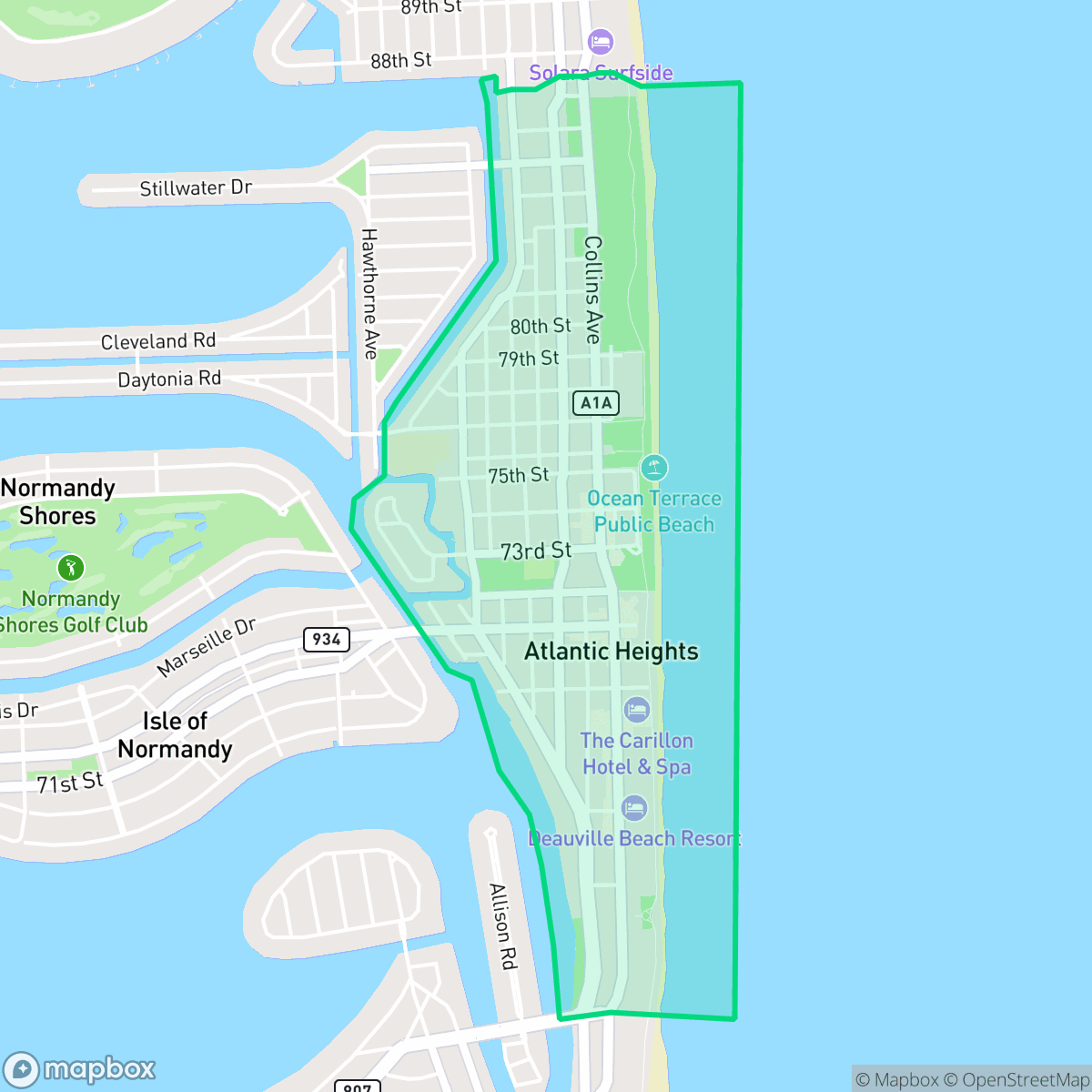
The North Shore neighborhood in Miami Beach, a key component of North Beach, was transformed from a wild barrier island into a residential community starting in 1919 by the Tatum brothers. Originally home to a Coast Guard station and coconut plantations, the area experienced its primary development surge following World War II. It is defined by the North Shore Historic District, which preserves one of the city's most intact concentrations of Miami Modern (MiMo) architecture. These mid-century garden-style apartments, featuring sweeping curves, acute angles, and airy designs, offer a distinct architectural contrast to the Art Deco style of South Beach. Notable local landmarks include the North Shore Open Space Park, which provides rare canopy-shaded beachfront, and the Tatum Waterway, a man-made canal that helped shape the neighborhood's western boundary.
The area functions as a lively urban hub where residents benefit from an extensive network of pedestrian paths and consistent crosswalks. It maintains a clean environment free from heavy industrial activity, supported by high levels of health insurance coverage among the local population. The aesthetic appeal is defined by manicured landscapes and luxury high-rises that overlook the Atlantic, creating a sophisticated visual environment that balances social energy with accessible outdoor spaces.
Prospective residents should consider that the neighborhood features a dense, high-rise layout that results in limited private outdoor space and a higher risk of flooding. While the community offers a diverse age profile and a balanced political climate, the prevalence of steady traffic noise and fluctuating air quality are notable trade-offs. The area is well-suited for those who prioritize walkability and proximity to the coast, though families should weigh these benefits against the broader challenges currently facing the Dade County School District, including budget constraints and shifting enrollment trends.
Neighborhood Scores Across 15 Qualities
Residential spacing varies significantly, though many areas feature closely packed structures and high-rises that overlook private backyards. This density leads to a lower level of privacy compared to the Miami Beach average.
Extensive sidewalk networks, pedestrian-only beach paths, and a dense grid layout make navigating this area on foot much easier than in most parts of Miami Beach. According to iHuus data, the neighborhood features consistent crosswalks and low-traffic residential streets that prioritize pedestrian movement.
Manicured landscapes, luxury high-rises, and private waterfront estates create a highly aesthetic environment that is consistent with the city average. According to iHuus data, the area features frequent amenities such as private pools, well-maintained greenspaces, and large docks.
Continuous sidewalks, coastal parks, and wide beachfront strips provide ample walking space for pets. According to iHuus data, these connected green corridors offer much better accessibility for dog owners than the average Miami Beach neighborhood.
High-rise buildings and significant grey infrastructure characterize this area, making it more densely built than the Miami Beach average. According to iHuus data, the landscape consists of multi-story structures with limited green space.
Active coastal corridors and dense high-rise hubs provide a noticeable concentration of dining, transit, and nightlife that is significantly more vibrant than the Miami Beach average. According to iHuus data, certain pockets offer intense social energy near major hotels, while other residential sections remain more subdued and focused on outdoor park spaces.
Steady traffic sounds from nearby busy streets are common here; however, acoustic comfort levels remain slightly higher than the Miami Beach average according to iHuus data.
Air quality levels in North Shore fluctuate between acceptable and unhealthy, though conditions are slightly better than the Miami Beach average. Sensitive groups may experience occasional concern during periods of poor air quality according to iHuus data.
Industrial activity is virtually nonexistent in this area, providing a cleaner environment than much of Miami Beach. While small-scale commercial services and utility tanks are present, there are no heavy industrial hazards or warehouses nearby.
Health insurance accessibility among residents is notably higher than the Miami Beach average, according to iHuus data.
Political leanings in North Shore are split relatively evenly between conservative and liberal perspectives, mirroring the broader distribution found across Miami Beach.
Residents live alongside a more varied mix of young adults, families, and seniors than is typically found in the wider Miami Beach area. This demographic variety according to iHuus data creates a community with a balanced age distribution.
Property sits within a designated floodplain, meaning flood insurance is typically required for residents. According to iHuus data, the level of flood risk in North Shore is higher than the Miami Beach average.
Address-Level Insights for North Shore


iHuus Neighborhood Intelligence Insights
Get address-level neighborhood insights for North Shore
- Street-level scores — see how individual blocks compare, not just neighborhood averages
- Micro-zone boundaries — identify quiet pockets, flood boundaries, and walkable clusters before you visit
- 15 dimensions in full — walkability, noise, air quality, school quality, insurance coverage, population age profile, urban/rural index, and more
- Boundary risk alerts — know if your address sits near a block boundary where scores drop, the kind of detail no listing will ever mention
- School insights — individual school ratings and insights, not just district-level data
- Compare before you commit — side-by-side data across neighborhoods, down to block precision
No credit card required
Compare with Any Neighborhood
| Dimension | North Shore | Bayshore |
|---|---|---|
| 🚶 Walkabilityavg 7.83 | ||
| 🔊 Acoustic Comfortavg 4 | ||
| 🤫 Privacy Indexavg 4.76 | ||
| 🎨 Visual Appealavg 8.17 | ||
| 🐕 Dog Friendlinessavg 5.83 | ||
| 🗺️ Urban-Rural Indexavg 4.39 | ||
| ✨ Neighborhood Vibeavg 4.49 | ||
| 🏥 Health Insurance Coverageavg 6.26 | ||
| 🌿 Air Qualityavg 3.72 | ||
| 🏭 Industrial Proximityavg 8.28 | ||
| 🌊 Flood Safetyavg 2.65 | ||
| 🗳️ Ideological Leanavg 4.64 | ||
| 👥 Population Age Profileavg 4.7 | ||
| 🔥 Fire Safety | ||
| 🏫 School Quality |
North Shore Rankings
School Districts Serving North Shore
School Insights for North Shore
Below average outcomes; significant attendance and academic challenges.
School Insights
See what's really behind every school rating near North Shore
- Individual school ratings — each school's own score with outcome context, not just a district average
- Enrollment & class size data — student-to-teacher ratio and how it compares to the state average
- Full demographics breakdown — ethnicity and gender composition for every school in the enrollment zone
- Every school in the district — all schools within the enrollment boundary ranked by rating, not just the closest one
- Grade levels & benchmarks — elementary through high school, with below/above state-average flags
No credit card required