Isle of Normandy, Miami Beach
Updated · 9,875 residents
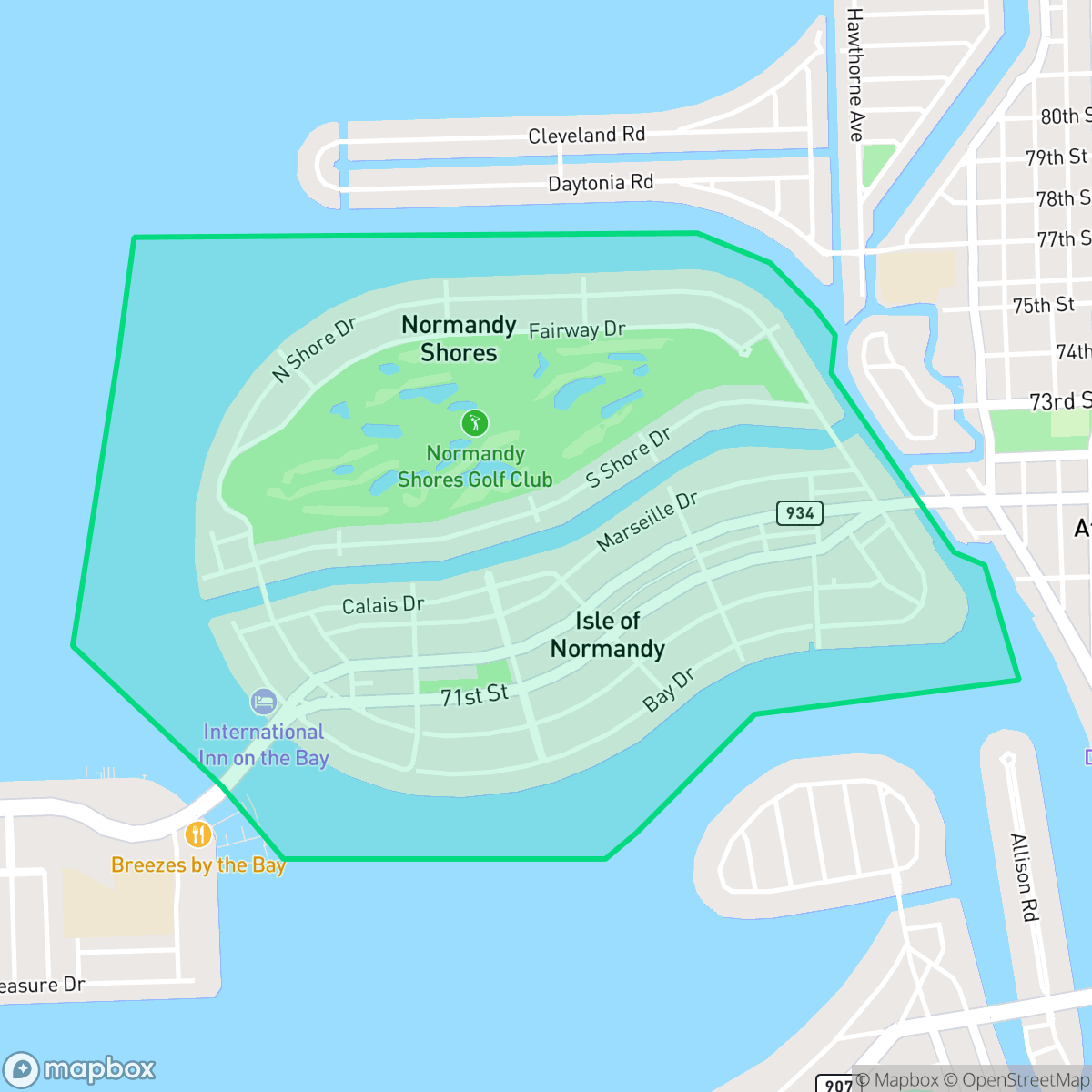
Isle of Normandy is a distinct bayfront enclave defined by its French-inspired street names and a blend of Mediterranean and Mid-Century Modern architecture. The area offers a highly walkable, suburban island atmosphere with significant aesthetic appeal, though residents should anticipate higher noise levels from nearby transit routes and a persistent risk of flooding.
Key Highlights
About Isle of Normandy
Developed in the 1920s by French-born entrepreneur Henri Levy, Normandy Isle was created by dredging mangrove swamps in Biscayne Bay. The neighborhood is distinguished by its French-themed street names—such as Rue Vendome and Rue Versailles—and its central historic landmark, the Normandy Fountain, which was constructed in 1925. The area, which comprises part of the Normandy Isles Historic District, features a unique architectural blend of Mediterranean Revival and Mid-Century Modern (MiMo) styles. Levy’s vision for a European-inspired resort community, connected to the mainland by the 79th Street Causeway, transformed the once-submerged land into a vibrant residential enclave. Today, the neighborhood remains a culturally distinct pocket of Miami Beach, defined by its preserved historic core and its enduring identity as a planned, bayfront community.
The neighborhood provides a unique residential experience characterized by its upscale waterfront views, manicured landscapes, and a quiet, suburban island atmosphere. It stands out for its visual prestige, featuring a dense concentration of luxury estates and high-rise amenities near golf course surroundings. Unlike the bustling urban core of Miami Beach, the area maintains a more subdued rhythm, offering a peaceful environment that is highly favored by a diverse demographic mix of young adults, families, and seniors. Its design encourages pedestrian activity, with a dense grid of sidewalks and well-defined crosswalks that make it one of the more accessible areas for those who prefer to walk.
Prospective residents should weigh these aesthetic and lifestyle benefits against certain livability trade-offs. The area is notably louder than the city average due to its proximity to major transit infrastructure and flight paths, and it is located within a designated floodplain that requires careful consideration for property protection. While the neighborhood is largely free from industrial activity, it offers limited public green space for pet owners and fewer local commercial amenities compared to more central districts. Families should also be aware that while the local school district offers elite magnet programs and maintains high graduation rates, it is currently navigating budget constraints and shifting enrollment trends.
Neighborhood Scores Across 15 Qualities
Residential spacing varies between tightly packed urban structures and medium-density estates with water buffers. This level of separation from neighbors is slightly higher than the Miami Beach average according to iHuus data.
Pedestrian movement is easy due to a dense grid of sidewalks and well-defined crosswalks that provide excellent connectivity. This area offers a more walkable environment than most of Miami Beach, featuring many low-traffic residential streets and accessible beach pathways.
Manicured landscapes, private pools, and waterfront docks characterize this area, which offers a higher level of visual prestige than the Miami Beach average. According to iHuus data, the neighborhood features a dense concentration of luxury estates and high-rise amenities near golf course surroundings.
Walking options for pets are somewhat restricted due to narrow green verges and a lack of large dedicated public parks, which places the area below the Miami Beach average. While proximity to a large golf course and nearby beach access provides some utility, much of the neighborhood's greenery remains private.
A balanced mix of green space and residential structures defines this area. This landscape offers more vegetation and open space than the typical Miami Beach urban core, according to iHuus data.
The neighborhood experiences a more subdued rhythm than the Miami Beach average, characterized by pockets of calm suburban streets and limited commercial activity. While some areas near parks and coastal stretches offer walkable access to dining, much of the landscape remains primarily residential with few local amenities.
Frequent acoustic disturbances from nearby transit infrastructure and flight paths characterize this area. According to iHuus data, noise levels are notably higher than the Miami Beach average.
Air quality in this area fluctuates between acceptable and unhealthy levels, with occasional concerns for sensitive groups. According to iHuus data, the air quality remains slightly better than the Miami Beach average.
Industrial activity is virtually non-existent here, offering a cleaner environment than much of Miami Beach. Residents can expect a landscape composed of residential and light commercial spaces without the presence of warehouses or heavy industrial hazards.
Health insurance accessibility is notably higher in this neighborhood than the Miami Beach average, according to iHuus data.
Political leanings in this area are split nearly evenly between conservative and liberal perspectives, representing a more balanced ideological landscape than the city average according to iHuus data.
Residents experience a balanced demographic spread of young adults, families, and seniors. This variety in age profiles is more diverse than the average found across Miami Beach, according to iHuus data.
Located within a designated floodplain, this area faces significant flood risks similar to much of the surrounding city. Residents should prepare for potential inundation and likely requirements for flood insurance, according to iHuus data.
Address-Level Insights for Isle of Normandy


iHuus Neighborhood Intelligence Insights
Get address-level neighborhood insights for Isle of Normandy
- Street-level scores — see how individual blocks compare, not just neighborhood averages
- Micro-zone boundaries — identify quiet pockets, flood boundaries, and walkable clusters before you visit
- 15 dimensions in full — walkability, noise, air quality, school quality, insurance coverage, population age profile, urban/rural index, and more
- Boundary risk alerts — know if your address sits near a block boundary where scores drop, the kind of detail no listing will ever mention
- School insights — individual school ratings and insights, not just district-level data
- Compare before you commit — side-by-side data across neighborhoods, down to block precision
No credit card required
Compare with Any Neighborhood
| Dimension | Isle of Normandy | Bayshore |
|---|---|---|
| 🚶 Walkabilityavg 7.83 | ||
| 🔊 Acoustic Comfortavg 4 | ||
| 🤫 Privacy Indexavg 4.76 | ||
| 🎨 Visual Appealavg 8.17 | ||
| 🐕 Dog Friendlinessavg 5.83 | ||
| 🗺️ Urban-Rural Indexavg 4.39 | ||
| ✨ Neighborhood Vibeavg 4.49 | ||
| 🏥 Health Insurance Coverageavg 6.26 | ||
| 🌿 Air Qualityavg 3.72 | ||
| 🏭 Industrial Proximityavg 8.28 | ||
| 🌊 Flood Safetyavg 2.65 | ||
| 🗳️ Ideological Leanavg 4.64 | ||
| 👥 Population Age Profileavg 4.7 | ||
| 🔥 Fire Safety | ||
| 🏫 School Quality |
Isle of Normandy Rankings
School Districts Serving Isle of Normandy
School Insights for Isle of Normandy
Below average outcomes; significant attendance and academic challenges.
School Insights
See what's really behind every school rating near Isle of Normandy
- Individual school ratings — each school's own score with outcome context, not just a district average
- Enrollment & class size data — student-to-teacher ratio and how it compares to the state average
- Full demographics breakdown — ethnicity and gender composition for every school in the enrollment zone
- Every school in the district — all schools within the enrollment boundary ranked by rating, not just the closest one
- Grade levels & benchmarks — elementary through high school, with below/above state-average flags
No credit card required