Hibiscus Island, Miami Beach
Updated · 266 residents
Hibiscus Island is a secluded, guard-gated residential enclave known for its high-end waterfront estates and private, low-density atmosphere. While the area offers a spacious, park-like environment with significant visual appeal, it is characterized by limited walkability and requires residents to rely on vehicles for daily errands.
Key Highlights
About Hibiscus Island
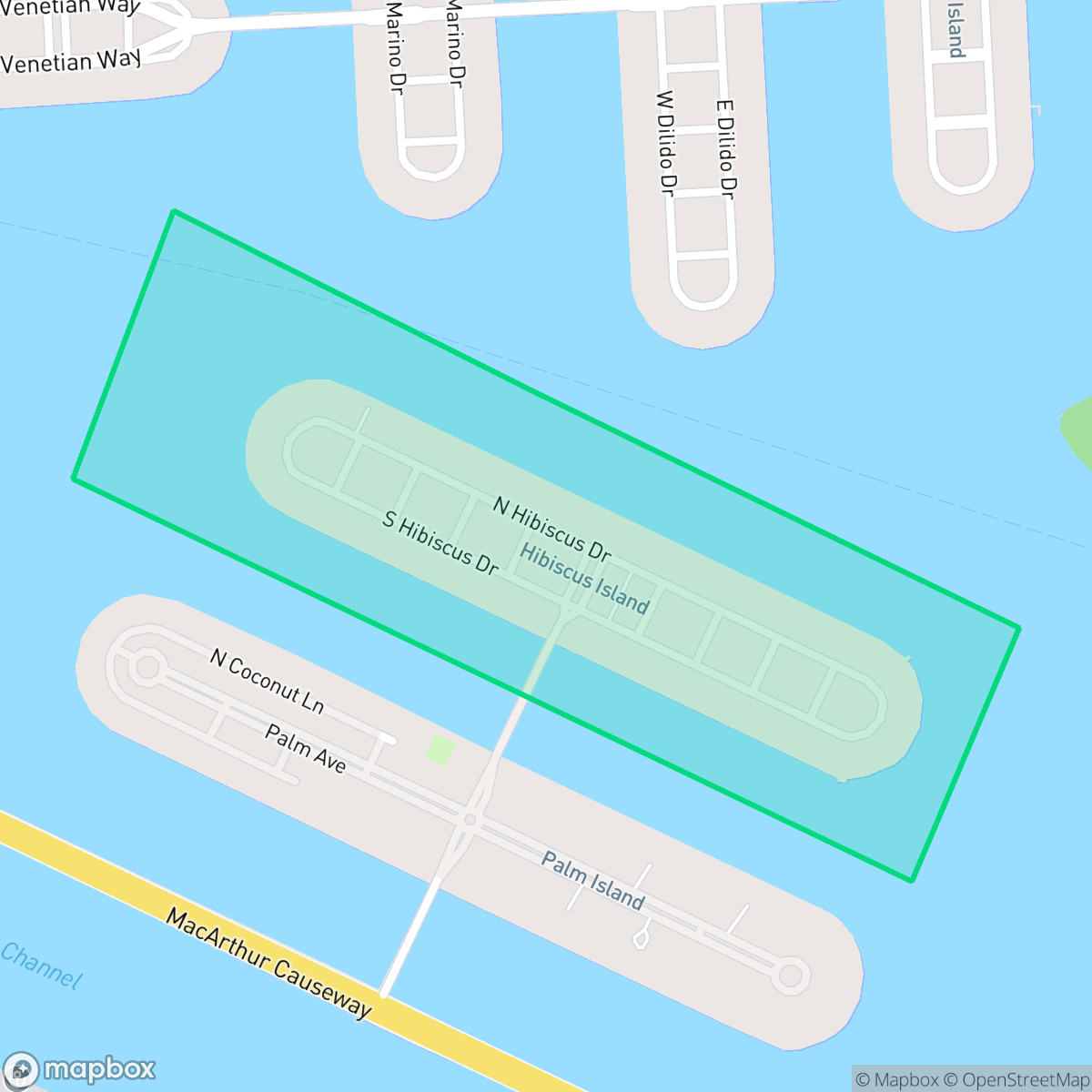
Hibiscus Island is an exclusive, man-made residential enclave in Miami Beach, created in 1922 through dredging and land reclamation by the Army Corps of Engineers. Developed during the Florida land boom as a luxury retreat, the island became a prominent destination for affluent winter residents. During the 1940s and 1950s, it gained cultural significance as the site of the famous Latin Quarter nightclub, owned by Lou Walters, father of journalist Barbara Walters. The club served as a premier entertainment venue for high-profile performers like Frank Sinatra and Sammy Davis Jr. before being destroyed by fire. Today, the island has transitioned into a quiet, guard-gated community characterized by a mix of original mid-century estates and contemporary luxury mansions, retaining its status as a prestigious, secluded waterfront neighborhood accessible via the MacArthur Causeway.
The neighborhood functions as a quiet retreat from the high-energy urban core of Miami Beach. With its expansive plots and custom-designed estates, the area provides a sense of seclusion that is rare in the surrounding coastal region. The layout prioritizes privacy and aesthetic quality, creating a serene environment that feels significantly more open and spacious than the typical city block. Residents enjoy a peaceful atmosphere that is largely free from heavy industry or intense commercial activity.
Prospective residents should consider that the area is primarily residential with minimal local amenities, necessitating travel for basic needs. Pedestrian access is restricted by limited sidewalk infrastructure, and the neighborhood faces notable vulnerability to coastal flooding. While the community offers a quiet environment suitable for those seeking privacy, it is less ideal for pet owners due to the lack of dedicated green spaces and public parks. The area is best suited for those who prioritize a low-density, exclusive living environment over urban convenience.
Neighborhood Scores Across 15 Qualities
Residential spacing provides a moderate level of seclusion with some buffer between neighbors. This degree of privacy is higher than the typical density found across Miami Beach, according to iHuus data.
Pedestrian movement is constrained by sidewalks being available only on one side of the road. This level of walkability is lower than the average found across Miami Beach, according to iHuus data.
Custom architecture and dense privacy buffers create a highly aesthetic landscape that sits well above the Miami Beach average. According to iHuus data, the area is characterized by low density estates and premium amenities.
Minimal access to public parks and few wide green verges make for limited walking options for pets. This area offers less utility for dog owners compared to the Miami Beach average, according to iHuus data.
Frequent open land and scattered residences provide a more semi-rural atmosphere than the typical Miami Beach urban density. This setting offers significantly more greenery and open space compared to the city average.
Subdued activity levels and sparse commercial options characterize this coastal area. According to iHuus data, the neighborhood lacks significant points of interest and features much less social energy than the Miami Beach average.
Persistent sounds from nearby thoroughfares are present, though levels remain more moderate than the typical experience found across Miami Beach according to iHuus data.
Air quality in this area fluctuates between acceptable and unhealthy levels, presenting occasional concerns for sensitive groups. According to iHuus data, conditions are slightly better than the Miami Beach average.
Residential streets and green spaces are largely free from heavy industry. According to iHuus data, the area maintains a level of industrial separation that is consistent with the rest of Miami Beach.
Health insurance enrollment among residents is lower than the Miami Beach average, according to iHuus data.
Political leanings in this area are notably more liberal than the Miami Beach average, according to iHuus data.
Residents live alongside a balanced mix of young adults, families, and older individuals. According to iHuus data, this demographic spread is slightly more concentrated in middle-aged populations compared to the broader Miami Beach average.
Property within the 100-year floodplain faces significant vulnerability to coastal flooding; according to iHuus data, this risk level is slightly higher than the Miami Beach average and often necessitates flood insurance.
Address-Level Insights for Hibiscus Island


iHuus Neighborhood Intelligence Insights
Get address-level neighborhood insights for Hibiscus Island
- Street-level scores — see how individual blocks compare, not just neighborhood averages
- Micro-zone boundaries — identify quiet pockets, flood boundaries, and walkable clusters before you visit
- 15 dimensions in full — walkability, noise, air quality, school quality, insurance coverage, population age profile, urban/rural index, and more
- Boundary risk alerts — know if your address sits near a block boundary where scores drop, the kind of detail no listing will ever mention
- School insights — individual school ratings and insights, not just district-level data
- Compare before you commit — side-by-side data across neighborhoods, down to block precision
No credit card required
Compare with Any Neighborhood
| Dimension | Hibiscus Island | Bayshore |
|---|---|---|
| 🚶 Walkabilityavg 7.83 | ||
| 🔊 Acoustic Comfortavg 4 | ||
| 🤫 Privacy Indexavg 4.76 | ||
| 🎨 Visual Appealavg 8.17 | ||
| 🐕 Dog Friendlinessavg 5.83 | ||
| 🗺️ Urban-Rural Indexavg 4.39 | ||
| ✨ Neighborhood Vibeavg 4.49 | ||
| 🏥 Health Insurance Coverageavg 6.26 | ||
| 🌿 Air Qualityavg 3.72 | ||
| 🏭 Industrial Proximityavg 8.28 | ||
| 🌊 Flood Safetyavg 2.65 | ||
| 🗳️ Ideological Leanavg 4.64 | ||
| 👥 Population Age Profileavg 4.7 | ||
| 🔥 Fire Safety | ||
| 🏫 School Quality |
Hibiscus Island Rankings
School Districts Serving Hibiscus Island
School Insights for Hibiscus Island
Below average outcomes; significant attendance and academic challenges.
School Insights
See what's really behind every school rating near Hibiscus Island
- Individual school ratings — each school's own score with outcome context, not just a district average
- Enrollment & class size data — student-to-teacher ratio and how it compares to the state average
- Full demographics breakdown — ethnicity and gender composition for every school in the enrollment zone
- Every school in the district — all schools within the enrollment boundary ranked by rating, not just the closest one
- Grade levels & benchmarks — elementary through high school, with below/above state-average flags
No credit card required