City Center, Miami Beach
Updated · 4,520 residents
City Center serves as the primary urban core of Miami Beach, defined by its high-density development and exceptional walkability. Residents enjoy a vibrant, upscale environment that balances proximity to major cultural institutions with a fast-paced, urban lifestyle.
Key Highlights
About City Center
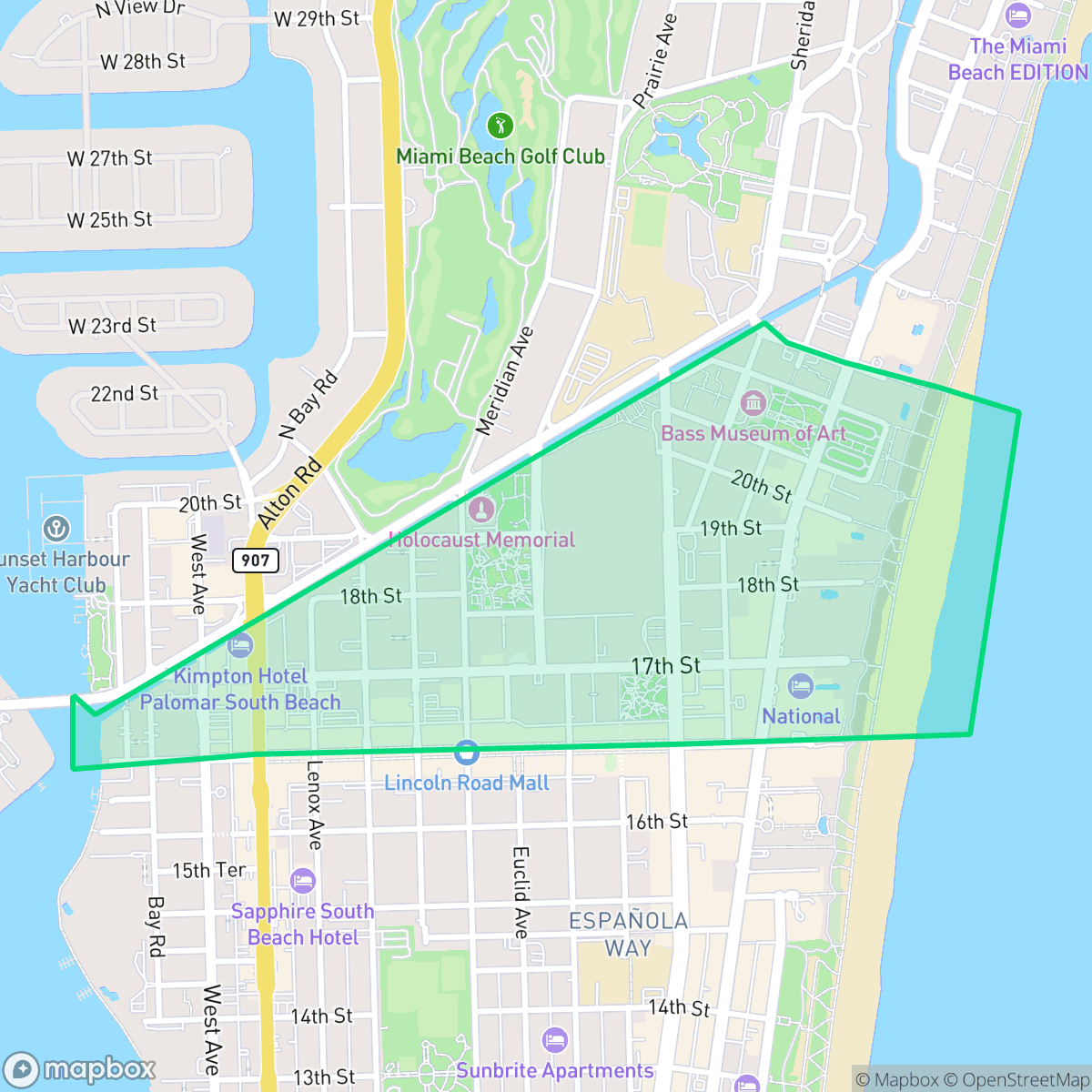
The City Center neighborhood in Miami Beach serves as a vibrant cultural and commercial hub, anchored by the iconic Lincoln Road, a historic pedestrian-only shopping and dining promenade. This area is home to significant landmarks, including the Fillmore Miami Beach at the Jackie Gleason Theater, an Art Deco venue that has hosted legendary performers for decades. The neighborhood also features the Holocaust Memorial, a sobering and architecturally significant site, and the lush Miami Beach Botanical Garden. Historically, City Center has evolved from the early 20th-century development of Miami Beach into a central gathering space that balances its preservation of mid-century architectural character with its role as a modern destination for arts, culture, and public life.
The area functions as a dense, vertical landscape characterized by its minimal industrial presence and polished, manicured aesthetic. As a high-energy hub, it offers residents immediate access to a wide array of retail, dining, and nightlife options, making it a central point for daily activity. The neighborhood maintains a multigenerational demographic, attracting a mix of young professionals, families, and older adults who value being at the heart of the city's infrastructure.
Living here requires adjusting to the realities of a dense urban environment, where privacy is limited and street noise is a constant factor. While the area provides excellent pedestrian access and pet-friendly coastal paths, prospective residents should be aware of the high flood risk and the variable air quality common in such built-up settings. It is well-suited for individuals who prioritize convenience and walkability over quiet, secluded living, and who are comfortable navigating the complexities of a major metropolitan school district.
Neighborhood Scores Across 15 Qualities
Buildings and structures are closely packed with very little separation between properties. This level of density results in lower privacy than the Miami Beach average according to iHuus data.
Pedestrian-friendly infrastructure, including continuous sidewalks and dedicated coastal paths, makes navigating the area on foot easy. This level of accessibility significantly exceeds the average found across Miami Beach.
High-end architectural footprints, manicured beachfront grounds, and luxury amenities create a visually polished environment that is slightly more refined than the Miami Beach average. According to iHuus data, the area features frequent sightings of well-maintained pools, private docks, and modern waterfront properties.
Direct access to the beach and several large public parks provides more accessible green space for pets than most of Miami. According to iHuus data, the presence of paved coastal paths and buffered parklands makes this area significantly more dog-friendly than the city average.
High-rise buildings and extensive paved surfaces define this area, creating a much more built-up environment than the typical Miami Beach neighborhood. According to iHuus data, the landscape is characterized by significant vertical development with very limited greenery.
Vibrant urban density and a wide array of dining, nightlife, and retail options create an atmosphere significantly more active than the Miami Beach average. This coastal core features a dense concentration of high-rise buildings and walkable destinations according to iHuus data.
Steady traffic sounds from nearby busy streets create a consistent background hum. This level of acoustic activity is roughly in line with the city average.
Air quality in this area fluctuates between acceptable and unhealthy levels, presenting occasional concerns for sensitive groups. According to iHuus data, conditions are slightly better than the average found throughout Miami Beach.
Land use is almost entirely residential, commercial, and recreational with no significant heavy industry or hazardous facilities nearby. According to iHuus data, this area remains slightly cleaner than the city average regarding industrial proximity.
Health insurance access among residents remains slightly above the Miami average, according to iHuus data.
Political leanings in this area are predominantly liberal, representing a significant departure from the more balanced ideological makeup found across the rest of Miami Beach.
A diverse range of age groups resides here, providing a more balanced demographic spread than the Miami Beach average. Residents will find a community comprising young professionals, families, and older adults.
Situated within a known floodplain, this area faces significant vulnerability to flooding; according to iHuus data, the risk level is comparable to the broader Miami Beach average.
Address-Level Insights for City Center


iHuus Neighborhood Intelligence Insights
Get address-level neighborhood insights for City Center
- Street-level scores — see how individual blocks compare, not just neighborhood averages
- Micro-zone boundaries — identify quiet pockets, flood boundaries, and walkable clusters before you visit
- 15 dimensions in full — walkability, noise, air quality, school quality, insurance coverage, population age profile, urban/rural index, and more
- Boundary risk alerts — know if your address sits near a block boundary where scores drop, the kind of detail no listing will ever mention
- School insights — individual school ratings and insights, not just district-level data
- Compare before you commit — side-by-side data across neighborhoods, down to block precision
No credit card required
Compare with Any Neighborhood
| Dimension | City Center | Bayshore |
|---|---|---|
| 🚶 Walkabilityavg 7.83 | ||
| 🔊 Acoustic Comfortavg 4 | ||
| 🤫 Privacy Indexavg 4.76 | ||
| 🎨 Visual Appealavg 8.17 | ||
| 🐕 Dog Friendlinessavg 5.83 | ||
| 🗺️ Urban-Rural Indexavg 4.39 | ||
| ✨ Neighborhood Vibeavg 4.49 | ||
| 🏥 Health Insurance Coverageavg 6.26 | ||
| 🌿 Air Qualityavg 3.72 | ||
| 🏭 Industrial Proximityavg 8.28 | ||
| 🌊 Flood Safetyavg 2.65 | ||
| 🗳️ Ideological Leanavg 4.64 | ||
| 👥 Population Age Profileavg 4.7 | ||
| 🔥 Fire Safety | ||
| 🏫 School Quality |
City Center Rankings
School Districts Serving City Center
School Insights for City Center
Below average outcomes; significant attendance and academic challenges.
School Insights
See what's really behind every school rating near City Center
- Individual school ratings — each school's own score with outcome context, not just a district average
- Enrollment & class size data — student-to-teacher ratio and how it compares to the state average
- Full demographics breakdown — ethnicity and gender composition for every school in the enrollment zone
- Every school in the district — all schools within the enrollment boundary ranked by rating, not just the closest one
- Grade levels & benchmarks — elementary through high school, with below/above state-average flags
No credit card required