Tigertown, Lakeland
Updated · 667 residents
Tigertown is a sports-centric community defined by its deep ties to baseball history and a highly walkable layout. Residents benefit from clean air, excellent pet-friendly amenities, and a diverse age demographic that fosters a vibrant, active local atmosphere.
Key Highlights
About Tigertown
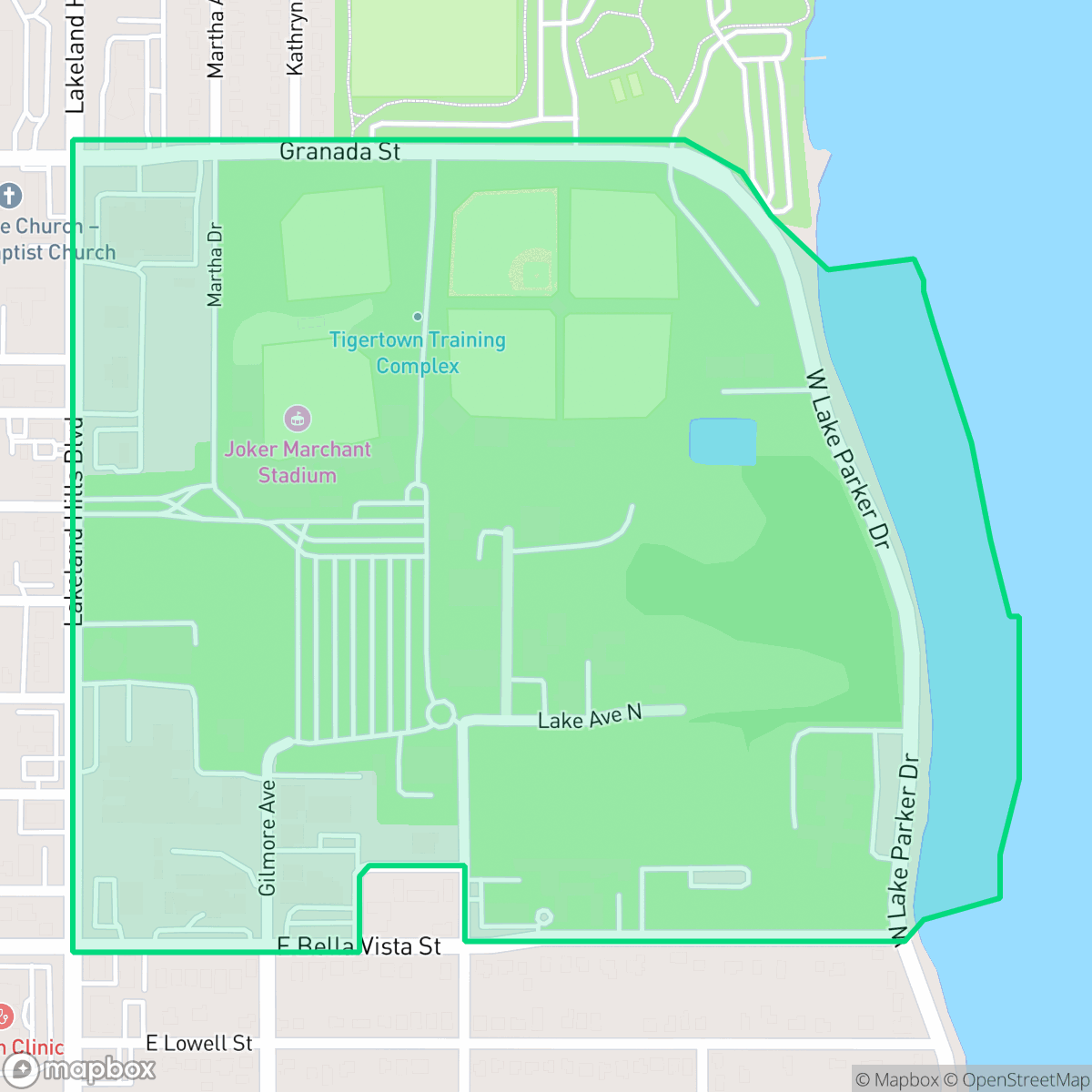
The area known as TigerTown in Lakeland, Florida, derives its name and cultural identity from its long-standing association with the Detroit Tigers, who have held spring training in the city since 1934. The site itself occupies land that formerly housed the Lodwick School of Aeronautics, a vital training center where over 8,000 American and British pilots learned to fly during World War II. Following the school's closure in 1945, the grounds were transitioned for baseball use, eventually becoming the home of Joker Marchant Stadium in 1966. This facility remains the hub of the neighborhood, hosting the Detroit Tigers and the Lakeland Flying Tigers—a minor league team named in honor of the site's wartime aviation history. The surrounding streets, such as Kaline Drive and Horton Way, are named after legendary Detroit Tigers players, cementing the area's unique sports-centric character.
The neighborhood offers a distinct suburban experience characterized by a blend of modest, tidy residential homes and light commercial services. The presence of significant sporting infrastructure creates a lively rhythm, providing residents with access to wellness services and independent shops within walking distance. The area maintains a balanced, age-diverse population that contributes to a welcoming environment, while the overall layout supports a high level of walkability compared to much of the surrounding city.
While the area provides superior flood safety and clean air, prospective residents should note that the proximity to major thoroughfares and railroad tracks results in higher noise levels. The housing landscape offers more privacy than many neighboring districts, featuring detached homes on larger paved lots. Families should be aware that while the local school district provides access to elite magnet and charter programs, success often depends on navigating a competitive school choice lottery system.
Neighborhood Scores Across 15 Qualities
Residential spacing provides a consistent buffer between neighbors, offering more seclusion than the average Lakeland area. According to iHuus data, the neighborhood features a mix of detached homes and larger paved lots.
Pedestrian infrastructure in Tigertown is significantly better than the Lakeland average, featuring safe crossings and sidewalks on many streets. While some high-traffic areas remain car-centric, much of the neighborhood is accessible for those traveling on foot.
Standard suburban architecture dominates the landscape, featuring modest housing footprints and tidy yards. According to iHuus data, this level of visual variety is slightly higher than the average found throughout Lakeland.
Connected green spaces and wide paths offer much higher dog friendliness than the Lakeland average. While many residents enjoy private greenery, sidewalk verges can be narrow in certain sections of the neighborhood.
Residential areas feature a blend of single-family homes and commercial strips alongside various sports facilities. This balance of developed space and open land is consistent with the average density found throughout Lakeland.
Local activity levels are significantly higher than the Lakeland average, providing a steady rhythm of wellness services and independent shops. Residents benefit from a mix of suburban quiet and accessible amenities near transit hubs and Lake Parker Park.
Frequent noise from nearby railroad tracks and major thoroughfares characterizes this area. According to iHuus data, acoustic comfort in Tigertown is consistent with the typical experience found across Lakeland.
Air quality remains consistently clean with rare instances of elevated readings, performing notably better than the Lakeland average according to iHuus data.
Heavy industrial activity is largely absent, with the area consisting primarily of residential spaces and light commercial services. While some logistics warehouses and fleet storage yards are present, the level of industrial proximity remains significantly lower than the Lakeland average.
Health insurance enrollment is notably higher in Tigertown than the Lakeland average, according to iHuus data.
Political leanings in this area are significantly more liberal than the Lakeland city average, according to iHuus data.
Residents will find a balanced mix of young adults, families, and older individuals, representing a more age-diverse community than the average Lakeland neighborhood according to iHuus data.
Flood risk in this area is considerably lower than the Lakeland average. According to iHuus data, while some residual risk exists within a 500-year floodplain, the neighborhood remains well outside typical high-risk zones.
Address-Level Insights for Tigertown


iHuus Neighborhood Intelligence Insights
Get address-level neighborhood insights for Tigertown
- Street-level scores — see how individual blocks compare, not just neighborhood averages
- Micro-zone boundaries — identify quiet pockets, flood boundaries, and walkable clusters before you visit
- 15 dimensions in full — walkability, noise, air quality, school quality, insurance coverage, population age profile, urban/rural index, and more
- Boundary risk alerts — know if your address sits near a block boundary where scores drop, the kind of detail no listing will ever mention
- School insights — individual school ratings and insights, not just district-level data
- Compare before you commit — side-by-side data across neighborhoods, down to block precision
No credit card required
Compare with Any Neighborhood
| Dimension | Tigertown | Beacon Hill |
|---|---|---|
| 🚶 Walkabilityavg 5.03 | ||
| 🔊 Acoustic Comfortavg 3.5 | ||
| 🤫 Privacy Indexavg 5.3 | ||
| 🎨 Visual Appealavg 5.07 | ||
| 🐕 Dog Friendlinessavg 5.42 | ||
| 🗺️ Urban-Rural Indexavg 6.53 | ||
| ✨ Neighborhood Vibeavg 2.18 | ||
| 🏥 Health Insurance Coverageavg 5.4 | ||
| 🌿 Air Qualityavg 7.09 | ||
| 🏭 Industrial Proximityavg 5.58 | ||
| 🌊 Flood Safetyavg 5.2 | ||
| 🗳️ Ideological Leanavg 2.17 | ||
| 👥 Population Age Profileavg 4.38 | ||
| 🔥 Fire Safety | ||
| 🏫 School Quality |
Tigertown Rankings
School Districts Serving Tigertown
School Insights for Tigertown
Below average outcomes; significant attendance and academic challenges.
School Insights
See what's really behind every school rating near Tigertown
- Individual school ratings — each school's own score with outcome context, not just a district average
- Enrollment & class size data — student-to-teacher ratio and how it compares to the state average
- Full demographics breakdown — ethnicity and gender composition for every school in the enrollment zone
- Every school in the district — all schools within the enrollment boundary ranked by rating, not just the closest one
- Grade levels & benchmarks — elementary through high school, with below/above state-average flags
No credit card required