South Lake Morton, Lakeland
Updated · 2,298 residents
South Lake Morton is a highly walkable neighborhood defined by its scenic lakefront and historic residential architecture. Residents enjoy exceptionally clean air and a vibrant atmosphere with easy access to local parks and community hubs.
Key Highlights
About South Lake Morton
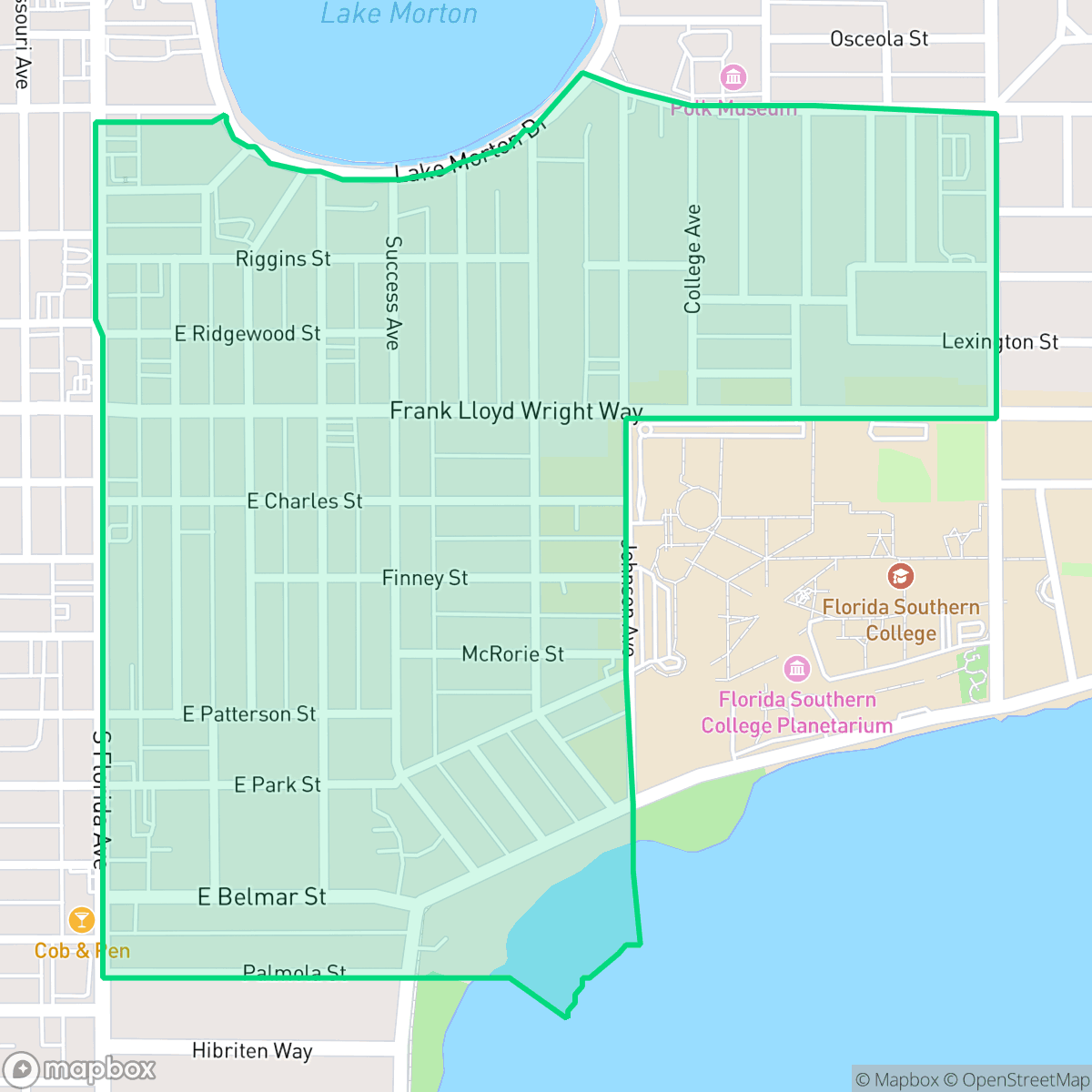
The South Lake Morton Historic District, designated on the National Register of Historic Places in 1985, represents one of Lakeland's earliest residential suburbs. While initial subdivision began around 1906, the neighborhood’s character was largely defined during the Florida Real Estate Boom of the 1920s. It features a high concentration of architecturally significant structures, primarily Craftsman-style bungalows, alongside Mediterranean Revival and Victorian homes. The neighborhood is anchored by the scenic Lake Morton, famous for its population of swans—a tradition dating back to a 1957 gift from Queen Elizabeth II. The area is also notable for its proximity to Florida Southern College, which houses the world's largest collection of Frank Lloyd Wright architecture, and local landmarks like the historic 'Lover's Oak' tree, which predates the city's incorporation.
The area offers a distinct suburban mix where mature trees and well-maintained grounds create a visually appealing environment. Its grid-based street network and central lake loop make it one of the most pedestrian-friendly locations in the city. With a high density of local eateries and social venues, the neighborhood maintains a lively atmosphere that attracts a diverse demographic of residents ranging from young professionals to seniors. The community is characterized by a strong sense of place and an established, upscale aesthetic that sets it apart from other parts of Lakeland. While the environment is generally tranquil, residents may experience periodic traffic noise near busier thoroughfares. The neighborhood provides a balanced level of privacy with standard yard distances and mature landscaping. Although the area sits within a floodplain, it remains a stable residential choice for those seeking an active lifestyle. According to iHuus data, the neighborhood benefits from high health insurance coverage and consistently high air quality, making it well-suited for individuals who prioritize health and outdoor accessibility.
Neighborhood Scores Across 15 Qualities
Residential spacing offers a balanced amount of separation between homes. According to iHuus data, this neighborhood provides more personal buffer zones than the typical Lakeland area due to mature trees and standard yard distances.
Pedestrian access is a primary feature of this area due to the grid-based street network and the central lake loop. Sidewalks are consistently present on both sides of many streets, making this neighborhood significantly more walkable than the Lakeland average.
Large homes, private pools, and well-maintained grounds contribute to a visual landscape that is notably more upscale than the Lakeland average. According to iHuus data, the area features prominent lakefront properties and manicured institutional campuses alongside standard single-family residences.
Abundant green spaces, tree-lined streets, and a large lakeside park with perimeter paths make this area significantly more dog-friendly than the Lakeland average. Continuous grass verges between sidewalks and roads provide additional safe walking space for pets.
Residential blocks and institutional buildings are interspersed with a significant tree canopy. This area aligns with the typical urban-rural balance found throughout Lakeland.
Social hubs, local eateries, and entertainment venues create a significantly more active environment than the Lakeland average. Residents benefit from a high density of coffee shops, bars, and parks that contribute to a bustling atmosphere throughout the neighborhood.
A steady hum of local traffic persists near busy thoroughfares, though acoustic levels remain significantly more tranquil than the average for Lakeland. According to iHuus data, residents may experience periodic sounds from nearby streets.
Air quality in South Lake Morton remains consistently high with very low levels of pollutants. This area offers significantly better air quality than the Lakeland average, according to iHuus data.
Primarily residential with very little industrial activity, this area remains significantly clearer of heavy industry than the Lakeland average. Occasional light commercial uses like a brewery and gas station may introduce minor transit traffic or utility odors, according to iHuus data.
Health insurance enrollment among residents is significantly higher than the Lakeland average, according to iHuus data.
Political leanings in this area are relatively balanced, showing a much more even split between conservative and liberal residents than the broader Lakeland average.
Residents occupy a diverse range of life stages, featuring a more even distribution of age groups than the typical Lakeland profile. This demographic variety provides a balanced social environment ranging from young professionals to established seniors.
Some residual flood risk exists within this area because it sits inside a 500-year floodplain, though the safety level remains higher than the Lakeland average according to iHuus data.
Address-Level Insights for South Lake Morton


iHuus Neighborhood Intelligence Insights
Get address-level neighborhood insights for South Lake Morton
- Street-level scores — see how individual blocks compare, not just neighborhood averages
- Micro-zone boundaries — identify quiet pockets, flood boundaries, and walkable clusters before you visit
- 15 dimensions in full — walkability, noise, air quality, school quality, insurance coverage, population age profile, urban/rural index, and more
- Boundary risk alerts — know if your address sits near a block boundary where scores drop, the kind of detail no listing will ever mention
- School insights — individual school ratings and insights, not just district-level data
- Compare before you commit — side-by-side data across neighborhoods, down to block precision
No credit card required
Compare with Any Neighborhood
| Dimension | South Lake Morton | Beacon Hill |
|---|---|---|
| 🚶 Walkabilityavg 5.03 | ||
| 🔊 Acoustic Comfortavg 3.5 | ||
| 🤫 Privacy Indexavg 5.3 | ||
| 🎨 Visual Appealavg 5.07 | ||
| 🐕 Dog Friendlinessavg 5.42 | ||
| 🗺️ Urban-Rural Indexavg 6.53 | ||
| ✨ Neighborhood Vibeavg 2.18 | ||
| 🏥 Health Insurance Coverageavg 5.4 | ||
| 🌿 Air Qualityavg 7.09 | ||
| 🏭 Industrial Proximityavg 5.58 | ||
| 🌊 Flood Safetyavg 5.2 | ||
| 🗳️ Ideological Leanavg 2.17 | ||
| 👥 Population Age Profileavg 4.38 | ||
| 🔥 Fire Safety | ||
| 🏫 School Quality |
South Lake Morton Rankings
School Districts Serving South Lake Morton
School Insights for South Lake Morton
Below average outcomes; significant attendance and academic challenges.
School Insights
See what's really behind every school rating near South Lake Morton
- Individual school ratings — each school's own score with outcome context, not just a district average
- Enrollment & class size data — student-to-teacher ratio and how it compares to the state average
- Full demographics breakdown — ethnicity and gender composition for every school in the enrollment zone
- Every school in the district — all schools within the enrollment boundary ranked by rating, not just the closest one
- Grade levels & benchmarks — elementary through high school, with below/above state-average flags
No credit card required