Paul A. Diggs, Lakeland
Updated · 2,548 residents
The Paul A. Diggs neighborhood is a culturally significant area in northwest Lakeland characterized by its semi-rural atmosphere and excellent air quality. Residents enjoy a moderately walkable environment with a balanced demographic mix, though the area experiences a persistent background hum from nearby traffic and light industrial activity.
Key Highlights
About Paul A. Diggs
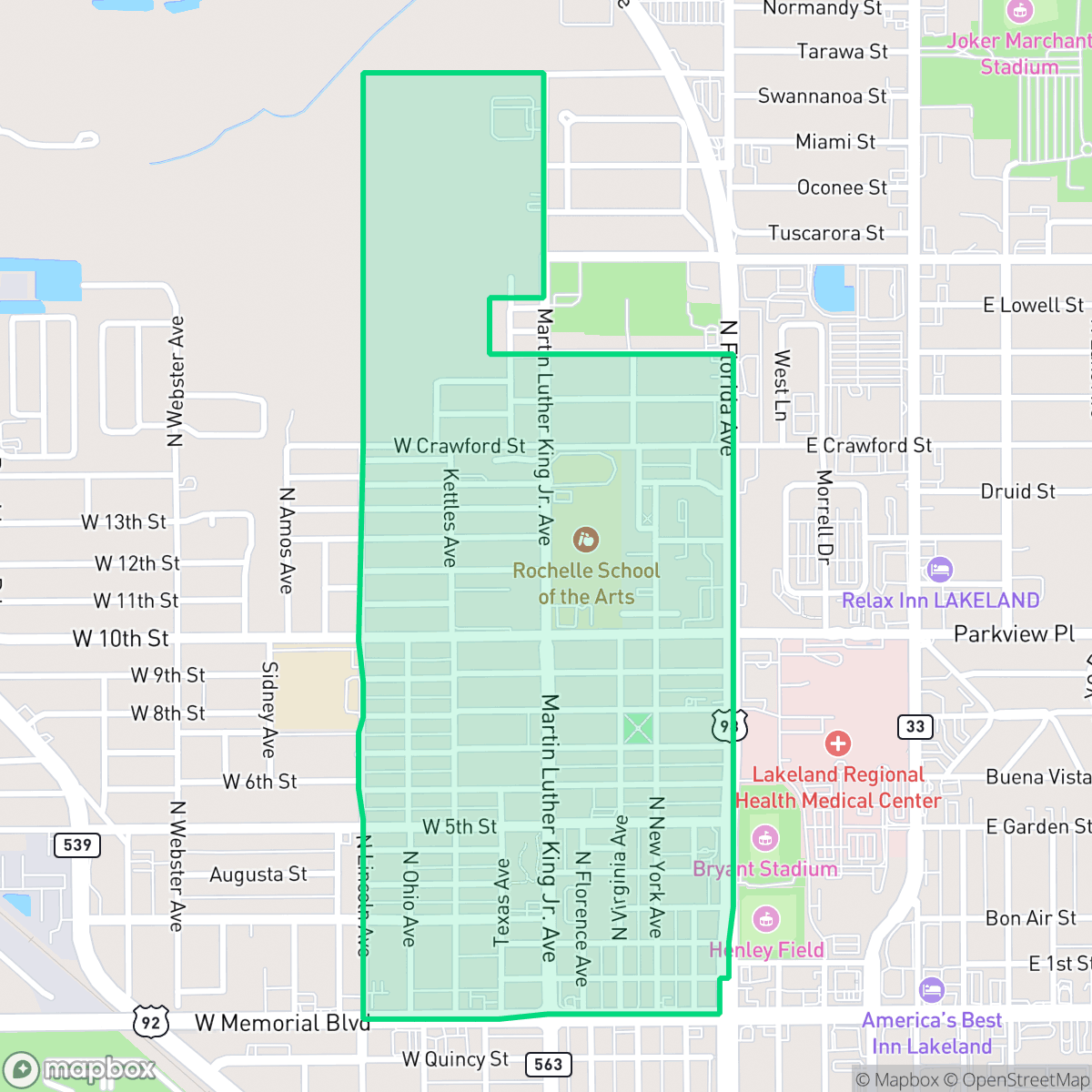
The Paul A. Diggs neighborhood in northwest Lakeland, Florida, has been a cornerstone of the city’s Black community since the 1920s. Formally named in 1993, the area honors Paul A. Diggs, a pioneering social worker, educator, and civic leader who significantly shaped the community during the 1930s through the 1950s. Diggs was instrumental in establishing local youth programs, including the first Boy Scout troop for Black youth in the area, and managed the Lake Ridge housing complex. The neighborhood, bounded by Florida and Lincoln Avenues, Memorial Boulevard, and Modest Street, features Jackson Park as a cultural focal point. This park now occupies the site of the former Diggs Soda Shop, a historic gathering place. Today, the community remains a testament to Diggs’ legacy of advocacy, civic engagement, and commitment to local youth development.
The area balances residential life with pockets of commercial activity, offering a unique rhythm that shifts between quiet, wooded zones and more energetic spots near Henley Field. The visual landscape is defined by a simple suburban layout with consistent rooflines and modest yards, providing a sense of order. With a strong commitment to community health, residents benefit from high levels of medical insurance coverage and clean air, which stand out as significant local advantages according to iHuus data.
Prospective residents should consider the trade-offs of living in a mixed-use environment, as the proximity to logistics warehouses and an electrical substation contributes to a steady level of ambient traffic noise. While the neighborhood offers better pedestrian access than many parts of the city, some streets feature a fragmented sidewalk network. Families should be aware that while local schools fall under the Polk County district, educational success often depends on navigating the district's competitive school choice lottery rather than relying on neighborhood zoning alone.
Neighborhood Scores Across 15 Qualities
Residential spacing varies throughout the area, with many homes providing more distance between neighbors than the Lakeland average. According to iHuus data, the neighborhood features a mix of standard suburban lots and larger buffers provided by institutional properties.
Sidewalks and safe crossings are available along many residential streets, providing better pedestrian access than the typical Lakeland neighborhood. However, some areas feature a fragmented network with missing sidewalks or high traffic that may impact walking comfort.
Uniform tract housing and modest yards define the area, providing a slightly more organized visual landscape than the Lakeland average. According to iHuus data, the neighborhood features consistent rooflines and limited luxury landscaping.
Grassy verges and school fields offer moderate opportunities for dog walking, making this area slightly more dog friendly than the Lakeland average. While public parks are limited, private yards and small pocket parks provide consistent greenery throughout the neighborhood.
Open land and wooded areas are frequently interspersed with scattered homes, making this area slightly more rural than the Lakeland average. According to iHuus data, the landscape features a mix of low density residential grids and significant forested patches.
Activity levels fluctuate between quiet, forested residential zones and energetic pockets near Henley Field that feature dense dining and retail options. This neighborhood offers a much higher level of social energy and commercial variety than the Lakeland average.
Consistent noise from nearby busy streets characterizes the area, though levels are slightly more tranquil than the Lakeland average. According to iHuus data, residents may experience a persistent background hum from local vehicle movement.
Air quality in this area is excellent, significantly surpassing the Lakeland average. According to iHuus data, residents can expect very clean air with minimal health concerns.
Residential life blends with light commercial activity and logistics warehouses, resulting in higher transit traffic than the Lakeland average. Residents should note the presence of an electrical substation and proximity to a Superfund site which may affect local soil and groundwater according to iHuus data.
Health insurance accessibility is notably higher than the Lakeland average, providing residents with better access to medical security. According to iHuus data, a significant majority of the population in this area maintains active coverage.
Voting patterns and census indicators show a predominantly liberal leaning, which is significantly higher than the Lakeland average according to iHuus data.
Residents will find a varied demographic spread of young adults, families, and seniors. This age distribution is slightly more balanced than the average seen across Lakeland.
Flood safety levels in this area are slightly below the Lakeland average, as official FEMA studies for this specific location have not yet been completed.
Address-Level Insights for Paul A. Diggs


iHuus Neighborhood Intelligence Insights
Get address-level neighborhood insights for Paul A. Diggs
- Street-level scores — see how individual blocks compare, not just neighborhood averages
- Micro-zone boundaries — identify quiet pockets, flood boundaries, and walkable clusters before you visit
- 15 dimensions in full — walkability, noise, air quality, school quality, insurance coverage, population age profile, urban/rural index, and more
- Boundary risk alerts — know if your address sits near a block boundary where scores drop, the kind of detail no listing will ever mention
- School insights — individual school ratings and insights, not just district-level data
- Compare before you commit — side-by-side data across neighborhoods, down to block precision
No credit card required
Compare with Any Neighborhood
| Dimension | Paul A. Diggs | Beacon Hill |
|---|---|---|
| 🚶 Walkabilityavg 5.03 | ||
| 🔊 Acoustic Comfortavg 3.5 | ||
| 🤫 Privacy Indexavg 5.3 | ||
| 🎨 Visual Appealavg 5.07 | ||
| 🐕 Dog Friendlinessavg 5.42 | ||
| 🗺️ Urban-Rural Indexavg 6.53 | ||
| ✨ Neighborhood Vibeavg 2.18 | ||
| 🏥 Health Insurance Coverageavg 5.4 | ||
| 🌿 Air Qualityavg 7.09 | ||
| 🏭 Industrial Proximityavg 5.58 | ||
| 🌊 Flood Safetyavg 5.2 | ||
| 🗳️ Ideological Leanavg 2.17 | ||
| 👥 Population Age Profileavg 4.38 | ||
| 🔥 Fire Safety | ||
| 🏫 School Quality |
Paul A. Diggs Rankings
School Districts Serving Paul A. Diggs
School Insights for Paul A. Diggs
Below average outcomes; significant attendance and academic challenges.
School Insights
See what's really behind every school rating near Paul A. Diggs
- Individual school ratings — each school's own score with outcome context, not just a district average
- Enrollment & class size data — student-to-teacher ratio and how it compares to the state average
- Full demographics breakdown — ethnicity and gender composition for every school in the enrollment zone
- Every school in the district — all schools within the enrollment boundary ranked by rating, not just the closest one
- Grade levels & benchmarks — elementary through high school, with below/above state-average flags
No credit card required