Parker Street, Lakeland
Updated · 1,556 residents
Parker Street is a vibrant, highly walkable neighborhood known for its strong sense of community and central location near Lakeland's cultural hubs. Residents benefit from excellent air quality and a diverse demographic mix, though the area experiences frequent noise from nearby rail and traffic patterns.
Key Highlights
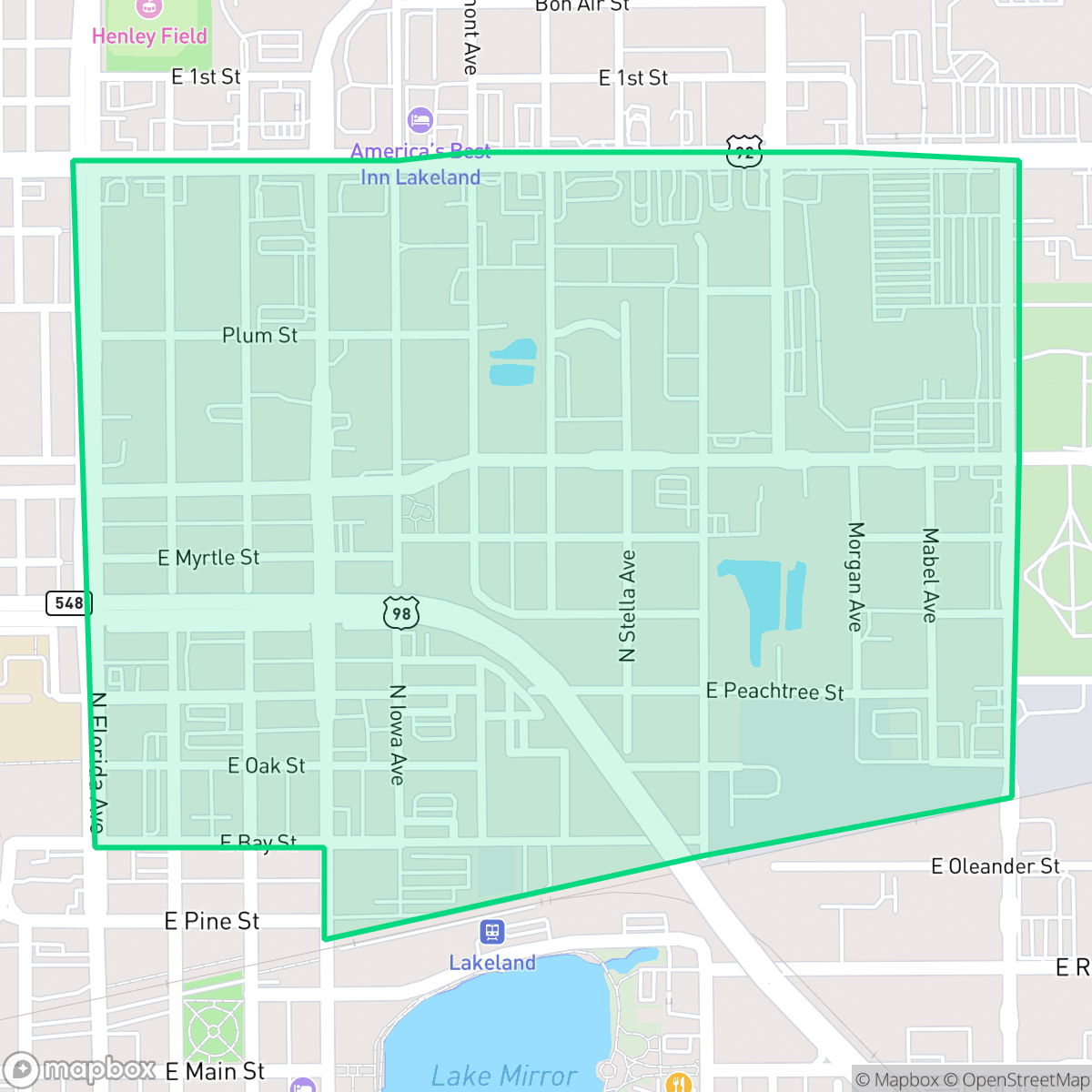
About Parker Street
The Parker Street neighborhood in Lakeland, Florida, is a community that has historically navigated challenges related to poverty and urban blight, becoming a focal point for local revitalization efforts. Since 1996, the area has been defined by the work of Parker Street Ministries, a nonprofit organization dedicated to community development, education, and neighborhood restoration. The neighborhood is situated within the Lakeland Community Redevelopment Agency's Midtown district, which has seen significant investment in recent decades to address infrastructure needs and promote urban renewal. While distinct from Lakeland’s designated historic districts, Parker Street maintains a unique cultural identity shaped by generations of residents and ongoing grassroots initiatives aimed at fostering financial sustainability, youth education, and community cohesion in the heart of the city.
The area serves as a lively urban hub where residents enjoy high walkability and proximity to civic institutions like the Polk Theatre. The landscape features a blend of standard residential architecture and open spaces, creating a semi-rural feel within the city limits. This neighborhood appeals to those who value social energy and pedestrian access to local amenities over the seclusion of a suburban estate. Prospective residents should weigh the benefits of a central, active lifestyle against some notable trade-offs. The proximity to rail lines and heavy traffic creates a consistent auditory presence, and the area faces some uncertainty regarding flood risks and soil conditions. While the local school district offers elite magnet programs, families should be prepared to navigate competitive school choice lotteries to access top-tier educational pathways.
Neighborhood Scores Across 15 Qualities
Housing density varies between apartment complexes and detached homes with moderate spacing. According to iHuus data, residents may experience more proximity to neighbors than the average Lakeland area.
Pedestrian infrastructure is notably more developed here than the city average, featuring a grid of sidewalks and safe crossings at major intersections. Walking loops around the local park provide accessible routes for residents, according to iHuus data.
Typical residential architecture and modest yards characterize this area, offering a visual profile slightly above the Lakeland average. According to iHuus data, the landscape consists primarily of mid-sized lots and standard apartment complexes without luxury estates.
Access to a large park with lakeside trails and grassy paths makes this area more suitable for dog owners than much of Lakeland. Sidewalk verges in residential sections provide additional safe walking routes away from traffic.
Open land and scattered homes are common throughout this area, mirroring the broader city average. Residents may find a blend of woodland patches and low-rise urban density depending on their specific location near commercial blocks.
Frequent activity and a dense concentration of dining, culture, and civic institutions make this area significantly more lively than the Lakeland average. Walkable streets near the Polk Theatre and local colleges provide a high level of social energy and variety.
Frequent noise from nearby railroad tracks and heavy traffic patterns characterizes this area. This level of acoustic disturbance is slightly higher than the average found throughout Lakeland.
Air quality remains consistently high with minimal health concerns. Levels are notably better than the Lakeland average, according to iHuus data.
Light commercial activity and a nearby rail line introduce occasional transit traffic and operational hum, though heavy manufacturing is absent. According to iHuus data, this area has more industrial proximity than the Lakeland average, and residents should note a nearby EPA Superfund site that may affect local soil or groundwater concerns.
Health insurance coverage levels in this area are consistent with the broader Lakeland average. According to iHuus data, a significant portion of the resident population remains uninsured.
Political leanings in this area trend toward a liberal majority, representing a notable departure from the more conservative average found across Lakeland.
Residents will find a balanced mix of young adults, families, and seniors. This demographic variety is more widespread than the typical age distribution seen across Lakeland.
Flood risk levels for this area remain undetermined because a detailed study has not yet been completed. According to iHuus data, the potential for flooding in this neighborhood is slightly higher than the Lakeland average.
Address-Level Insights for Parker Street


iHuus Neighborhood Intelligence Insights
Get address-level neighborhood insights for Parker Street
- Street-level scores — see how individual blocks compare, not just neighborhood averages
- Micro-zone boundaries — identify quiet pockets, flood boundaries, and walkable clusters before you visit
- 15 dimensions in full — walkability, noise, air quality, school quality, insurance coverage, population age profile, urban/rural index, and more
- Boundary risk alerts — know if your address sits near a block boundary where scores drop, the kind of detail no listing will ever mention
- School insights — individual school ratings and insights, not just district-level data
- Compare before you commit — side-by-side data across neighborhoods, down to block precision
No credit card required
Compare with Any Neighborhood
| Dimension | Parker Street | Beacon Hill |
|---|---|---|
| 🚶 Walkabilityavg 5.03 | ||
| 🔊 Acoustic Comfortavg 3.5 | ||
| 🤫 Privacy Indexavg 5.3 | ||
| 🎨 Visual Appealavg 5.07 | ||
| 🐕 Dog Friendlinessavg 5.42 | ||
| 🗺️ Urban-Rural Indexavg 6.53 | ||
| ✨ Neighborhood Vibeavg 2.18 | ||
| 🏥 Health Insurance Coverageavg 5.4 | ||
| 🌿 Air Qualityavg 7.09 | ||
| 🏭 Industrial Proximityavg 5.58 | ||
| 🌊 Flood Safetyavg 5.2 | ||
| 🗳️ Ideological Leanavg 2.17 | ||
| 👥 Population Age Profileavg 4.38 | ||
| 🔥 Fire Safety | ||
| 🏫 School Quality |
Parker Street Rankings
School Districts Serving Parker Street
School Insights for Parker Street
Below average outcomes; significant attendance and academic challenges.
School Insights
See what's really behind every school rating near Parker Street
- Individual school ratings — each school's own score with outcome context, not just a district average
- Enrollment & class size data — student-to-teacher ratio and how it compares to the state average
- Full demographics breakdown — ethnicity and gender composition for every school in the enrollment zone
- Every school in the district — all schools within the enrollment boundary ranked by rating, not just the closest one
- Grade levels & benchmarks — elementary through high school, with below/above state-average flags
No credit card required