North Lake Wire, Lakeland
Updated · 1,062 residents
North Lake Wire is a highly walkable residential community offering a semi-rural atmosphere within the city of Lakeland. The neighborhood features a mix of early 20th-century homes and benefits from exceptionally clean air and easy access to local parks and cultural amenities.
Key Highlights
About North Lake Wire
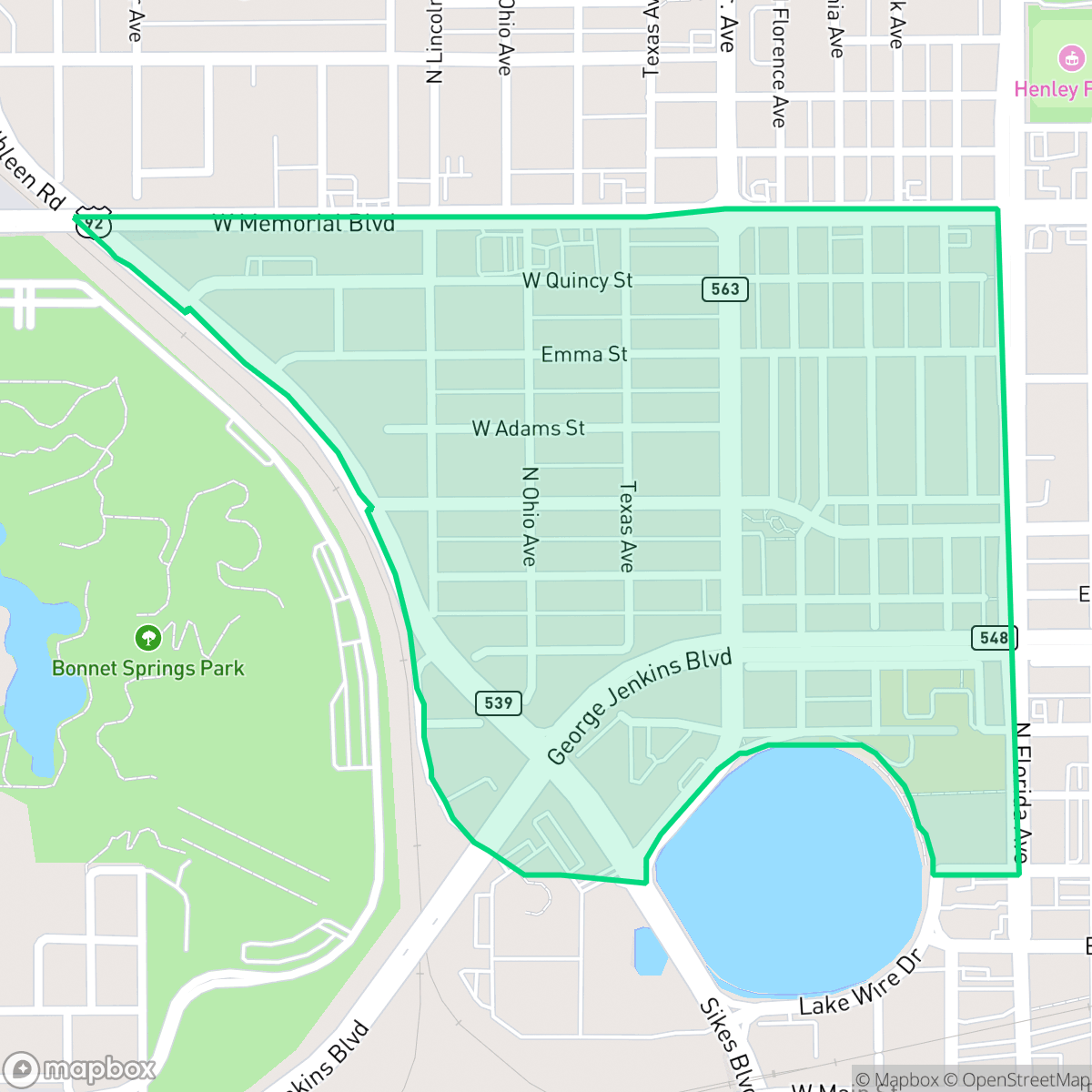
North Lake Wire is a historically significant residential community in Lakeland, Florida, currently identified as part of the city's 'Downtown West' district. The neighborhood’s development and connectivity were notably altered by the construction of Memorial Boulevard, which severed it from its historic counterpart. Characterized by a mix of early 20th-century residential stock, such as the 1925 Emory Bryant house, the area has long been a focus for city revitalization efforts. Today, North Lake Wire is undergoing a transition as part of a broader master plan to integrate the neighborhood with the nearby Bonnet Springs Park and downtown core. Recent infrastructure projects, including sidewalk improvements along North Scott Avenue and Emma Street, aim to enhance walkability and support new multi-family developments, marking a new chapter in the neighborhood's ongoing evolution.
The area functions as an active suburban hub that blends historic residential character with modern connectivity. Residents benefit from a dense street grid that encourages pedestrian travel, while the presence of pocket parks and wide grassy verges supports outdoor activities like dog walking. The atmosphere is notably diverse in its age profile and leans toward a liberal demographic, creating a unique social fabric within the broader Lakeland landscape. The visual environment is characterized by standard single-family homes with tidy yards and a varied landscape that feels more open than typical urban tracts.
Prospective residents should weigh the benefits of the neighborhood's walkability and clean air against potential trade-offs. The area experiences noticeable noise from nearby transit corridors, and the presence of commercial storage and gas stations introduces a mixed industrial feel. Additionally, because formal flood assessments remain pending for this specific location, caution is advised regarding environmental risk. Families may find the local school district offers strong magnet and charter pathways, though these often require navigating a competitive lottery system rather than relying on standard residential zoning.
Neighborhood Scores Across 15 Qualities
Residential spacing provides a moderate level of separation between homes, offering more buffer from neighbors than the typical Lakeland neighborhood. According to iHuus data, while some houses are situated close together, many properties maintain significant distance from adjacent structures.
Low traffic residential streets and a dense grid make pedestrian travel easy, providing much better walkability than the Lakeland average. While sidewalks are present on one side of many roads, some areas lack continuous pavement or significant tree canopy.
Standard single-family homes feature tidy yards and simple architectural lines. This area offers a more visually varied landscape than the average Lakeland residential tract.
Wide grassy verges and pocket parks provide reliable walking opportunities that are significantly better than the Lakeland average. According to iHuus data, these connected green spaces offer safe routes away from heavy traffic.
Open land and scattered homes among woodlands characterize this area, providing a more rural atmosphere than the typical Lakeland landscape. According to iHuus data, the neighborhood maintains a lower density of development compared to the city average.
Vibrant pockets of activity and a diverse selection of dining, culture, and wellness services make this area significantly more lively than the Lakeland average. Residents can access various points of interest near local parks and theaters, though some stretches become more subdued after dark.
Frequent sounds from nearby transit corridors and infrastructure are common in this area. According to iHuus data, noise levels are roughly comparable to the average found throughout Lakeland.
Air quality remains consistently high with minimal health concerns, significantly outperforming the Lakeland average according to iHuus data.
Commercial activities like gas stations and storage facilities introduce moderate vehicle traffic and utility odors to the area. According to iHuus data, the proximity of an EPA Superfund site nearby may also present concerns regarding soil or groundwater quality.
Health insurance access for residents in this area is slightly higher than the Lakeland average, according to iHuus data.
Political leanings in this area are significantly more liberal than the typical Lakeland profile, according to iHuus data.
Residents live alongside a balanced mix of young adults, families, and older individuals; this age distribution is slightly more varied than the average found across Lakeland.
Flood safety levels in this area are lower than the Lakeland average because FEMA has not yet finalized detailed studies for this specific location. Residents should exercise caution as official risk assessments remain undetermined according to iHuus data.
Address-Level Insights for North Lake Wire


iHuus Neighborhood Intelligence Insights
Get address-level neighborhood insights for North Lake Wire
- Street-level scores — see how individual blocks compare, not just neighborhood averages
- Micro-zone boundaries — identify quiet pockets, flood boundaries, and walkable clusters before you visit
- 15 dimensions in full — walkability, noise, air quality, school quality, insurance coverage, population age profile, urban/rural index, and more
- Boundary risk alerts — know if your address sits near a block boundary where scores drop, the kind of detail no listing will ever mention
- School insights — individual school ratings and insights, not just district-level data
- Compare before you commit — side-by-side data across neighborhoods, down to block precision
No credit card required
Compare with Any Neighborhood
| Dimension | North Lake Wire | Beacon Hill |
|---|---|---|
| 🚶 Walkabilityavg 5.03 | ||
| 🔊 Acoustic Comfortavg 3.5 | ||
| 🤫 Privacy Indexavg 5.3 | ||
| 🎨 Visual Appealavg 5.07 | ||
| 🐕 Dog Friendlinessavg 5.42 | ||
| 🗺️ Urban-Rural Indexavg 6.53 | ||
| ✨ Neighborhood Vibeavg 2.18 | ||
| 🏥 Health Insurance Coverageavg 5.4 | ||
| 🌿 Air Qualityavg 7.09 | ||
| 🏭 Industrial Proximityavg 5.58 | ||
| 🌊 Flood Safetyavg 5.2 | ||
| 🗳️ Ideological Leanavg 2.17 | ||
| 👥 Population Age Profileavg 4.38 | ||
| 🔥 Fire Safety | ||
| 🏫 School Quality |
North Lake Wire Rankings
School Districts Serving North Lake Wire
School Insights for North Lake Wire
Below average outcomes; significant attendance and academic challenges.
School Insights
See what's really behind every school rating near North Lake Wire
- Individual school ratings — each school's own score with outcome context, not just a district average
- Enrollment & class size data — student-to-teacher ratio and how it compares to the state average
- Full demographics breakdown — ethnicity and gender composition for every school in the enrollment zone
- Every school in the district — all schools within the enrollment boundary ranked by rating, not just the closest one
- Grade levels & benchmarks — elementary through high school, with below/above state-average flags
No credit card required