Lake Bonny, Lakeland
Updated · 1,201 residents
Lake Bonny is a residential enclave defined by its semi-rural atmosphere and abundant greenery, offering a quieter alternative to central Lakeland. Residents benefit from exceptionally clean air and a peaceful street environment that encourages walking despite the absence of formal sidewalks.
Key Highlights
About Lake Bonny
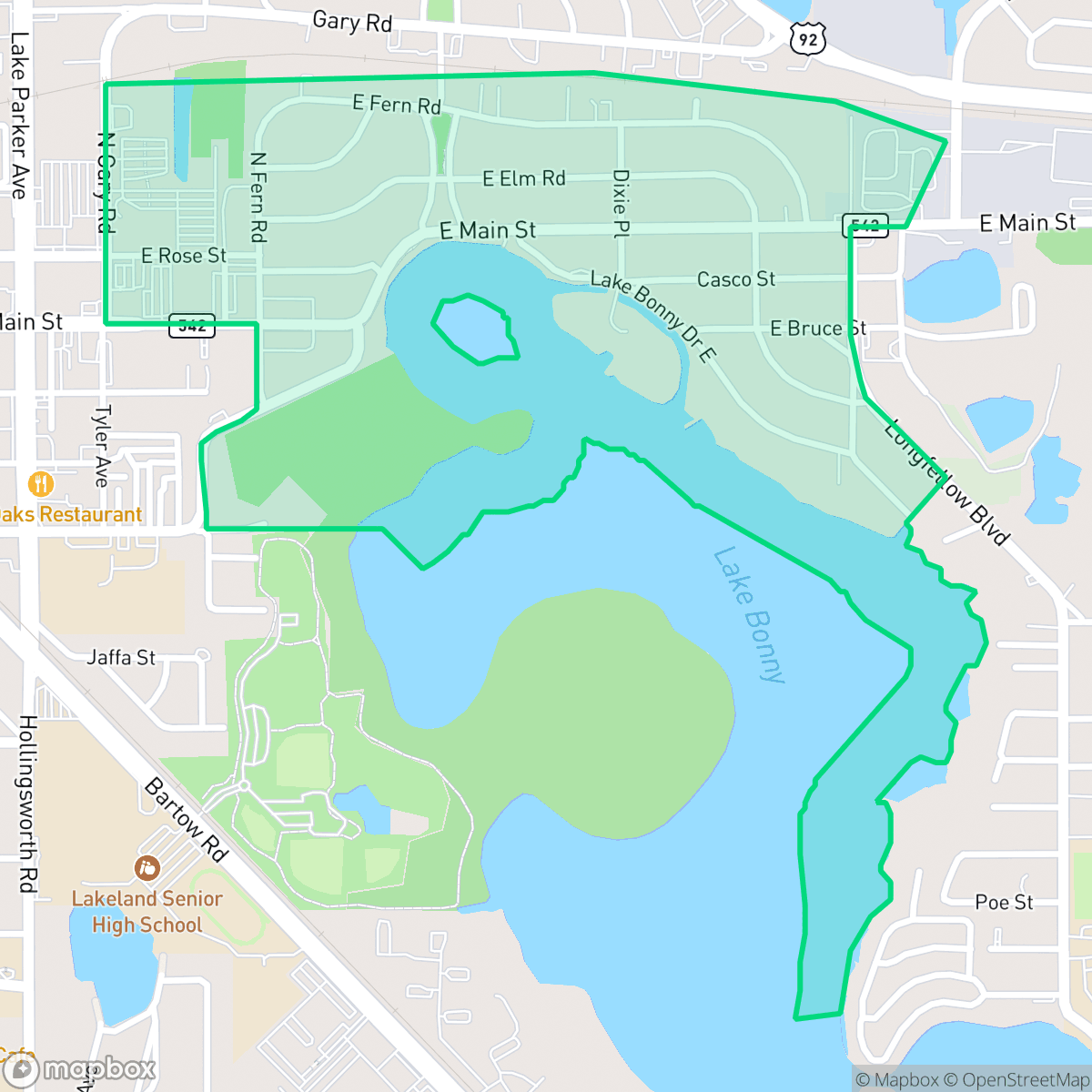
The Lake Bonny neighborhood in Lakeland, Florida, takes its name from David J. Washington Boney, a pioneer settler who purchased the land in 1860. Geologically, the area is defined by karst topography, with Lake Bonny originating as a sinkhole lake within the Bone Valley Formation, a region historically significant for its phosphate-rich fossil beds. The surrounding residential community features architectural styles ranging from Dutch Colonial and Spanish to Craftsman, with homes primarily constructed between 1910 and the 1960s. A notable landmark is the 113-acre Fletcher Park at Lake Bonny, which serves as a recreational hub and includes the award-winning Lakeland Skatepark. The area remains a distinct residential enclave, characterized by its proximity to the city's historic core and its connection to the broader local network of lakes.
The neighborhood serves as a steady local hub that balances suburban convenience with an open, airy landscape. While the area features a mix of modest, tidy homes, it maintains a distinct sense of space that provides more privacy than many other parts of the city. The presence of significant green space and light commercial services creates a community that feels connected to the city's resources while retaining a calmer, more relaxed pace of daily life.
The area is well-suited for those who value clean air and a balanced environment. While traffic noise from nearby thoroughfares is occasionally noticeable, the overall acoustic environment remains tranquil. Families and individuals will find a diverse demographic mix, though prospective residents should consider the district's school choice system to access the most competitive educational programs. According to iHuus data, the neighborhood offers a reliable, low-industrial setting that is ideal for those seeking a settled, community-focused lifestyle.
Neighborhood Scores Across 15 Qualities
Residential spacing provides a moderate level of separation between neighbors, which is slightly higher than the typical density found across Lakeland. According to iHuus data, property layouts offer a balance of open space and proximity to adjacent homes.
Low traffic volumes and calm streets make this area suitable for walking, even though sidewalks are absent. According to iHuus data, the neighborhood offers better pedestrian conditions than the average Lakeland area.
Standard tract housing with uniform rooflines and small, tidy yards defines the area. According to iHuus data, this level of visual character is higher than the average found across Lakeland.
Wide green verges and nearby park access provide decent opportunities for pet owners. This level of dog friendliness is slightly above the Lakeland average, according to iHuus data.
Frequent open land and scattered homes amid woodlands provide a more rural atmosphere than the typical Lakeland landscape. According to iHuus data, this area features more undeveloped space and greenery than the city average.
This area offers a more active rhythm than the rest of Lakeland, featuring a mix of wellness services, dining, and local institutions. While some pockets remain semi-rural and quiet, many streets serve as suburban hubs with notable access to retail and hospitality.
Steady traffic sounds from a nearby busy street are noticeable, though the acoustic environment remains more tranquil than much of Lakeland. According to iHuus data, the level of noise is higher than the city average but lacks the intense levels found in more central urban areas.
Air quality remains consistently high with minimal pollutants, presenting much better conditions than the Lakeland average. Residents can expect very low health concerns related to air particulates according to iHuus data.
Minimal heavy industry exists within Lake Bonny, as the area consists primarily of residential streets and light commercial services. This lack of industrial activity is notably lower than the Lakeland average, according to iHuus data.
Health insurance enrollment among Lake Bonny residents is notably higher than the average for Lakeland. According to iHuus data, a significant portion of the population maintains active coverage.
Political perspectives in this area are evenly split, representing a more moderate landscape than the more strongly conservative leaning average seen across Lakeland.
Residents live alongside a diverse range of age groups, including young adults, families, and seniors. According to iHuus data, this demographic variety is slightly more varied than the typical Lakeland profile.
Residual flood risk exists within the area as it falls within a five hundred year floodplain; however, safety levels remain notably higher than the Lakeland average according to iHuus data.
Address-Level Insights for Lake Bonny


iHuus Neighborhood Intelligence Insights
Get address-level neighborhood insights for Lake Bonny
- Street-level scores — see how individual blocks compare, not just neighborhood averages
- Micro-zone boundaries — identify quiet pockets, flood boundaries, and walkable clusters before you visit
- 15 dimensions in full — walkability, noise, air quality, school quality, insurance coverage, population age profile, urban/rural index, and more
- Boundary risk alerts — know if your address sits near a block boundary where scores drop, the kind of detail no listing will ever mention
- School insights — individual school ratings and insights, not just district-level data
- Compare before you commit — side-by-side data across neighborhoods, down to block precision
No credit card required
Compare with Any Neighborhood
| Dimension | Lake Bonny | Beacon Hill |
|---|---|---|
| 🚶 Walkabilityavg 5.03 | ||
| 🔊 Acoustic Comfortavg 3.5 | ||
| 🤫 Privacy Indexavg 5.3 | ||
| 🎨 Visual Appealavg 5.07 | ||
| 🐕 Dog Friendlinessavg 5.42 | ||
| 🗺️ Urban-Rural Indexavg 6.53 | ||
| ✨ Neighborhood Vibeavg 2.18 | ||
| 🏥 Health Insurance Coverageavg 5.4 | ||
| 🌿 Air Qualityavg 7.09 | ||
| 🏭 Industrial Proximityavg 5.58 | ||
| 🌊 Flood Safetyavg 5.2 | ||
| 🗳️ Ideological Leanavg 2.17 | ||
| 👥 Population Age Profileavg 4.38 | ||
| 🔥 Fire Safety | ||
| 🏫 School Quality |
Lake Bonny Rankings
School Districts Serving Lake Bonny
School Insights for Lake Bonny
Below average outcomes; significant attendance and academic challenges.
School Insights
See what's really behind every school rating near Lake Bonny
- Individual school ratings — each school's own score with outcome context, not just a district average
- Enrollment & class size data — student-to-teacher ratio and how it compares to the state average
- Full demographics breakdown — ethnicity and gender composition for every school in the enrollment zone
- Every school in the district — all schools within the enrollment boundary ranked by rating, not just the closest one
- Grade levels & benchmarks — elementary through high school, with below/above state-average flags
No credit card required