Lake Bonnet, Lakeland
Updated · 1,069 residents
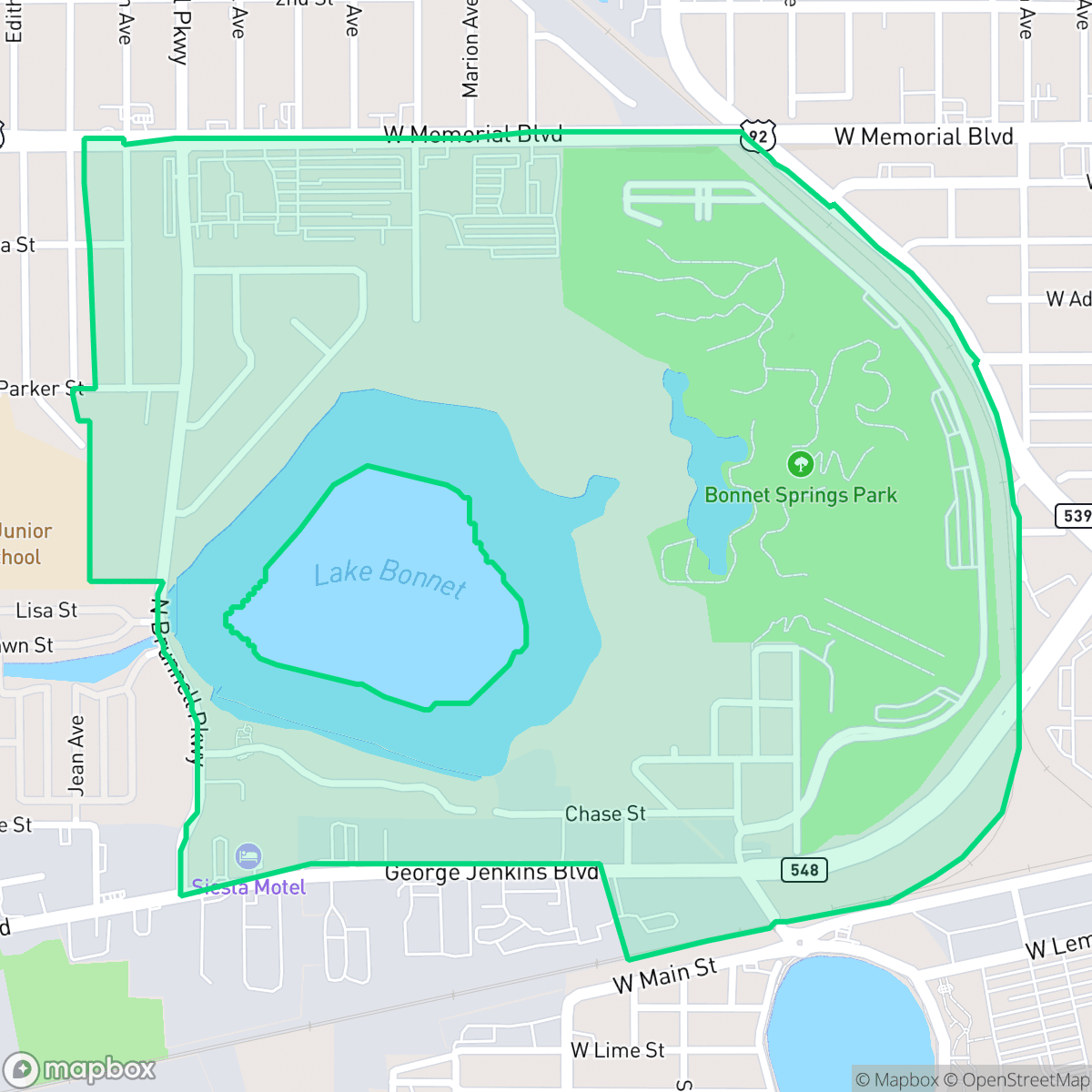
Lake Bonnet is a transitioning area defined by its proximity to the expansive Bonnet Springs Park and a blend of residential and industrial land use. Residents enjoy exceptionally clean air and a steady local rhythm, though the neighborhood landscape remains primarily functional with a mix of dense housing and industrial facilities.
Key Highlights
About Lake Bonnet
The area surrounding Lake Bonnet in Lakeland, Florida, is defined by its significant industrial history and recent ecological transformation. From approximately 1880 to 1952, the site served as a major rail yard and freight hub, which eventually led to the land becoming a contaminated brownfield. Following decades of abandonment, the area underwent extensive environmental remediation to address industrial pollution. This effort culminated in the 2022 opening of Bonnet Springs Park, a 168-acre urban greenspace that repurposed the former industrial site. Today, the neighborhood is characterized by this revitalization, featuring botanical gardens, the Florida Children’s Museum, and a heritage-focused welcome center that highlights the site’s past as a rail hub and citrus production center.
The neighborhood maintains a semi-rural feel characterized by a mix of modest residential lots and large industrial warehouses. While the area offers a diverse age demographic and a steady presence of local services, it remains influenced by its proximity to active commercial storage facilities and transit corridors. Pedestrians can navigate local streets with relative ease due to low traffic volumes, although the sidewalk network is fragmented and requires caution. According to iHuus data, the area provides a unique, functional character that stands apart from the typical Lakeland landscape.
Prospective residents should note that while air quality is consistently high, the area experiences frequent noise from nearby rail lines and transit routes. The housing stock is dense and functional, often lacking significant ornamental greenery, which provides a distinct visual character. Families looking at local schools will find a district that balances traditional campus performance with competitive magnet and charter options, though success often depends on navigating the school choice lottery rather than relying on neighborhood zoning.
Neighborhood Scores Across 15 Qualities
Residential spacing varies throughout the area, ranging from dense clusters in trailer parks to more isolated homes near wooded zones. This level of privacy is roughly in line with the average seen across Lakeland.
Low traffic volumes make local streets suitable for walking, though a fragmented sidewalk network means pedestrians must often use the pavement. This level of walkability is higher than the Lakeland average according to iHuus data.
Dense housing and mobile home communities characterize the area, resulting in a visual landscape that is less varied than the Lakeland average. According to iHuus data, the neighborhood consists primarily of modest, functional structures with minimal ornamental greenery.
Walking pets in this area can be challenging due to narrow verges and a lack of sidewalks near roadways. According to iHuus data, the neighborhood offers slightly better access to green space for dogs than the Lakeland average, though much of the vegetation is located on private property or within unmaintained forest fringes.
Open land and scattered residences provide a more semi-rural feel than the typical Lakeland landscape. According to iHuus data, the area features a low-density mix of small residential lots alongside large industrial warehouses.
Mixed-use streets provide a much higher level of activity and service variety than the typical Lakeland average. Residents benefit from a consistent presence of dining, fitness services, and cultural landmarks near Bonnet Springs Park and Webster Park.
High levels of noise from nearby transit corridors and rail lines are present. This level of acoustic disturbance is consistent with the average found across Lakeland.
Air quality remains consistently high with minimal health concerns for residents. According to iHuus data, the atmosphere in Lake Bonnet is significantly cleaner than the Lakeland average.
Active commercial units and storage facilities introduce intermittent heavy vehicle traffic and operational noise. According to iHuus data, the neighborhood has a lower density of industrial activity than the Lakeland average, though proximity to a nearby Superfund site remains a consideration for soil and groundwater quality.
Health insurance coverage levels in Lake Bonnet are slightly higher than the Lakeland average, according to iHuus data.
Political leanings in Lake Bonnet are notably more liberal than the average for Lakeland. According to iHuus data, the area contains a liberal majority with a modest opposing presence.
A balanced mix of young adults, families, and older residents characterizes the area. According to iHuus data, this demographic spread is slightly more varied than the average found across Lakeland.
Flood safety in this area is higher than the Lakeland average, though a lack of detailed FEMA studies means risks remain somewhat undetermined. Residents should account for potential uncertainty regarding precise flood zones according to iHuus data.
Address-Level Insights for Lake Bonnet


iHuus Neighborhood Intelligence Insights
Get address-level neighborhood insights for Lake Bonnet
- Street-level scores — see how individual blocks compare, not just neighborhood averages
- Micro-zone boundaries — identify quiet pockets, flood boundaries, and walkable clusters before you visit
- 15 dimensions in full — walkability, noise, air quality, school quality, insurance coverage, population age profile, urban/rural index, and more
- Boundary risk alerts — know if your address sits near a block boundary where scores drop, the kind of detail no listing will ever mention
- School insights — individual school ratings and insights, not just district-level data
- Compare before you commit — side-by-side data across neighborhoods, down to block precision
No credit card required
Compare with Any Neighborhood
| Dimension | Lake Bonnet | Beacon Hill |
|---|---|---|
| 🚶 Walkabilityavg 5.03 | ||
| 🔊 Acoustic Comfortavg 3.5 | ||
| 🤫 Privacy Indexavg 5.3 | ||
| 🎨 Visual Appealavg 5.07 | ||
| 🐕 Dog Friendlinessavg 5.42 | ||
| 🗺️ Urban-Rural Indexavg 6.53 | ||
| ✨ Neighborhood Vibeavg 2.18 | ||
| 🏥 Health Insurance Coverageavg 5.4 | ||
| 🌿 Air Qualityavg 7.09 | ||
| 🏭 Industrial Proximityavg 5.58 | ||
| 🌊 Flood Safetyavg 5.2 | ||
| 🗳️ Ideological Leanavg 2.17 | ||
| 👥 Population Age Profileavg 4.38 | ||
| 🔥 Fire Safety | ||
| 🏫 School Quality |
Lake Bonnet Rankings
School Districts Serving Lake Bonnet
School Insights for Lake Bonnet
Below average outcomes; significant attendance and academic challenges.
School Insights
See what's really behind every school rating near Lake Bonnet
- Individual school ratings — each school's own score with outcome context, not just a district average
- Enrollment & class size data — student-to-teacher ratio and how it compares to the state average
- Full demographics breakdown — ethnicity and gender composition for every school in the enrollment zone
- Every school in the district — all schools within the enrollment boundary ranked by rating, not just the closest one
- Grade levels & benchmarks — elementary through high school, with below/above state-average flags
No credit card required