Francis Blvd, Lakeland
Updated · 335 residents
Francis Blvd is a highly walkable neighborhood in Lakeland that balances a semi-rural aesthetic with proximity to the social activity of Florida Southern College and the Polk Theatre. Residents enjoy a polished, green environment with spacious residential lots and excellent air quality.
Key Highlights
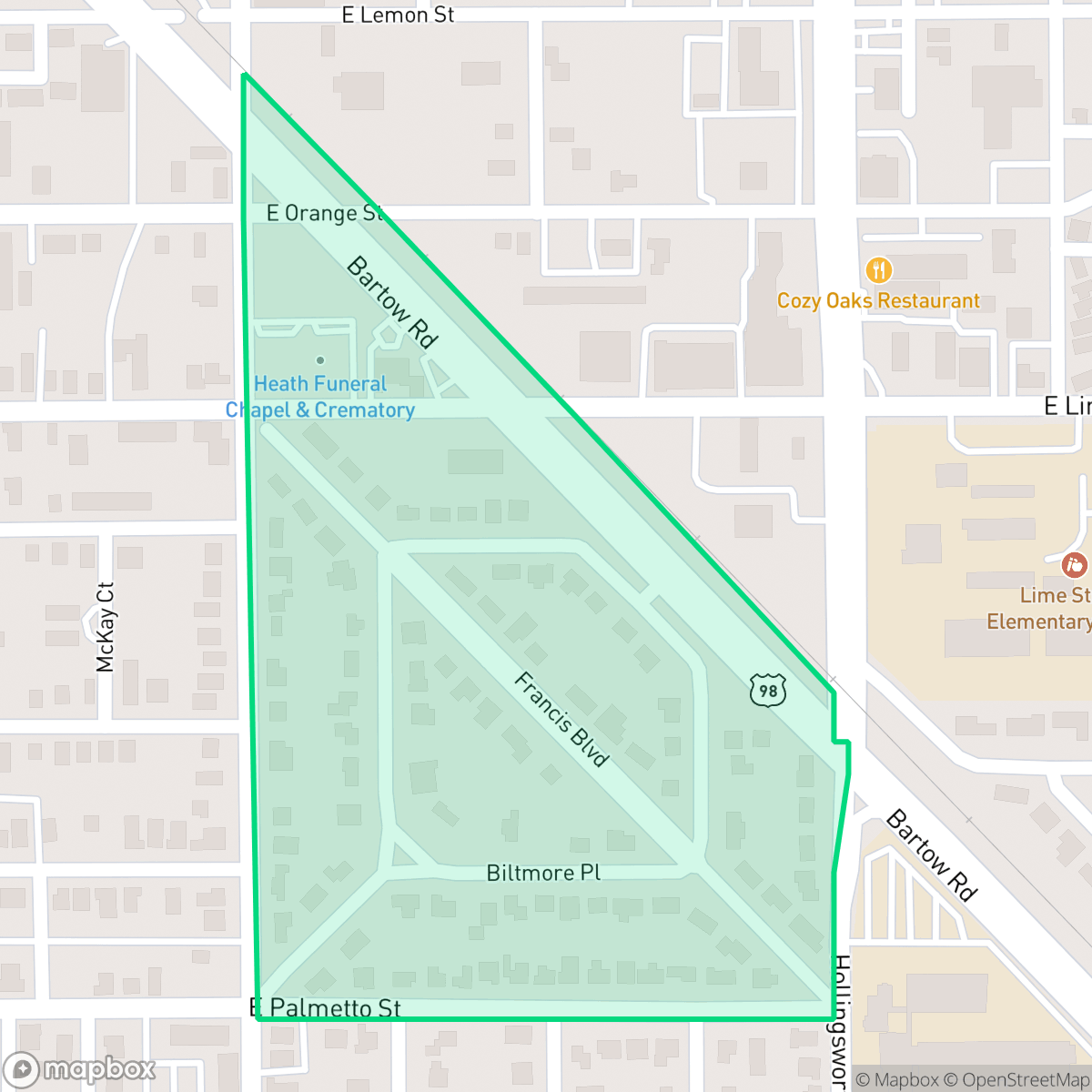
About Francis Blvd
Francis Blvd offers a refined, upscale atmosphere defined by mature trees and generous lot sizes that provide residents with a sense of seclusion. The area maintains a high level of walkability, allowing easy access to nearby cultural landmarks like the Polk Theatre and the vibrant social scene surrounding Florida Southern College. With very little industrial activity nearby, the neighborhood preserves a peaceful, clean-air environment that feels distinct from the typical urban density found elsewhere in the city.
While the area is generally quiet, those living here may notice a consistent background hum from nearby traffic. The neighborhood is situated within a 500-year floodplain, so prospective residents should be aware of seasonal water management. Families will find a diverse demographic and access to the broader Polk County School District, where success often depends on navigating competitive magnet and charter school options. It is an ideal location for those who value pedestrian access to local culture and a spacious, well-maintained living environment.
Neighborhood Scores Across 15 Qualities
Residential spacing offers a balance of density and separation, providing more buffer between neighbors than the typical Lakeland area. According to iHuus data, mature trees and varied distances between structures create a moderate level of seclusion.
Dense street grids, dedicated sidewalks, and pedestrian-priority lakefront paths make navigating this area easy on foot. This level of accessibility for pedestrians is significantly higher than the average found throughout Lakeland.
Larger homes, private pools, and well-maintained amenities provide a more polished aesthetic than the typical Lakeland neighborhood. According to iHuus data, this area features significantly more greenery and spacious residential lots compared to the city average.
Abundant green spaces and trails around Mirror Lake and Lake Morton provide excellent walking areas for pets. According to iHuus data, this area offers significantly more access to parks and tree-lined streets than the Lakeland average.
Open land and scattered homes amidst woodland characterize this area, matching the typical landscape found throughout Lakeland. Residents can expect a mix of residential blocks and significant tree canopy according to iHuus data.
Lively blocks with a concentration of local dining, independent retail, and entertainment venues provide significantly more activity than the Lakeland average. This neighborhood functions as a notable social center near Florida Southern College and the Polk Theatre.
Local traffic from nearby busy streets creates a consistent background noise, though this level of acoustic activity is slightly more pronounced than the Lakeland average.
Air quality in this area remains consistently high with very little pollution detected. According to iHuus data, these conditions are significantly better than the average for Lakeland.
Primarily residential and institutional uses define this area, which lacks the heavy industrial activity found more commonly across Lakeland. While a rail corridor and light warehousing exist to the northeast, there are no significant industrial hazards near the neighborhood core.
Health insurance accessibility in this area is slightly higher than the Lakeland average, according to iHuus data.
Political leanings in this area are split nearly evenly between conservative and liberal perspectives. This represents a more moderate ideological landscape than the broader Lakeland average, according to iHuus data.
Residents will find a varied demographic spread across different life stages, which is slightly more balanced than the broader Lakeland area according to iHuus data.
Flood safety levels are notably higher than the Lakeland average, though some residual risk remains due to being within a 500-year floodplain. According to iHuus data, residents should remain aware of potential seasonal water accumulation.
Address-Level Insights for Francis Blvd


iHuus Neighborhood Intelligence Insights
Get address-level neighborhood insights for Francis Blvd
- Street-level scores — see how individual blocks compare, not just neighborhood averages
- Micro-zone boundaries — identify quiet pockets, flood boundaries, and walkable clusters before you visit
- 15 dimensions in full — walkability, noise, air quality, school quality, insurance coverage, population age profile, urban/rural index, and more
- Boundary risk alerts — know if your address sits near a block boundary where scores drop, the kind of detail no listing will ever mention
- School insights — individual school ratings and insights, not just district-level data
- Compare before you commit — side-by-side data across neighborhoods, down to block precision
No credit card required
Compare with Any Neighborhood
| Dimension | Francis Blvd | Beacon Hill |
|---|---|---|
| 🚶 Walkabilityavg 5.03 | ||
| 🔊 Acoustic Comfortavg 3.5 | ||
| 🤫 Privacy Indexavg 5.3 | ||
| 🎨 Visual Appealavg 5.07 | ||
| 🐕 Dog Friendlinessavg 5.42 | ||
| 🗺️ Urban-Rural Indexavg 6.53 | ||
| ✨ Neighborhood Vibeavg 2.18 | ||
| 🏥 Health Insurance Coverageavg 5.4 | ||
| 🌿 Air Qualityavg 7.09 | ||
| 🏭 Industrial Proximityavg 5.58 | ||
| 🌊 Flood Safetyavg 5.2 | ||
| 🗳️ Ideological Leanavg 2.17 | ||
| 👥 Population Age Profileavg 4.38 | ||
| 🔥 Fire Safety | ||
| 🏫 School Quality |
Francis Blvd Rankings
School Districts Serving Francis Blvd
School Insights for Francis Blvd
Below average outcomes; significant attendance and academic challenges.
School Insights
See what's really behind every school rating near Francis Blvd
- Individual school ratings — each school's own score with outcome context, not just a district average
- Enrollment & class size data — student-to-teacher ratio and how it compares to the state average
- Full demographics breakdown — ethnicity and gender composition for every school in the enrollment zone
- Every school in the district — all schools within the enrollment boundary ranked by rating, not just the closest one
- Grade levels & benchmarks — elementary through high school, with below/above state-average flags
No credit card required